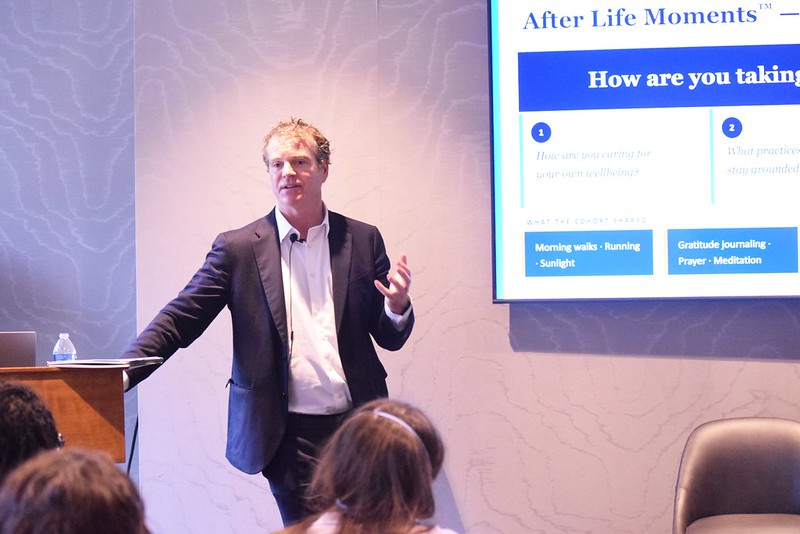
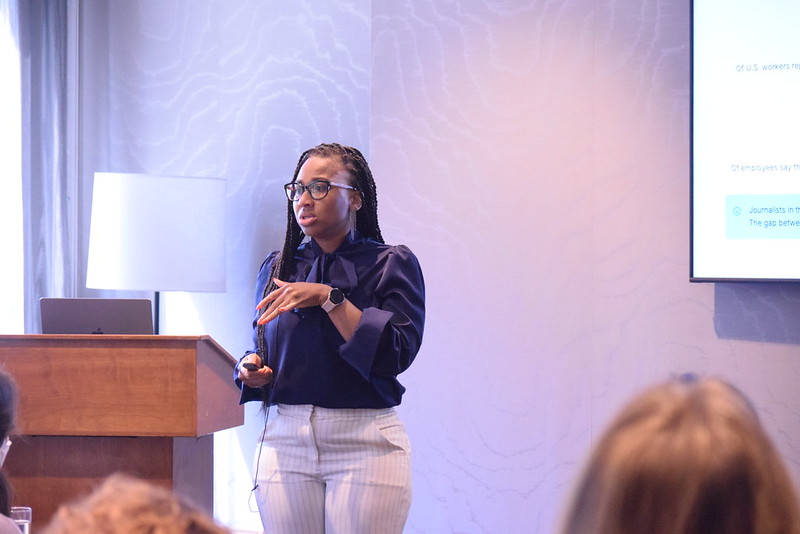
As the 2026 Mental Health Awareness Month concludes, journalists should remember that it’s critically important to recognize emerging trends and relevant research about workplace mental health. Two experts provided valuable insight to NPF Covering Workplace Mental Health fellows about investigating the fast-evolving American workplace.
First, veteran journalist Brigid Schulte, director of the Better Life Lab at the New America think tank, explored how combinations of situational and systemic factors have fueled a decline in workplace mental health.
Schulte urged journalists to look beyond surface-level corporate wellness trends to uncover the root causes of worker stress. These pressures include uncertainty about AI, layoffs, gender and race wage gaps, and other foundational inequities embedded in the structure of work. She also cited a Harvard Business School study that found that 73% of all employees have some form of caregiving responsibilities, which can influence burnout and stress.
“It’s just a ripe area for exploring the human element and what that precarity and stress is doing to people. That’s a huge mental health challenge,” Schulte said. “They’re big questions that we need to be answering. Think about, again, getting to the root. How did we get here?”
Schulte argued that the most powerful workplace mental health stories connect personal experiences of all kinds, including those of low-wage and care workers, to the larger political and systemic contexts that shape them. She advocated looking for personal examples of people trying to make a difference in their organization’s mental health landscape and incorporating these empowering “bright spots” into related journalism.
“It changes the energy, gives readers more of a sense of agency that things can change,” she said.
Tori Espensen, media training manager at SciLine, zoomed out to unpack ways to accurately analyze and write about scientific papers about workplace trends. According to Espensen, journalists should avoid writing stories about a single scientific study. This tactic helps reflect the iterative nature of the scientific process, where understanding of science evolves over time.
“Instead, you want to look to studies for evidence that you can insert into broader stories,” Espensen explained. “You can be backing up that human element with scientific evidence, with data, with research.”
She also outlined strategic ways to read scientific papers and search scientific databases to find diverse and appropriate expert sources. Finally, Espensen underscored the importance of using precise language when writing about research, such as saying a study “suggests” or “is associated with” a finding, instead of using definitive words like “proves.”
Both Schulte and Espensen emphasized the ethical responsibilities of journalists to cover scientific topics, including mental health, with sophistication, accuracy, and a focus on solutions.
“We can really write these stories with complexity and nuance and help shift perspectives and open minds and eyes,” Schulte said. “And hopefully that will lead to the changes in policy, practice, and culture that we need so people and families can thrive.”
Access the full transcript here.
This program is sponsored by the Luv U Project, with associate sponsor the American Psychological Association. The National Press Foundation is solely responsible for its content.