When the Biden Administration created the US Department of Agriculture Regional Food Business Centers (RFBC) program in September 2022, the stated goal was to support small farms and food businesses after the pandemic. They were hit hard when restaurants, schools, and businesses like nursing homes stopped buying their produce. Because the USDA is responsible for developing and implementing policy related to agriculture, food, and nutrition, it plays a critical role in fueling the nation’s food system and farmers.
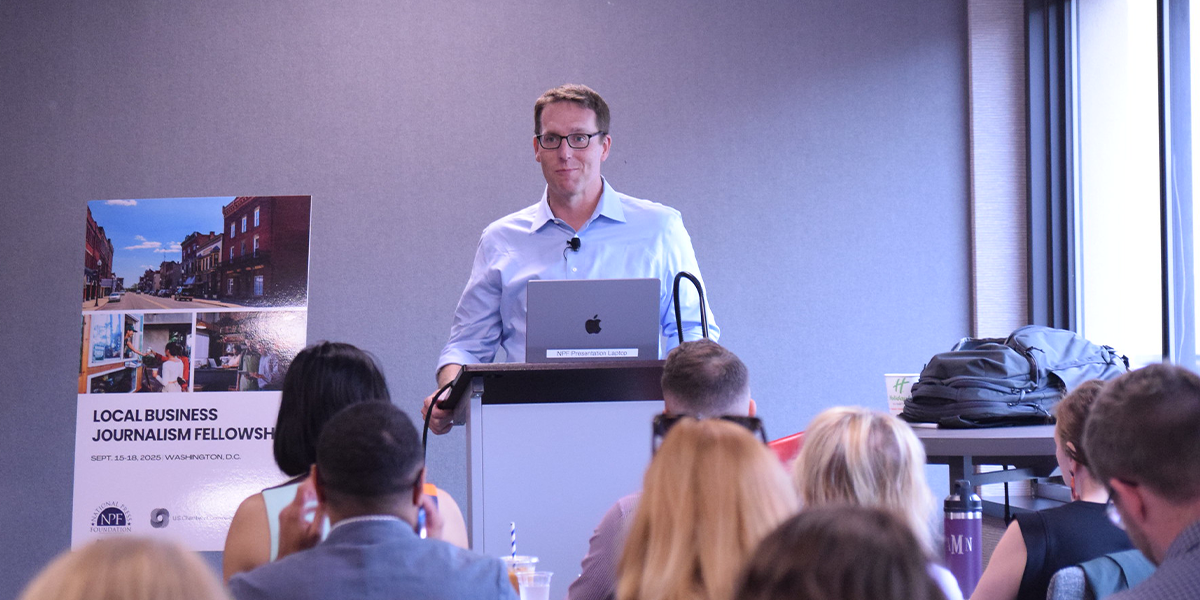
But in July of 2025, when Capital B News rural issues reporter Aallyah Wright received an email tip that the Trump administration plan to shutter the program, she saw an opportunity to explore the program’s intended impact–and how farmers might be affected. On September 17, Wright spoke with NPF Local Business Journalism Fellowship participants about her reporting, highlighting the impact of that policy decision on people like Philip J. Haynie III, the fifth-generation African American farmer and co-founder of the National Black Growers Council, who joined her for the session.
Here are key takeaways from the session:
Despite its brief existence, the program had already demonstrated significant positive impacts. Wright said the program was designed to provide crucial support, including technical assistance, help with market access, equipment purchasing, and marketing. Its $400 million commitment was cut short before four of the 12 designated regional centers could even disperse any grants. The timing was bad, especially for farmers who were still trying to regroup after COVID.
“We know that when the pandemic happened, a lot of farmers did not have access to their markets anymore. Folks weren’t able to even reach their customers, and there were also some farmers who had more demand than they could actually fulfill. So there was a lot of different challenges happening. And so this was one of the programs aimed to help support them so that they could actually sustain themselves.” Wright said the RFBC program distributed over $600,000 in small grants and helped create new farms and businesses between July 2023 and December 2024.
Wright’s reporting revealed that during a brief window, the RFBC program yielded some solid, tangible results. “One of the farmers had this vegan brand of baked pastries that she was actually able to secure a contract with Costco, and she was able to get her stuff in Costco. They were also able to build a relationship between a local school and the farmer, and that farmer was able to sell her strawberries in the local school that was near her neighborhood.”
The negative impact on farmers of color can’t be overstated. Haynie and his father still rotate crops of wheat, corn, and soybeans on the same 60 acres in Virginia that their formerly enslaved great-grandfather purchased in September of 1867. They’ve also added more than 9,000 owned and leased acres across four counties in the state, as well as rice crops in Arkansas.
But building that level of prosperity in agriculture is more difficult when you’re a person of color, Haynie said, due to the historical barrier of racism. “The challenge with that for farmers that look like me is on a local level, that local county office is governed by a county committee, and that county committee is made up of the good old boys in that county who make the decisions on who gets loans, who gets disaster payments, who doesn’t.” Those ongoing hurdles have yielded a raft class action lawsuits and complaints through the decades, Haynie said, but Black and brown farmers still haven’t been able to close the gaps in support and access.
“In 1920, there were a million black farmers in the country. African-Americans owned 16 million acres of land. Today, there are less than a thousand black row crop farmers in the whole US and African-Americans only own 2 million acres of land. That acreage didn’t erode off the coastal plains of Virginia or erode off the coastal plains of California. That acreage changed hands. And when you have these shady people sitting in these county offices that are going to come in and say, ‘Scott, Patricia and Catherine are on that county committee and say, you know what? Scott owns that land between us and if we want to get it, all we got to do is slow his loan down and he’s not going to make his crop.’ ”
Talk to farmers to get the full story. Wright has interviewed farmers throughout the South who applied for RFBC grants and never received them. But despite the challenges, they’re still motivated.
“They’re not allowing what’s happening to stop them from doing what they’re doing. They’re… still energized to bring in the next generation of young farmers. So how can we get them involved on the farm? How can we pool our resources with a farmer that’s next to us? What can we do as a community of farmers to make sure that we’re all able to get through this? And a lot of them, especially the older farmers are like, well, we done been through worse. So it’s not like we can’t get through this.”
Access the full transcript here.
This fellowship is sponsored by the U.S. Chamber of Commerce as part of a journalism training and award program. NPF is solely responsible for its content.




 Reload document
 Open in new tab