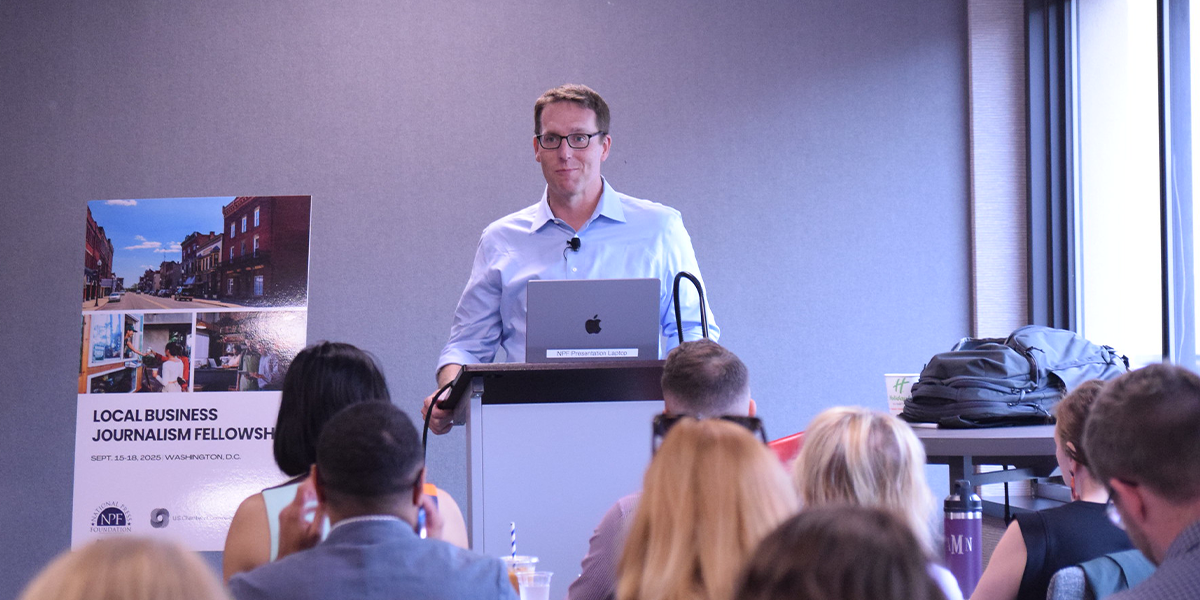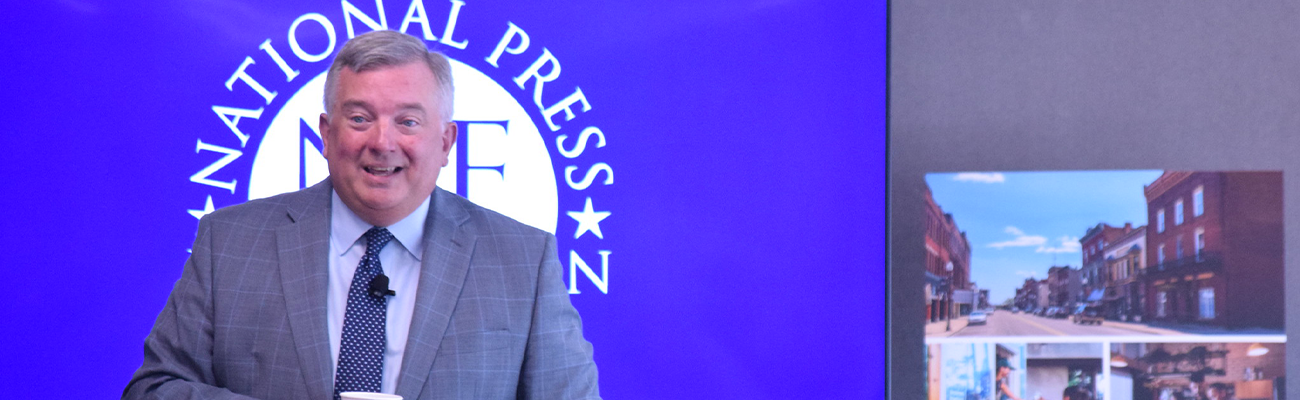
Americans are confronting financial strains driven in part by limited housing stocks and a U.S. workforce at risk of decline for the first time in history, U.S. Chamber of Commerce Executive Vice President Neil Bradley told the National Press Foundation’s Local Business Journalism Fellowship. (The U.S. Chamber of Commerce sponsored the four-day conference.)
Bradley, who also serves as the chamber’s chief policy officer and head of strategic advocacy, described the economic measures as challenges to the affordability of basic consumer needs.
“Think about the old adage: demographics as destiny. This is a problem for the United States. It’s a real problem,” Bradley said. “Beginning in the early 1960s, the Baby boomers started entering the workforce, my parents, and they kept coming, and coming, and coming, and coming and coming. And about 20 years ago they started to retire, slowly at first, because they were the oldest. Now we’re at about 10,000 retiring every day. Our generations aren’t big enough to replace those.”
That demographic shift has consequences.
“The supply of people to serve in the restaurants, to work at the hospital or at the doctor’s clinic is constricted,” Bradley said, adding that recent estimates from the nonpartisan Congressional Budget Office indicate that the U.S. working age population may soon decline for the first time ever. “If you want (the) kind of things and services to be affordable, you have to have a population that can help provide them.”
It’s why the chamber advocates for immigration reform.
“They’re going to have to resolve folks who haven’t committed crimes and who’ve been here a long time and who are in the workforce and working. When we talk to lawmakers on the Hill, the pressure is building.”
Another major pain point, particularly for American young adults, is the housing market.
“Let’s talk about housing: the real issue in a lot of communities … is we have overly restrictive zoning requirements that prohibit building density,” Bradley said. “It’s Economics 101; it’s a supply curve and a demand curve and the price is set where those two cross and if you can’t change demand and demand is constant and supply is constricting, prices are going to go up.”
Bradley said the housing market’s “fundamental supply problem” is coupled with a “regulatory problem as well,” citing a National Association of Home Builders study that found that government regulations and permitting cost about $100,000 on a new house.
Young people today have to wait until their mid-30s to see their “piece of the pie” increase in the way it did by age 20 for their parents, Bradley noted.
“From 1950 to 2010, the American economy grew at 3.4% a year averaged out … The size of the pie was doubling pretty much from the time someone was born to the time they entered the workforce in their early twenties. Today since 2010, we’ve been growing at about 2.2% a year. Economists forecast that will grow at 1.8% a year over the next decade.”
Bradley said he has noticed an increase in anti-big business sentiment.
“We can’t have just small businesses or just big businesses. We need the scale that big businesses provide. We need the innovation that startups and small business provide if we really want to have a growing, thriving economy,” he said. “At the chamber, we’re big advocates of free markets. We kind of ascribe to a version of that old Churchill saying, Churchill once remarked that democracy is the worst form of government except for every other form that’s ever been tried in the history of mankind. In the same way, free markets are the worst form of allocating goods and services and wealth except for every other system that’s ever been tried in the history of man.”
Access the full transcript here.
This fellowship is sponsored by the U.S. Chamber of Commerce as part of a journalism training and award program. NPF is solely responsible for its content.