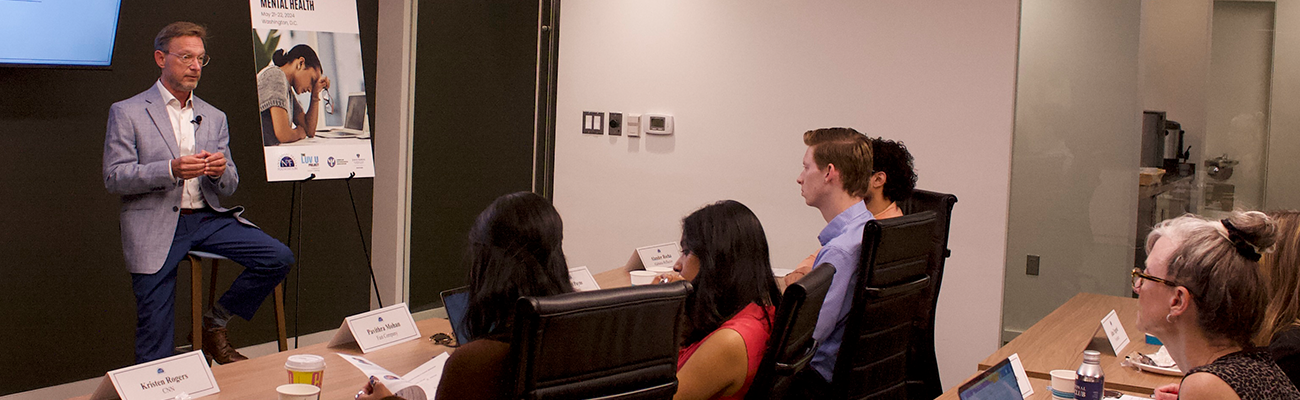
Psychological capital is the concept that people, as well as groups, can build up a reserve of psychological well-being that can be drawn upon when times get tough. And having strong psychological capital can improve mental health in the workplace, Dr. Dennis Stolle, the Senior Director of Applied Psychology at the American Psychological Association told NPF’s Covering Workplace Mental Health fellows.
Measuring psychological capital using HERO: Hope, Efficacy, Resilience and Optimism
“In this context, hope means the concept that there is an identifiable path forward. It doesn’t mean that it is going to be an easy path forward. It just means that there is some potential, plausible, imaginable way out of this situation.”
“The next one is efficacy. … You can do stuff. You’ve done stuff before, you can do stuff again. And when you combine that with hope, hope being identification of some path forward, self-efficacy is the idea that, ‘wow, that sounds almost impossible, but we are pretty effective.’”
“Resilience is the ability to come back up to baseline in some reasonable amount of time, or better yet, to come back above baseline because you have learned from the experience and you have been strengthened by the experience.”
“The final one is optimism … optimism has gotten a bad name, there are people going around talking about ‘toxic positivity’,” Stolle said. It’s the belief that, “in the end, we’re all going to be OK, we don’t need to be paralyzed by fear.”
The PsyCap scale – measured in a questionnaire of roughly 40 questions – can measure how individuals, teams and organizations are doing in terms of their psychological capital.
When reporting on workplace wellness, be intentional with headlines and don’t bury important information, Stolle urges.
A headline of an article – Workplace Wellness Programs Have Little Benefit, Study Finds – caused Stolle and his colleagues to worry.
“I’m not claiming that anybody did anything wrong with this, but you read that headline and you’re a person who has dedicated your life to workplace wellness interventions, and you see that in probably the leading newspaper in the country. And you know that CEOs read headlines, not articles. Yikes! So then, well, all right, I got to keep reading. Start actually reading the article and it looks bad initially, but then you look at it and it’s like, well, this is talking about massage classes and sleep apps.”
Access the full transcript here.
This program is sponsored by the Luv U Project, with associate sponsors the Johns Hopkins Bloomberg School of Public Health’s Department of Mental Health and the American Psychological Association. The National Press Foundation is solely responsible for its content.