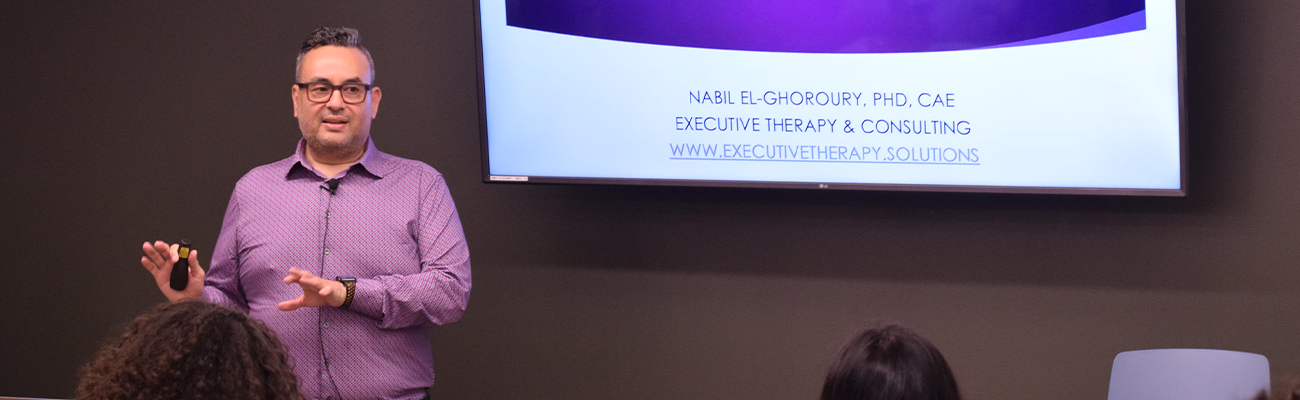
Dr. Nabil El-Ghoroury told NPF Fellows that whenever he takes a plane, his favorite part of the in-flight safety briefing was the message to “put your mask on first before helping others.”
“They don’t complete the sentence, but really the issue is, if the air drops, and if you try to help your son or your daughter or your parent and you pass out while you’re trying to help them, now two people need help.”
El-Ghoroury said that the same rule applied to mental health — if you can’t help yourself, you can’t help others, either.
El-Ghoroury is a psychologist and principal at Executive Therapy & Consulting, and he works as an executive coach. He spoke to NPF’s Covering Workplace Mental Health fellows about how to build best practices for a culture of good mental health in the workplace.
4 takeaways:
➀ Organizations need to build a culture of good mental health practices.
“That’s what organizations can do, is model mental health and well-being,” El-Ghoroury said. To do this, he made a habit of communicating to his coworkers about taking mental health days when needed. This was one way of preventing burnout in the workplace.
➁ Communication is key.
“Talk to your employees, talk to them way more than you think you want to or that they want to,” El-Ghoroury said. “If you don’t talk enough, people will make up hypotheses about what’s going on. So the rumor wheel about layoffs is going to be constant. I see this in my clients at large companies that are always concerned about when the next cut is going to be.”
El-Ghoroury said that the COVID-19 pandemic had made communication more difficult, but he still found ways to make it work.
“I started filming videos, a two-minute video, and I’d post it on Slack in a channel that we had. And I ended up doing that every workday I worked for the first year,” El-Ghoroury said. “It was one way, but it was my way of letting people get airtime with me. And then it became bidirectional in the Slack channel as people commented on what I said. And I’d respond and it would be a conversation back and forth.”
➂ Respect boundaries.
El-Ghoroury said that it’s also important to know when to stop communicating.
“Respecting boundaries, to me that means not emailing or calling after hours,” El-Ghoroury said. He talked about a time when one of his employees was going to a concert but asked El-Ghoroury to text her during the show if her workplace needed her.
“I said, ‘I’m not going to do that. There is nothing that’s going to happen that we will need to call you,'” El-Ghoroury said. This interaction established a culture of separating employees’ work lives from their personal lives.
➃ Provide the right resources.
One of the most important things companies can do to build a culture of good mental health in the workplace is to provide employees with the resources needed for their mental well-being. El-Ghoroury said that EAPs, or employee assistance programs, which offer mental health services and other resources, are a good start. But his “stretch goal” for good mental health practices in the workplace was self-insurance.
“At the American Psychological Association, my former employer, they had a supplemental insurance policy that they paid everything but $10 of your mental health services,” El-Ghoroury said. “That’s free therapy. That’s amazing. I know that’s a huge stretch because it’s a cost to employers, but I’m putting it out there because, like Hamilton, I’m not throwing away my shot. I’m going to try to get this for as many companies as possible.”
Access the full transcript here.
This program is sponsored by the Luv U Project, with associate sponsors the Johns Hopkins Bloomberg School of Public Health’s Department of Mental Health and the American Psychological Association. The National Press Foundation is solely responsible for its content.