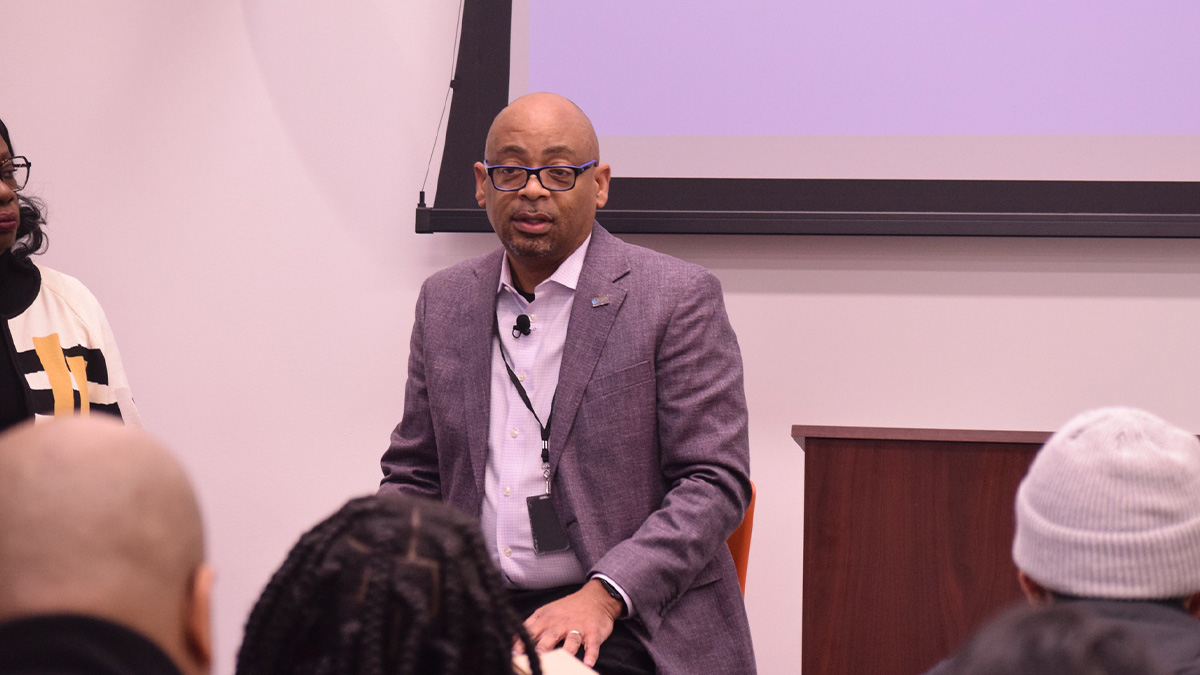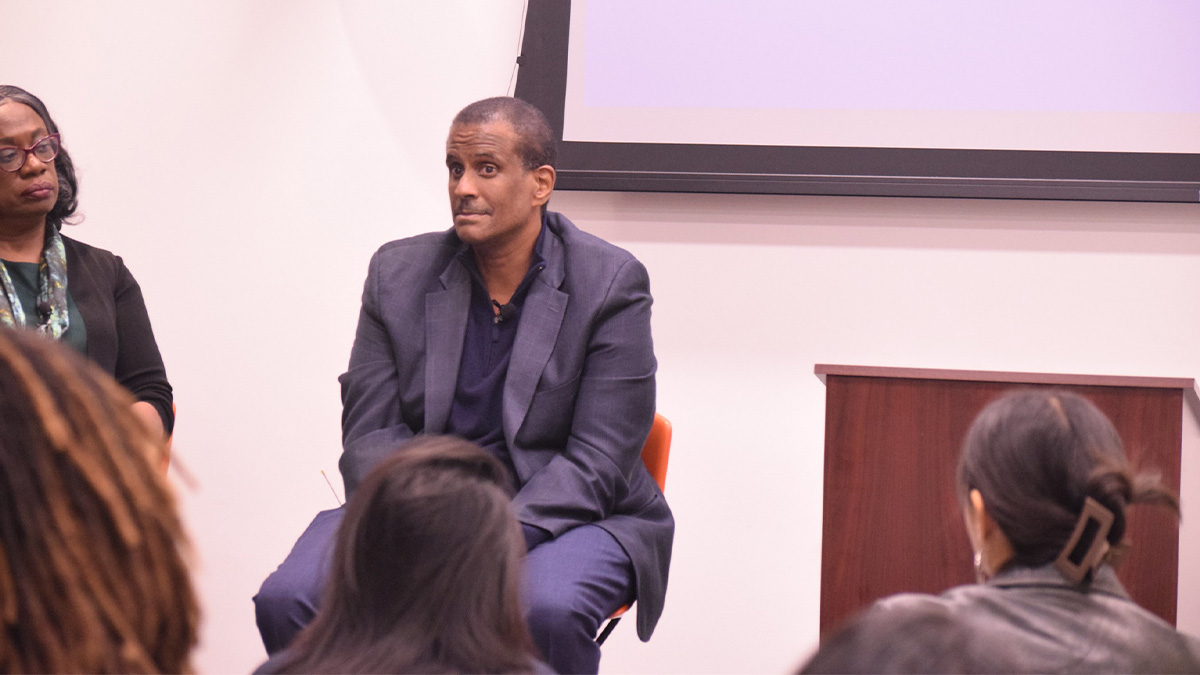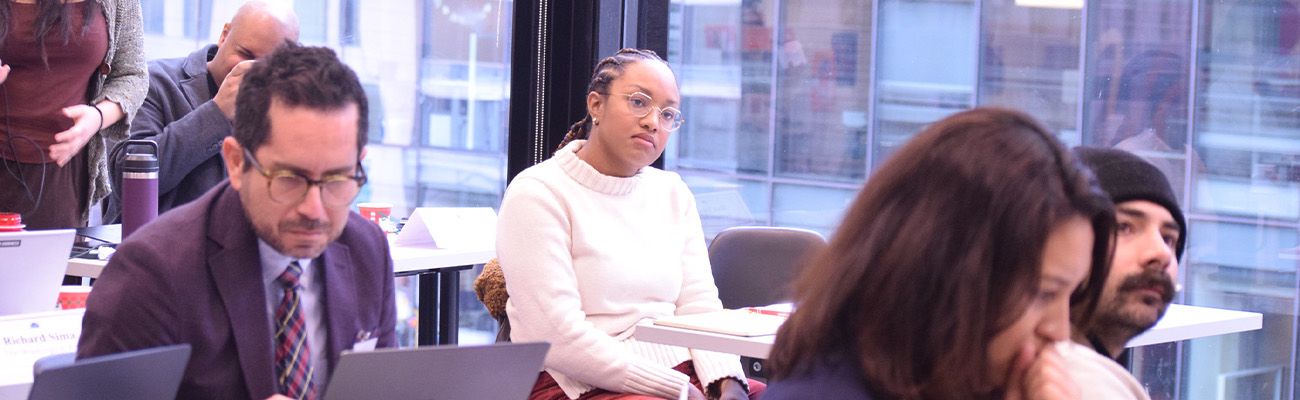
The career path that led Saeed Ahmed to his current role as VP of news for digital platforms with the Associated Press is stellar, marked by stints at other major media companies like NPR, BBC and CNN. What’s more impressive is his clarity about how culture and identity have enriched his life and career. When Ahmed spoke during the 2025 Widening the Pipeline Fellowship final training, that ease and flexibility was palpable.
“I was born in Bangladesh, lived in the Middle East, went to Morehouse, and then married a white woman. And I say this and then everybody starts laughing. But there’s a point to this, which is I look at the world through multiple lenses. I look at it as parent of biracial kids, as an immigrant, as a Muslim, as a South Asian, and all of them inform when I was a reporter, inform the way I approached my journalism, and now it informs the kind of people I hire, the kind of stories I assign, every aspect of my life.”
That introduction launched a wide-ranging conversation about lived experience, media transformation, AI in newsrooms and much more.
“When I started in journalism, we were taught that you have to leave all your identities by the door to come and worship at the altar of objectivity. And now that whole concept is kind of flawed. There were so many times in my life, there were stories I wasn’t allowed to cover because they’re like, ‘oh, he’s a Muslim, he’s going to be biased.’ But that only seems to apply when you’re a person of color. It doesn’t apply when you are the majority.”
Ahmed’s remarkable ability to leverage his identity and skills during critical moments of newsroom transformation has vaulted him to the front ranks of news innovators. Here are highlights from his session:
It’s never too early to play all the angles
While seeking internships and jobs after college, Ahmed learned that Cox Media Group, which owned the Atlanta Journal Constitution newspaper, was trying to create a one-stop news portal called Campaign 2000, which would be a repository of all their best campaign reporting. They asked Ahmed if he knew HTML. He didn’t, but they didn’t need to know that. After spending a few days in the campus computer lab, he taught himself and reported for duty the following Monday.
“It wasn’t needed because they just needed someone to maintain it, to add the bold heads, et cetera,” Ahmed said. “They didn’t need me to build the whole thing. They said my job would be there until the end of the elections. This was the election that ran long because of hanging chads, et cetera. So I was there all the way until the end of December. Then in January, they said, ‘OK, you did really well. We’re going to move you upstairs to ajc.com because just like with all of you, social and digital seem to be the realm of young people.'”
When breaking news meets lived experience
By August of 2001, AJC work had dwindled, and Ahmed was told he could stay on as a part-timer. Then September 11th happened.
“Every single news organization in America were completely caught off guard. They didn’t have any connections in the Muslim community. I was born a Muslim. I grew up in the Middle East … there are things about you that make you truly special and needed in a newsroom that others don’t have. You just have to find out what it is.”
Decide how you let negative influences affect you
As a journalist of Muslim descent, the months following 9/11 were challenging for Ahmed.
“I had to go to the Richard Russell building because we all had to register. If you’re a Muslim [immigrant], you had to register. And right outside the ACLU would sit there with a table, and I’m like, ‘why are you here?’ And they go, ‘oh, because many people that go in don’t come out. So give me the name of your family members that you want me to call.’”
There was another time when a reader responded to one of his stories by saying all Muslims should die.
“I wrote back saying, ‘I’m sorry you feel that way.’ And the person wrote back saying, ‘oh, your name is Muslim. You should die as well.’ And then I laughed and sent it to our security people. They traced it up to a woman in her sixties in upstate New York.”
Ahmed said there are two ways of dealing with this kind of discrimination.
“One is to feel overwhelmed and rightfully assume that I am under attack, which you are, which you’ll always be. Whether it was this moment or if it’s not, you’ll always be under attack because you’re different. Maybe the attack takes on different forms. Or the other one is how do I soldier through even amidst all of the obstacles that are placed my way? And you have to do that anyway in your journalism career. You have to figure it out.”
Timing is everything in media transformation
Ahmed’s career timing has been impeccable. Again and again, he arrived at major media companies just when they were beginning to pivot toward producing more digital content. After his work at the AJC, Ahmed supported the digital transformation for BBC and NPR before joining AP.
“I came on to start the digital platform side of the AP where our goal is to go direct to the audience. And the reason I came on is because as more and more of these news organizations die, the news desert is getting wider and wider. So what better time than now for the AP? Because the middleman is going to go directly to the places where no one else can access the information. The future of journalism is going to be local.”
The big question for now is just what will it take to preserve journalism?
“Does it get sustained by billionaires who feel some sort of kinship to a community? Another model is the NPR model, which is donations and memberships. That model works as well. Another is partnering with content creators so that maybe the brand isn’t the center, but the personalities that are disseminating your news. That’s another model. But what’s happening is in the last 20 years, we are just banding about the same four models. Every news organization is doing the same four things and then expecting different results.”
Ahmed advised an industry reset.
“NPR News is not competing for the attention of someone with the Boston Globe. You are competing with someone who’s focused on Netflix, YouTube, all of those other things. So you have to be in that space, and my advice to people, to journalists is I wish journalists took more vacations. Because only when you take vacations do you consume the news like a regular person.”
Too often, journalists view their work as somehow elevated instead of authentically addressing their audiences’ interests.
“One of the things I always say is create like you consume, and another problem that happens in journalism is all your friends end up being other journalists. Please make friends who are not journalists.”
And speaking of timing, Ahmed said journalists who don’t adopt artificial intelligence tools risk making themselves irrelevant in newsrooms of the future.
“I don’t use Google anymore. I use ChatGPT for everything. Sorry. but I do. In a moment of reinvention, we are going to be in a permanent mode of reinvention, permanent, and so either you can be afraid that, ‘oh my God, the industry is leaving me behind.’ Or you can say, ‘I am so excited about this future because I am the best positioned to take advantage of it. I know how to write. I know how to report. Now I know how to use these tools that it’s going to make my job easier.’ If you approach it from that mindset, you’re not going to be afraid of it.”
Access the full transcript.
This fellowship is funded by the Evelyn Y. Davis Foundation and the John C. and Ethel C. Eklund Scholarship Fund. NPF is solely responsible for the content.