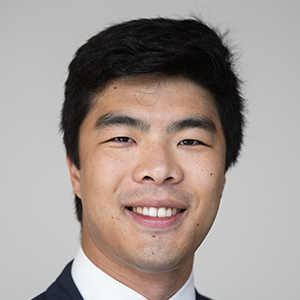
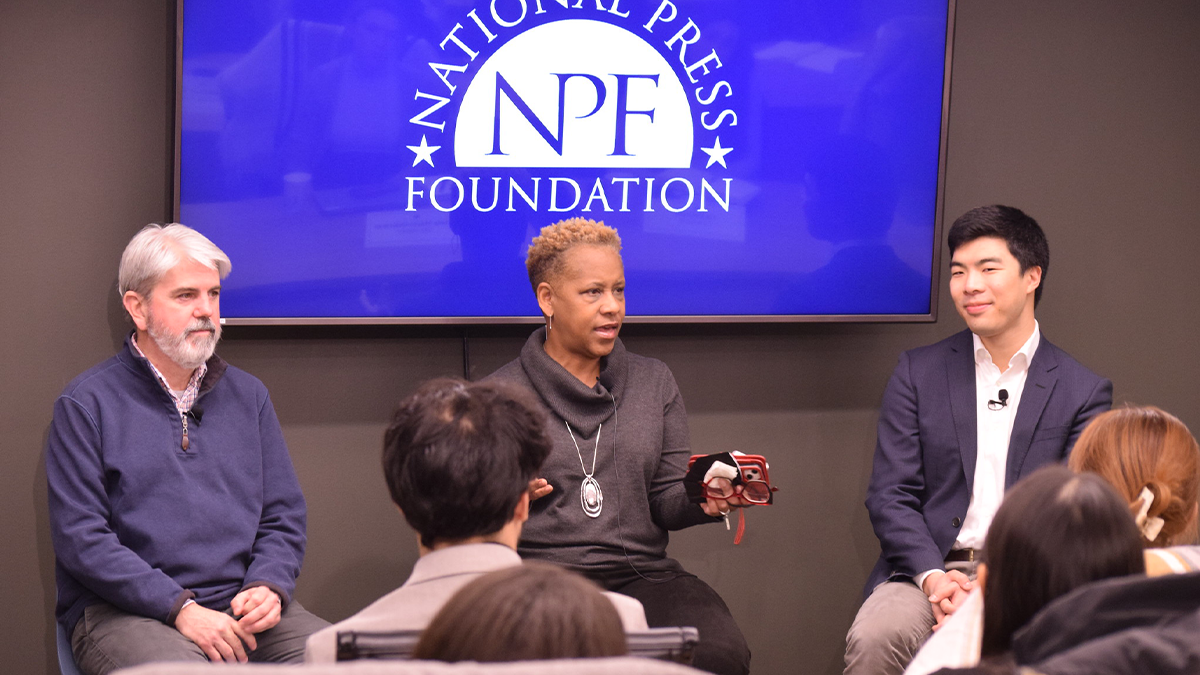
In just more than five years on the beat, Nicholas Wu‘s congressional reporting career already has spanned a crucible of American history.
Presidential impeachments. An insurrection. A deadly pandemic.
It has been a gauntlet that has tested the resilience of a democracy and the endurance of journalists covering a relentless news cycle.
“I like to say that covering Congress these days is kind of an exercise (in) having all of your expectations subverted,” the Politico correspondent told the National Press Foundation’s Widening the Pipeline Fellowship program. “When I first started covering Congress, we thought that the impeachment was a historic, once in a generation event, never to be repeated again.”
But President Donald Trump’s first impeachment was followed by the Capitol insurrection and another impeachment proceeding shortly after.
“So it’s been a wild ride,” Wu said.
As a public policy major at Princeton, Wu’s senior thesis examined how undocumented children fared in asylum cases. He turned the academic examination into one of his first pieces of journalism in 2018 during an early fellowship at the National Journal.
He was still weighing other career options, possibly law, when his association with the Asian American Journalists Association helped connect him with a job at USA Today.
“It was through the whole (Asian journalists) network that I was able to talk to people and I was able to learn … what exactly this job was, gain connections with folks there and really get an appreciation for what that position would entail and what I would need to pull together to be a viable candidate for it,” Wu said. “I’m very grateful to organizations like that, that have opened a lot of doors for me along the way.”
The USA Today job sent him to Capitol Hill to cover Trump’s first impeachment on charges of abuse of power, related to his 2019 telephone call to Ukraine President Volodymyr Zelensky when he urged the country to launch an investigation into then-political rival Joe Biden, while threatening to withhold military aid. Trump was later acquitted by the Senate.
“What I’d always been interested in was the kind of more theoretical parts of politics and policy,” he said. “But I think what covering Congress … has really given me an appreciation for is the really nitty-gritty little parts of how policy comes together and how perhaps this is just a function of how broken Congress is right now.”
Consequential debates come and go, but Wu said an underlying reality often never changes: “These big policy disputes and big issues among figures are often just driven by very petty rivalries among personalities.”
Other early-career events required some personal introspection.
As an Asian journalist, Wu said the rise of anti-Asian sentiment in the country prompted by the coronavirus pandemic, made for a “difficult dynamic to navigate.”
“That very much affected my community, but … you want to preserve impartiality. That was often a difficult balance to strike between figuring out … is it actually OK for me to pitch this story on the congressional response to the anti-Asian hate crisis or like, ‘Oh no, am I overstepping as the Asian dude in the newsroom?'”
Access the full transcript.
This fellowship is funded by the Evelyn Y. Davis Foundation and the John C. and Ethel C. Eklund Scholarship Fund. NPF is solely responsible for the content.