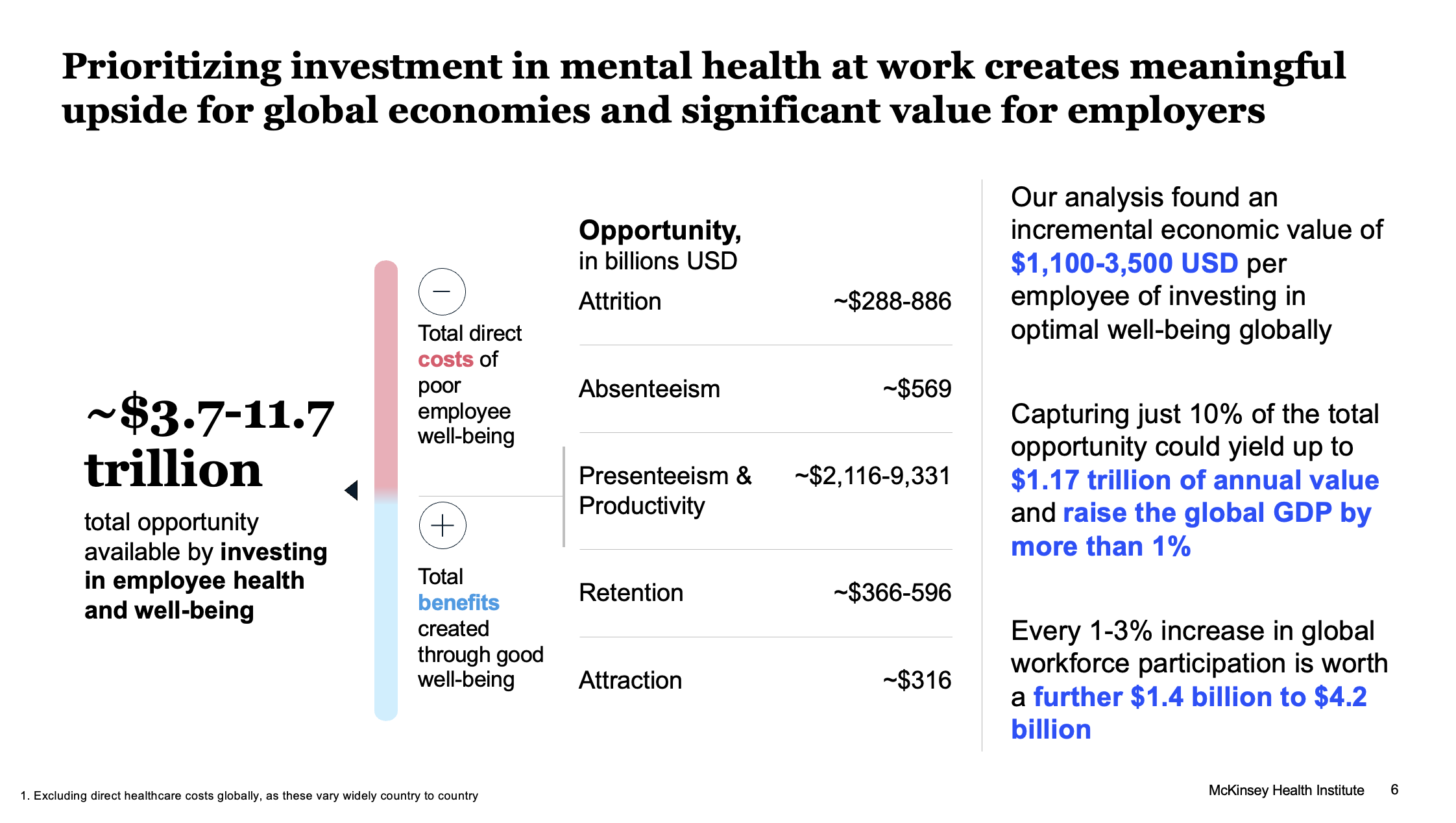
There’s an estimated $3.7 trillion to $11.7 trillion of value that can be gained by investing in employee health and well-being, said Kana Enomoto, partner and director of brain health at the McKinsey Health Institute.
“If we could get 10% of that, that would unlock $1 trillion of annual value and raise global GDP by 1%,” she said.
Enomoto and Betsy Schwartz, director of the Center for Workplace Mental Health at the American Psychiatric Association Foundation, spoke to NPF’s Covering Workplace Mental Health Fellows about how workplace mental health has economic impact related to productivity, absenteeism and other factors.
Key Quotes from Betsy Schwartz:
“Last year, 65% of employees said that their mental health affected their ability to do their job, whether they were less focused, less engaged or less productive.”
“We’re hearing from companies that as they’re out in the field, prospective employees want to know what their mental health benefits are, not just benefits as far as their health insurance,” she said, noting that 68% of Millennials and 81% of Gen Z employees have reported leaving a job for mental health reasons.
Key quotes from Kana Enomoto:
“If we could retain people who like where they’re working, not only do they have great purpose, but because they’re taking care of their employees then we’re attracting … the best talent.”
“I hope you think of employee health as a strategic imperative for companies … that when a company decides to do this, it has to be an organization-wide thing, it can’t just be a pocket … it’s not just the ERGs. ERGs are great, but it’s ERGs in the context of other broader initiatives. Invest better not more.”
Read the full transcript here.
This program is sponsored by the Luv U Project, with associate sponsors the Johns Hopkins Bloomberg School of Public Health’s Department of Mental Health and the American Psychological Association. The National Press Foundation is solely responsible for its content.