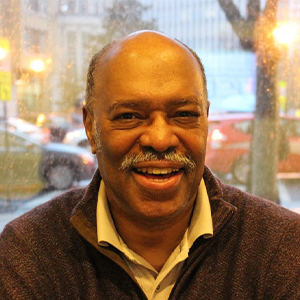
By any measure, veteran journalist Richard Prince is a living archive of diversity and equity initiatives in American media. Long before “DEI” became a corporate acronym – and long before it became a political target – Prince and six other Black reporters at The Washington Post took a step that reshaped journalism history. In 1972, they became known as the Metro Seven, a group of journalists of color who filed a complaint with the Equal Employment Opportunity Commission (EEOC), charging that the paper systematically denied Black reporters opportunities to advance.
More than 50 years later, Prince’s reflections – shared with National Press Foundation Widening the Pipeline fellows – land with renewed urgency. As newsrooms retreat from diversity commitments under political and corporate pressure, Prince makes clear: this moment is not new.
“Whenever there’s progress, there’s always a backlash. And now we’re in the backlash again.”
‘It Was Just in Our Genes’
Prince explained that the Metro Seven initiative did not begin with confrontation, but with documentation.
“We were all unhappy,” he recalled, describing how Black reporters were excluded from prime beats – sports, finance, foreign affairs – and leadership roles. Rather than making demands, the group asked written questions:
Why are there no Black reporters here? Why is Africa erased? Why are Black journalists excluded from covering Shirley Chisholm’s historic presidential campaign?
Their approach was deliberate, disciplined, and rooted in collective memory. “We all grew up during the civil rights movement,” Prince said. “This was our chance to show that we could assert ourselves just as well in the field of journalism.”
With guidance from Clifford Alexander Jr., former chair of the EEOC, the Metro Seven pushed for goals and timetables – two key components of affirmative action efforts. Management rejected the proposal, dismissing it as “quotas,” a word Prince said has been rebranded in today’s attacks on DEI.
When the group announced their EEOC complaint at a press conference in a Black church, the impact was immediate. Promotions followed. Hiring improved. And, perhaps most importantly, others took courage – women at The Post, journalists at The New York Times, Newsweek, and beyond. Within three years, the National Association of Black Journalists (NABJ) was founded.
Countering Anti-DEI Strategy
Prince was blunt about the current wave of rollbacks. The dismantling of DEI initiatives at NBC, CBS, and other outlets, he said, is not about journalistic values – it’s about power and regulation.
“These companies had business before regulatory agencies,” Prince said, referring to the FCC, which has stepped up its anti-DEI efforts under Brendan Carr. “If they wanted approvals, they had to play ball.” Under political pressure, media conglomerates stripped DEI language from websites and eliminated identity-focused verticals, such as NBC Latino.
Prince has carefully documented the challenges and successes for journalists of color through his Journal-isms column, which began as an offshoot of the NABJ Journal in 2002. And through the monthly roundtable he curates, Prince and others work with civil rights groups, unions, and journalism organizations to counter the anti-DEI push. One concrete strategy: embedding diversity requirements into union contracts – forcing companies to release diversity data annually and making equity enforceable, not symbolic.
Advice for Young Journalists of Color: Know Your History, Cover Your People
Prince’s advice to young journalists of color covering today’s social and political turmoil is rooted in both realism and resolve.
First, know your history.
“You have to know what came before you and where you fit in,” he said. Without that grounding, it’s easy to believe that progress is permanent or that resistance is futile.
Second, connect to everyday people. Citing research highlighted by Nieman Lab, Prince noted that audiences are increasingly turning to community-based news and social networks – not legacy outlets – for information about survival, affordability and daily life. Journalism, he argued, began as a public service and must return there.
Finally, Prince urged young journalists not to accept erasure as inevitable.
“No, we don’t have to accept it,” he said of DEI rollbacks. “We can fight it.”
That fight, he emphasized, is not just about representation in newsrooms. It’s about who gets to define reality in American society.
Access the full transcript here.
This fellowship is funded by the Evelyn Y. Davis Foundation and the John C. and Ethel C. Eklund Scholarship Fund. NPF is solely responsible for the content.