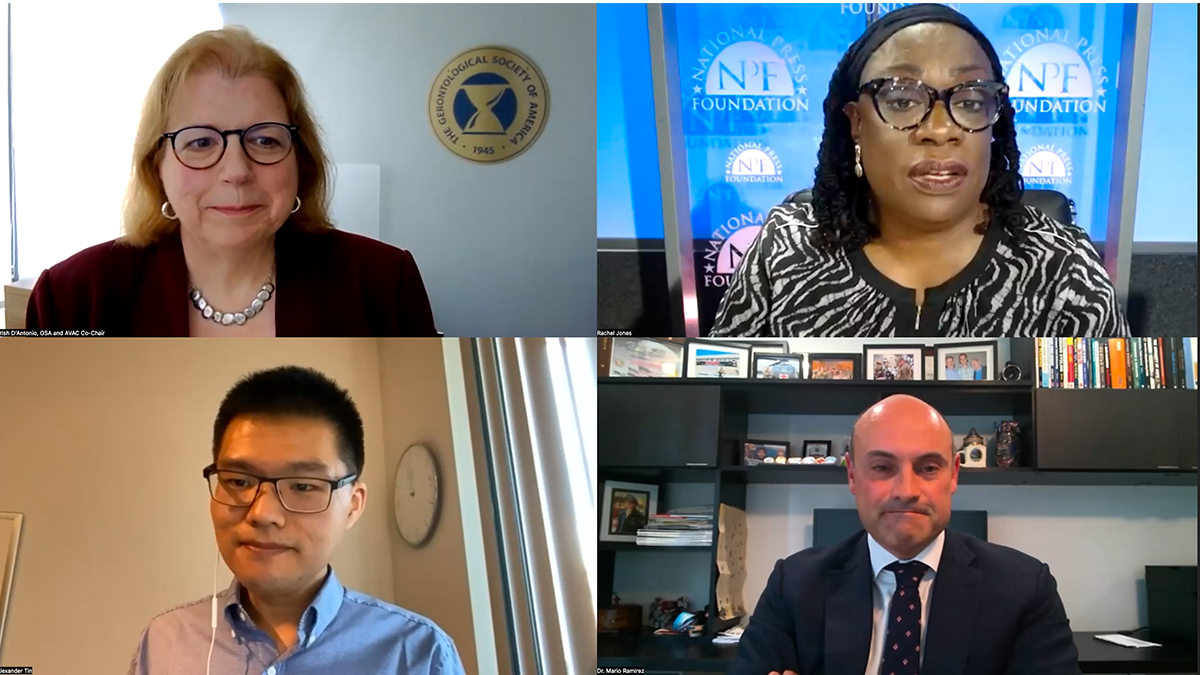
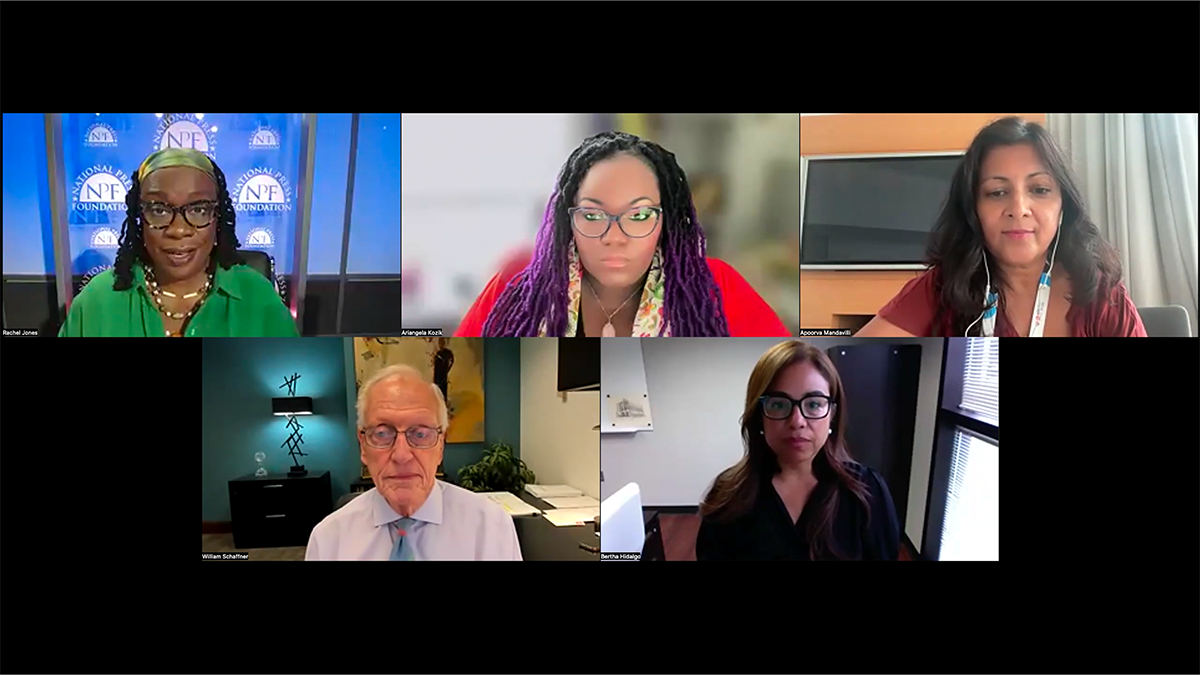
While summer is winding down, the Summer Wave of COVID-19 isn’t. Current CDC data shows COVID-19 test positivity at 18%, higher than it was a month ago. And as fall approaches and school begins, RSV and flu will also become a part of the mix. On August 27, five experts joined a National Press Foundation online briefing to tackle questions about vaccine recommendations, recent shifts in RSV guidelines, the timing of vaccine availability and more.
Family physician Dr. Ada Stewart said the COVID numbers this summer have been “unbelievable.”
“I can tell you even last week, every day we had at least, within my practice, five individuals who were positive for COVID-19. And that’s not to say that we have not already seen individuals who are positive for the flu. So now is the time for individuals to get vaccinated.”
As a past president of the American Academy of Family Physicians, Stewart also chairs its inaugural Commission on Diversity, Equity and Inclusiveness in Family Medicine. “Individuals have the exciting opportunity to get immunized against flu, RSV and COVID at the same time,” Stewart said.
But there has been an “erosion in the public’s perception of the value of vaccines,” said Dr. Amesh Adalja, a senior scholar at the Johns Hopkins Center for Health Security.
Because there was an increase in anti-vaccine activity during the height of the COVID-19 pandemic, Dr. Adalja said he’s been seeing that spill into other vaccinations and an overall lower rate of childhood immunizations. But vaccination is a cornerstone of emergency preparedness, he said.
Journalists can help educate the public on misconceptions, said Washington Post health and science reporter Fenit Nirappil.
“I think there’s a lot of misconceptions that the vaccines don’t do anything for infection because people hear about their vaccinated friend who got sick… So I do think it’s important to include that context that there is research that suggests that vaccines do increase protection against both infection and transmission. It’s not the kind of nearly full proof protection that we see from other vaccines like measles, but it does do things to help prevent against infection and transmission.”
He also encourages journalists write about the consequences of the federal government no longer treating COVID as a public health emergency.
“Vaccines went from being treated as a public good to now being treated as a commercial product. That means that people are up to the mercy of all the other problems with our American healthcare system.” He said to listen for stories of issues with insurance or availability.
He said the most common question he gets from readers is about the best time to get a new COVID vaccine.
“The public health guidance is generally that you can get your COVID and flu shot at the same time, but the flu season may vary depending on where you live. Usually the optimal timing is September or October….So it can be a little bit more complicated than we sometimes think, and that’s where journalism can help in walking people through the different trade-offs that are at play.”
Nirappil said that, often, journalists tell readers to talk to their doctors about when to get vaccinated. But he said that the reality is most people need four months just to get an appointment. “So it’s helpful if we can connect people to the experts to help them inform their decision-making, or to inform the questions that they can ask their doctor if they are able to get an appointment.”
Toronto-based journalist Lygia Navarro has reported extensively about the health consequeces of Long COVID. She’s also one of millions who live with the illness. Navarro says people with Long COVID have been “shut out from society” because people don’t mask anymore or isolate when they’re ill.
She encourages reporters to to look for diverse sources. Long COVID organizations can help journalists find sources who are affected. Her advice for interviewing people Long COVID is to offer accommodations with how you interview, as well as length of interviews. She offers to do the interview in a variety of ways including by phone or Zoom (with or without camera), but also by email, text or voice memos.
Dr. Brendan Jackson, the senior advisor for Preparedness and Response for CDC’s National Center for Immunization and Respiratory Diseases, said a Health and Human Services campaign has kicked off focused on education around RSV, as well as the flu and COVID.
Last year, the RSV vaccine became available for individuals aged 60 and older. But people tend to think of it as a young children disease and don’t realize that it’s a problem for older adults, he said.
“If you’re over 75, you just go ahead and get that vaccine if you didn’t get it last year because it’s not an annual vaccine like COVID and flu are. Or if now if you’re 60 to 74 and you have a certain underlying health conditions that raise your risk, people can then go out and get that vaccine right there.”
But Jackson says the most important message to take seriously moving into Fall and Winter is that COVID is here to stay.
“It has certainly changed from where we were several years ago. It’s not the emergency that it once was, but it’s still clearly a public health threat. There were nearly a million hospitalizations last year from COVID, and approximately 75,000 deaths. It’s a problem for a lot of people.”
Access the full transcript here.
This webinar is sponsored by CVEEP. NPF is solely responsible for its content.