A recent NIH study found only 15% of high-risk COVID patients eligible for Paxlovid took it. Why is the U.S. seeing such low usage of the antiviral when it’s been shown to significantly reduce hospitalizations and deaths?
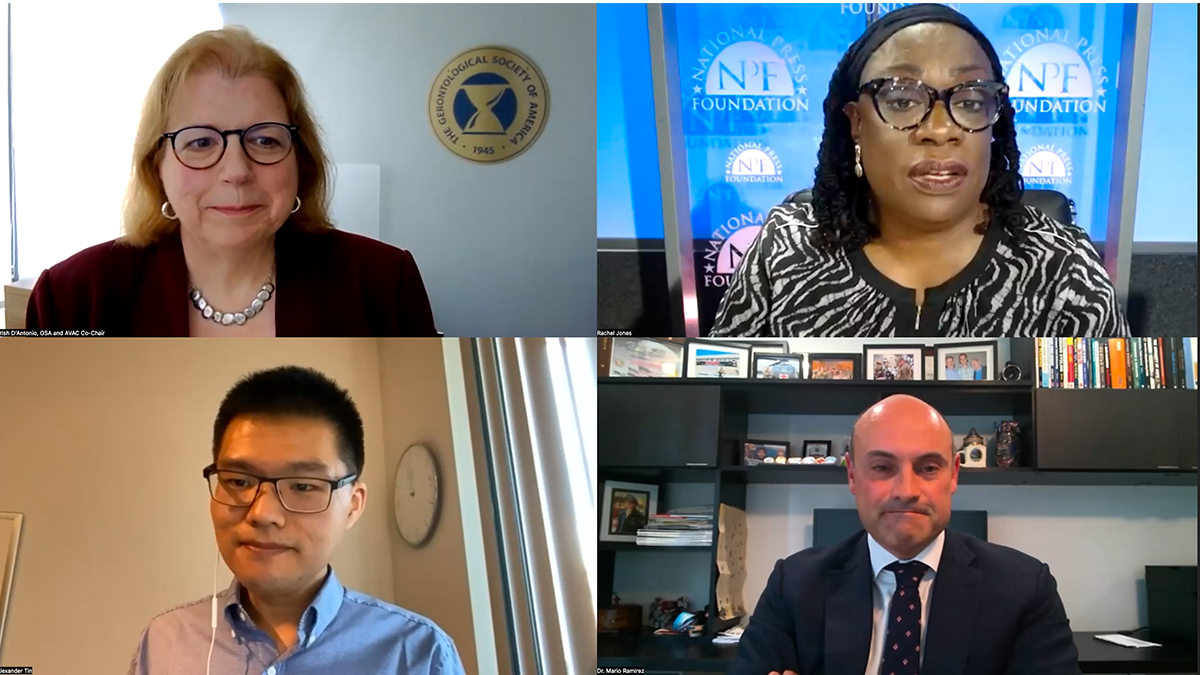
Four experts joined a National Press Foundation online briefing Jan. 11 to tackle that question and discuss awareness, access and effectiveness of antiviral treatments – and how journalists can better report on the future of COVID-19.
Watch the video here:
COVID-19 oral antiviral treatments — like Paxlovid — have recently transitioned from a government-funded program to the commercial market. Experts explained how that impacts public access.
“No one should be paying full price for Paxlovid,” said Meghan Pennini, Chief Vaccine and Therapeutics Officer at the U.S. Department of Health and Human Services (HHS).
PAXCESS has two programs available: The Patient Assistance Program, which is for anyone uninsured or who has public insurance such as Medicare, as well as a Pfizer program for those who have commercial insurance, Pennini said.
“All you need to do is enroll,” she said, and she suggests people enroll before they’re sick.
CBS reporter Alexander Tin said he’s found that the patient journey to access Paxlovid “can really get difficult” now that it’s commercialized.
“A lot of providers … don’t really know that this program exists. So, when they’re prescribing it to their patients, they don’t know to tell their patient, ‘Hey, if you’re Medicare, if you’re Medicaid, if you are uninsured, you need to go to this website to sign up or call this number,’” said Tin.
“We also know that there are all kinds of other issues happening in this space of treatments for COVID-19. We know that there are other treatments in the pipeline, especially for those populations that maybe can’t quite benefit as much from Pfizer’s Paxlovid, [like] immunocompromised Americans.”
Racial disparities in treatment persist as well, said Jacinda Abdul-Mutakabbir, assistant professor of Clinical Pharmacy at the University of California, San Diego.
“I think we can trace this back to the start of the pandemic. We saw that Black individuals, Hispanic individuals, American Indian/Native Americans were 30% less likely to receive a prescription for Paxlovid in comparison to their non-minoritized counterparts. That’s something that we continue to see perpetuated,” she said.
She said awareness and access to health care play a role in these disparities, both for minoritized groups and those in rural areas.
“We continue to see that people that live in rural conditions are upwards of 30% less likely to be offered a prescription. They are further than 20 miles out of being able to go to a pharmacy and ask for this,” she said. “They’re unaware of the fact that you have to do this within the five days” of developing symptoms.
Journalists should inform the public about COVID treatment facts, said Arti Barnes, Chief Medical Officer at the Illinois Department of Public Health.
“Systemically we’re seeing that there are lower per capita prescriptions from providers who are in the more vulnerable areas in spite of a higher hospitalization rates in those areas,” she said.
Understanding how to interpret statistics and scientific data is important for health journalists.
“When the real-world studies came out around Paxlovid, the first big media headlines were, ‘Paxlovid doesn’t work as well as we think it does. It’s only 37% effective.’ And that was a big headline. But when you deconstruct that actual study … the risk of just not dying if you took either Paxlovid or molnupiravir was 84% or 77%. That is huge. And that message completely got lost. If you tell me you have a risk factor, this drug will be 84% effective and preventing you from dying. That’s a very different headline.”
Access the full transcript here.
This webinar was sponsored by the COVID-19 Vaccine Education and Equity Project. NPF is solely responsible for its content.