As podcast audiences continue to grow, more journalists are exploring audio as a storytelling tool.
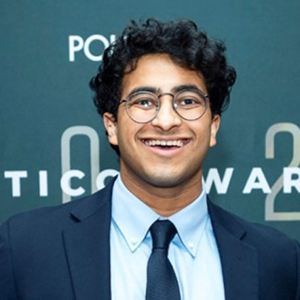
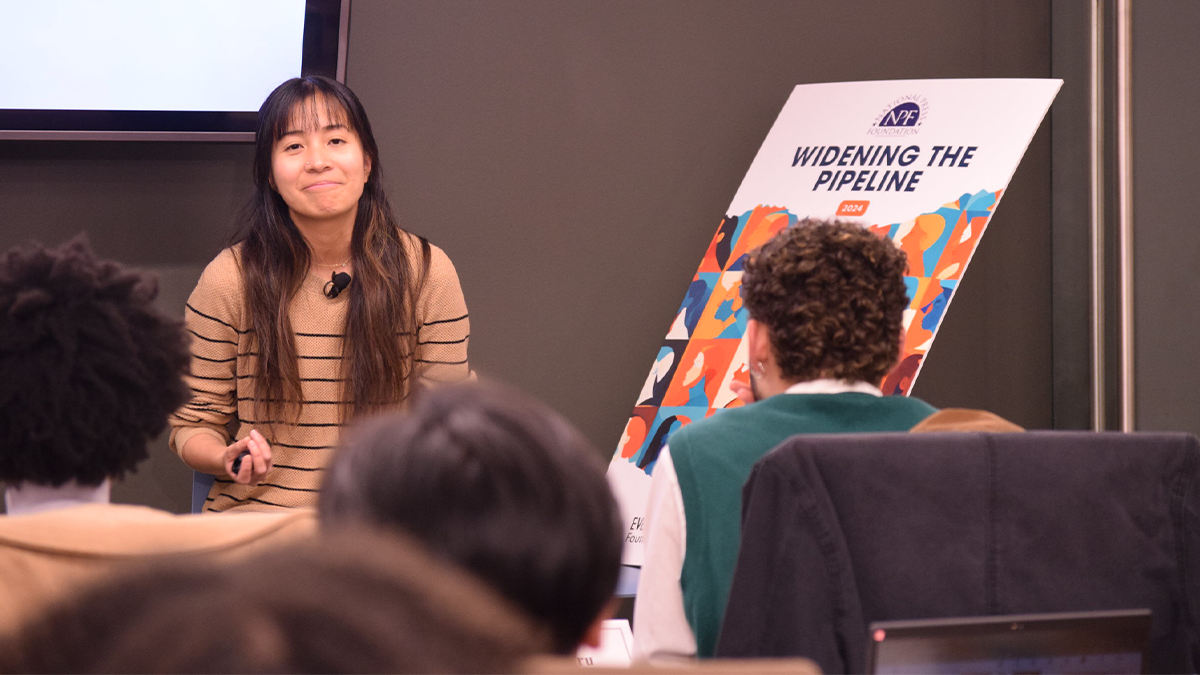
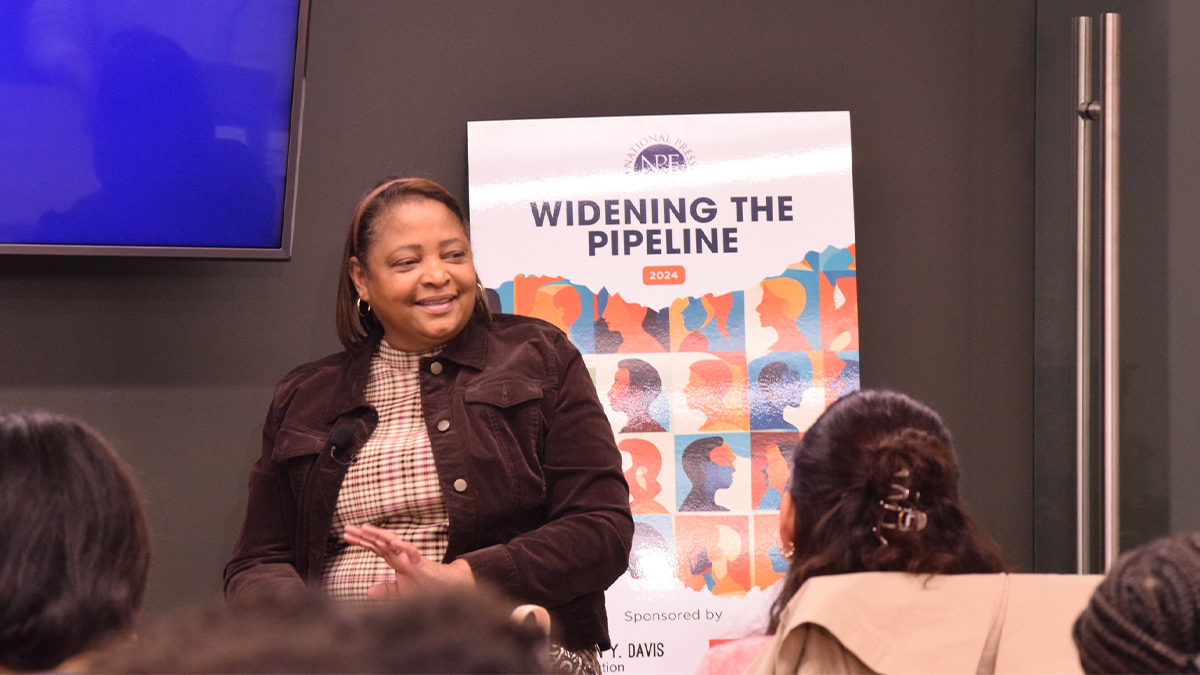
Nirmal Mulaikal, a producer/host with Politico’s Energy podcast, and Amina Al-Sadi, supervising producer for Vox Media’s Today Explained podcast, shared insights and advice with NPF’s Widening the Pipeline fellows about how to get into podcasting and the challenges that come along with it.
5 Takeaways:
1. Be authentic
Both Mulaikal and Al-Sadi emphasized the importance of bringing your personality to podcasting. Many people listen to podcasts for the host and their “vibe,” according to Mulaikal.
“Bring your personality, but do be ready for some pushback. If people don’t exactly vibe with it or have weird comments about it, be ready for that,” he said.
One way that Al-Sadi recommended for finding your podcasting voice is to think of how you would explain something to a friend.
“If I was having a conversation with my friend, how would I tell them this story? How would I relay it? Because that’s going to be your most natural and relaxed voice.
“People can spot when you are not being yourself or being authentic,” Al-Sadi said. “It’s important to find your voice and put out a story that is in your voice.”
2. ‘Meet people where they are’
Audiences continue to grow and are often loyal, Mulaikal and Al-Sadi said.
“More and more people are finding podcasts and it’s a great way to connect with people because of the intimacy of podcasting. When you’re listening to a podcast, they’re kind of like your companion,” Al-Sadi said.
Podcasts are also easy to engage with since many people multi-task while listening.
“Audio is a very intimate format and it can be consumed passively. I’m listening to audio all the time when I’m commuting and working out, doing other things. So, this is a way to meet people where they are even when they’re not trying to consume journalism,” Mulaikal said.
3. Guests, creativity and storytelling are key to creating a good podcast
Identifying the right guests is critically important, according to Al-Sadi.
“This is the foundation of what you’re putting out there. It all hangs on the person you’re talking to,” she said.
Increasingly, prominent actors, entertainers and athletes are participating in podcasts because it allows them to reach a different or wider audience, Mulaikal explained.
“They feel like they’re heard. Clips are not just cut to a couple quotes in a story,” he said.
More politicians, as seen with the recent presidential election, are also participating in podcasts because it allows them to share a more well-rounded message.
“A longer interview gives the lawmaker a lot of leeway,” Mulaikal said.
As with any form of journalism, storytelling is also key in podcasting, according to Al-Sadi.
“No matter what you do in journalism, you need to be a good storyteller. So whether it is the story itself or the fact that you are finding a person who’s good at telling a story, it all comes together as a reminder that this is an art form,” she said.
4. Podcasting is harder than it sounds
As with any industry, there are challenges to producing a successful podcast. Mulaikal referenced the stereotypical “NPR voice,” and sometimes, journalists can be dismissed for “not sounding right.”
Podcasting can also be extremely demanding, and the possibility for burnout is real, Mulaikal said.
“People like someone who can do all the technical stuff but also come with editorial creativity,” he said.
Technical skills are important.
“It actually does take a really distinct set of skills. A lot of you have those skills already just as journalists, but there are ways to refine them and there are ways in which they are distinct from different mediums,” Al-Sadi said.
The industry has also become a bit saturated, according to Al-Sadi, so journalists must work harder to stand out.
“Anyone who has something to say or wants to say something can. And I think that that’s great for just making the industry more equitable,” Al-Sadi said.
5. Journalists can hone their craft with these resources
Since many journalists already have the basic skills needed to break in to podcasting, there are resources that can help you take the next step.
Al-Sadi recommended a free NPR training. She also recommended Radio Boot Camp and the Association of Independents in Radio.
“Learning the craft, sharpening your skills and then learning your voice. This is really important for the authenticity aspect of audio,” Al-Sadi said.
Access the full transcript here.
This fellowship is sponsored by the Evelyn Y. Davis Foundation and Lenovo. NPF is solely responsible for the content.