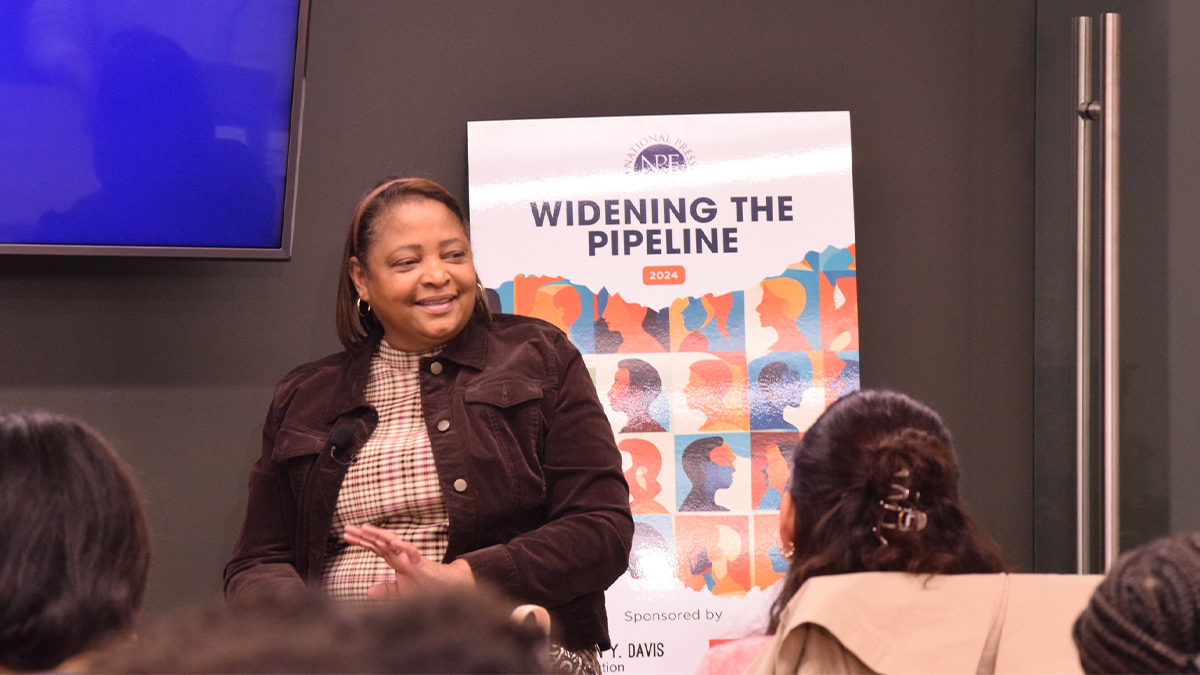
As concerns about journalists’ safety increase in the U.S. and globally, International Women’s Media Foundation safety trainer Rosem Morton urged a pragmatic approach during her conversation with 2024 Widening the Pipeline fellows. That’s because definitions of safety may differ, even within the same newsroom.
“The people managing me have a different lens of how they look at safety. They may not necessarily think of my safety as an individual. They think of it as an operational context and an organizational context. So again, this is really where we can give each other grace and communication becomes really important.”
Morton, who is also a nurse and a freelance photojournalist, said her work with IWMF helps her identify the key concerns for journalists, especially following the extremely challenging 2024 election season.
Given the deep fractures in American society at present, Morton said journalists must keep their identities front and center.
“A lot of our safety is really affected by our own personal profile,” Morton said. “When we talk about profile, oftentimes we also talk about high profile versus low profile. Am I going to try to blend in or am I going to stand out? I think historically people always think that, oh, blending in is the safest route, and it’s not always the safest route. So it’s really, a lot of it is situational.”
Questions Journalists Should Ask Themselves Before Going Out In The Field
A cornerstone of journalist safety must be situational awareness—especially when covering large crowds alone or as part of a reporting team, Morton said.
“We want to think about where are you? What are the safe havens? Where are the exits? Who’s around you? What are they wearing? What are they doing? Did they change behavior? Did the crowd suddenly feel aggressive?”
Morton explained the importance of monitoring your own mental and emotional health, because it can affect how you perceive your environment and the reactions of others. “When your cup is not filled, you’re slower to react.”
Another big part of risk assessment is really thinking about the different participants in any given situation, which Morton described as “actor mapping.”
“You want to think about ‘who are the different actors in this space? What are their motives and what typical methods do they use?’ very broadly. This could be different political parties, their supporters, it could be activists and their supporters, the general public, law enforcement, military extremists, precarious groups, whoever has money, power, and influence.”
Journalists also need to thoroughly explore the resources and support systems that their organizations have in place.
“Do they know the legal processes in their newsroom? Do they know who they’re going to call? So again, if you get arrested, you only get one phone call. So it has to be a really good phone call. And that person has to be on your location at all times, not having a family party. So again, communication and planning things out is really important.”
Journalist Safety Resources
Morton advised journalists to investigate all available resources for protecting themselves in the field. Some U.S.-based safety resources include:
- US Emergency Fund: open to journalists of all genders, includes PPE, medical and mental health grants, must be related to reporting in US
- One-on-one safety consultations
- Virtual safety training and policy support for US newsrooms and journalism associations
- Newsroom Policy Guide (Spanish) & Protecting Freelance Journalists Guide
- Mental Health Guide (Spanish)
- Online Violence Response Hub (digital security resources)
Access the full transcript here.
This fellowship is sponsored by the Evelyn Y. Davis Foundation and Lenovo. NPF is solely responsible for the content.


 Reload document
 Open in new tab