Good business journalism begins with understanding the basics, from fundamental accounting principles to interpreting companies’ earning calls and financial statements.
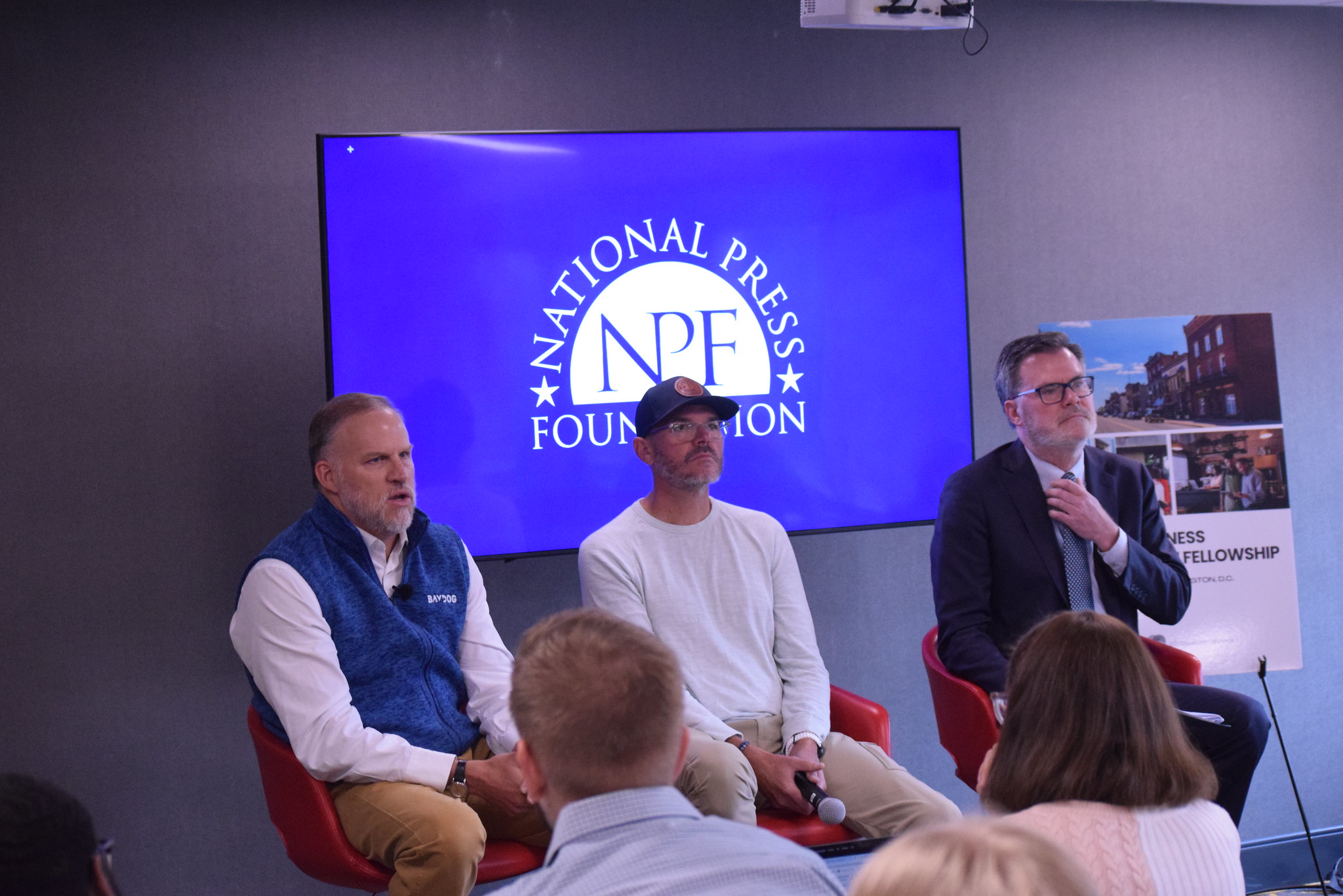
Paul Fischer, a professor at the University of Pennsylvania’s Wharton School of Business, took reporters behind the press releases for a primer on making sense of the numbers at the core of business operations.
Some outtakes from Fischer’s visit with the National Press Foundation’s Local Business Journalism Fellowship:
Using accounting to tell a company’s story
“Financial accounting has evolved basically as a mechanism for communicating a firm’s current standing and past performance,” Fischer said.
There are two sets of “generally accepted accounting principles”: U.S. GAAP (generally accepted accounting principles) and International Financial Reporting Standards (IFRS). Most U.S. companies use the U.S. GAAP “language.”
“Like all communications systems, it’s imperfect. So … what somebody sees and what ultimately ends up in those financial statements sometimes doesn’t perfectly align.”
Explaining ‘issuing’ debt vs. equity
“Typically, you can think about issue as selling your debt. It’s basically, ‘I’m selling you a promise to pay you something in the future. Give me some cash.’ That’s issuing debt. And the same thing with issuing equity: ‘I’m selling you an equity claim, which is a promise to pay you excess cash flow in the form of dividends in exchange for you giving me something.’ So it’s basically just selling a claim on your entity.”
What’s in a balance sheet?
A balance sheet “represents piles of assets, liabilities and equities at a point in time for the firm,” Fischer said, defining the terms as such:
- assets: “claims or resources that are controlled by the firm, like their cash and their inventory”
- liabilities: “certain kinds of claims on the firm, their payables and debt”
- equities: “residual claims on the firm, so the common stockholders’ claims on the firm and the book value of a firm”
“When people refer to an accounting book value, they’re referring in many cases to the book value of equity … so, if somebody says the book value of this firm is 200, what that means is their total equity balance is 200 at a point in time.”
Reading an income statement
An income statement shows the flow of net assets into and out of a firm.
“It adopts an equity holder perspective. So, the net income is net income for equity holders and that net income ultimately is going to land in the equity account called ‘retained earnings’ on the balance sheet. So the income that the firm has accumulated to date that hasn’t been paid out as dividends is what the balance of retained earnings is. And finally, just keep in mind, dividends aren’t an expense. They’re just a distribution to the owners of the firm.”
Financial statements inform internal and external decisions
“Firms communicate via these financial statements to outside parties who use that information to make decisions that are often relevant to the firm. So equity investors are going to use that information to maybe decide how much they want to value the stock in the marketplace, whether they think the shares are priced too high or priced too low, should I buy or should I sell? Creditors might use those financial statements to assess should we give these guys a loan or should we not?
“Outside shareholders or activist investors might look at these financial teams to assess should we get rid of top management or should we not? Are they doing a good job or aren’t they? So they’re used for all sorts of different reasons to assess different decisions,” Fischer said, noting that there aren’t specific benchmarks or rules that indicate what decision to make, the data simply inform the decision. “Oftentimes what they want to do is they want to benchmark one firm against another or against their peers. How are you doing relative to your peers or how you do relative to how you’ve done in the past? Are you getting better or worse?”
Access the full transcript here.
This fellowship is sponsored by the U.S. Chamber of Commerce as part of a journalism training and award program. NPF is solely responsible for its content.



 Reload document
 Open in new tab