Artificial intelligence won’t be replacing all journalists any time soon. But it is delivering a bold message: journalists who don’t embrace AI as a reporting tool risk being left behind.
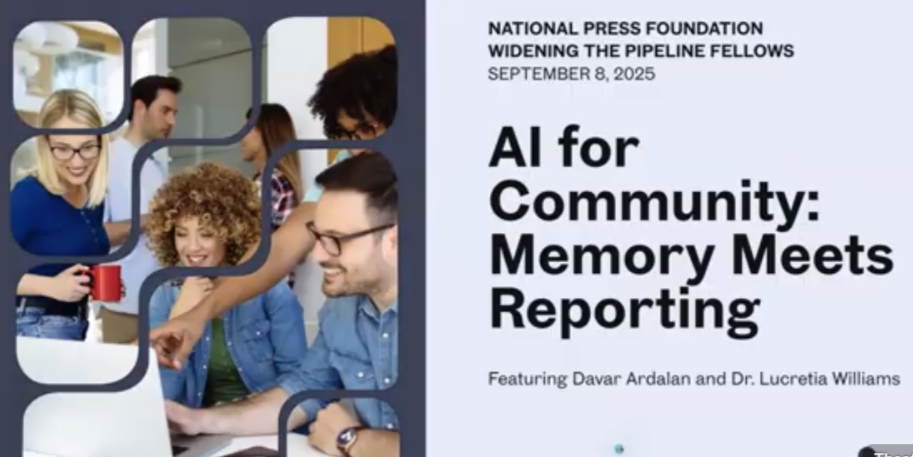
Inarguably, AI is making the most impact in investigative reporting ranks. During the first virtual training session for the 2026 Widening the Pipeline Fellowship program, CalMatters reporter Ryan Sabalow introduced fellows to the Digital Democracy custom AI tool, designed to illuminate the inner workings of power and access in California’s legislature.
The platform tracks legislation, votes, campaign donations, and public hearing transcripts, allowing reporters to spot patterns that would be nearly impossible to uncover manually.
Here are highlights from Sabalow’s presentation:
Transparency is the story
To Sabalow, Digital Democracy was born out of necessity. That’s because one-party dominance in California, combined with the collapse of local statehouse coverage, has created an environment where key decisions increasingly happen out of public view.
This tool aggregates different public records into one searchable system, making it easier to see how lawmakers actually behave and countering a culture of opaque politics.
“An ideal Digital Democracy story is less about what a bill does, and more about what does it say about the people making these decisions.” Sabalow said. “They’ve been circumventing this stuff because nobody’s really keeping a close tab on it. And that’s part of what our job is: to make them care.”
And for the moment, that seems to be working. Outside of newsroom use, Sabalow explained that a new newsletter tool from Digital Democracy, designed to give subscribers a weekly summary of their lawmakers’ votes and campaign donations, is very successful. In its first month, the newsletter attracted more than 8,300 subscribers with a two-thirds open rate.
“Some of the most important decisions impacting Americans’ lives are being made in state houses around the country,” Sabalow said. He hopes tools like this will continue to help people take a closer look.
Finding stories among the data
After sharing examples of stories that Digital Democracy has helped unearth, Sabalow walked the fellows through a demo of the tool and discussed how it can tease out patterns in otherwise dry data sets, leading to important public service stories.
In one example, Sabalow showed how a wildfire liability bill died in committee. Digital Democracy immediately showed that committee members had received millions of dollars from oil industry unions opposed to the measure.
“You’re never going to be able to beat being in the room ever,” Sabalow said of newsrooms that continue to send reporters into courtrooms and hearings. “But this can help.”
The tool links voting records with campaign contributions, helping reporters expose how special interests influence outcomes and how lawmakers sometimes kill bills quietly by abstaining rather than voting “no.”
Human judgment still matters
Sabalow emphasized that Digital Democracy is designed to lift the burden of data analysis so journalists can focus on sourcing, context, and storytelling. AI-powered “Tip Sheets” flag unusual voting patterns and potential conflicts of interest. But, there is still a need for journalists to help explain what this means to readers.
“That’s why journalism is still so important,” Sabalow said. “You have to have the sourcing and the knowledge about how the sausage got made behind the scenes.”
Access the full transcript here.