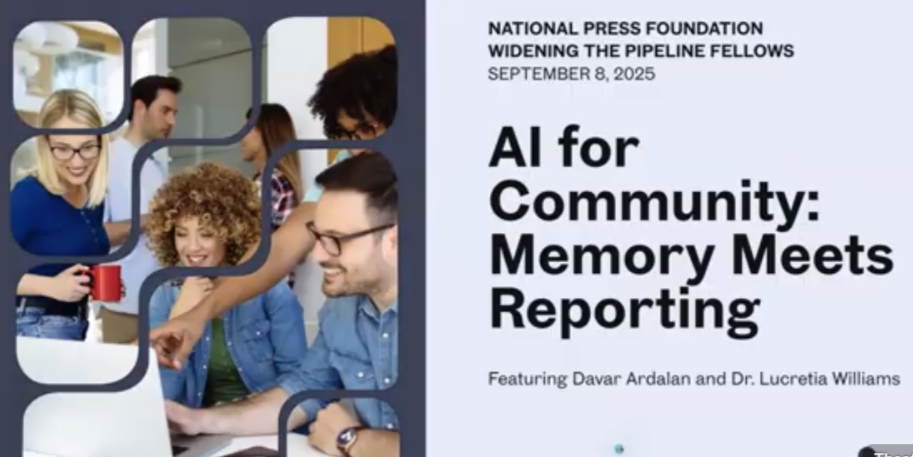
As the influence of artificial intelligence deepens across all societal sectors, the potential impact on journalism and in media requires careful consideration about whose voices will be captured and amplified.
That was the message to National Press Foundation Widening the Pipeline fellows from veteran journalist Davar Ardalan, author of “AI for Community: Preserving Culture and Tradition” and Lucretia Williams, a senior research scientist at Howard University. Both presented case studies emphasizing the need for AI to adapt to diverse communities: Howard University’s “Elevate Black Voices” project, which created a dataset of African American English to improve speech recognition technology, and “My Name is Iran,” a custom GPT built on open-source datasets of Persian history.
The discussion also covered the ethical responsibilities for journalists using AI, including fact-checking, ensuring cultural responsiveness, and being mindful of the technology’s environmental impact.
Here are key points covered during the session:
What voices is AI amplifying?
Ardalan said the development of AI technology should answer some basic questions.
“What is the human-centered design aspect? How do we preserve voices, lived experiences and memory?”
She used India as an example, where data sets are being built by recording the voices of people in rural areas.
“If you’re building an AI tool for farmers to be able to get the latest weather report, but their AI doesn’t recognize their voice or understand what they’re saying, what’s the point?”
Ardalan also pointed journalists to the Nvidia project based in New Zealand’s Maori community, designed to protect their language and show how AI can help revitalize cultural heritage.
“The idea here is that AI should adapt to the communities and not flatten them,” she said.
AI can address historical gaps in databases
Williams’ work focuses on human-computer interaction. As a researcher, she engages with communities to design AI tools and study how they’re adopted in local contexts.
“Black communities have been historically excluded ever since the inception of this country, and that trickles down into the technology that we now own and use every day,” Williams said.
“So the main problem we try to solve with Elevate Black Voices is to have automatic speech recognition, be able to understand African-American English. Currently, our voices technology sometimes won’t understand certain speakers who don’t have standard American English speech patterns, and the data proves it. We just wanted to make sure that we were [developing] an inclusive data set that these LLMs can be trained on to improve automatic speech recognition technology.”
If it doesn’t exist, build it.
As more and more media organizations begin adopting AI in their coverage strategies, Ardalan said journalists need to be more proactive about the source of the data.
“As you build the future and start using these AI tools, you can look to see what kind of data sets are out there so that you can build custom AI models that can inform your reporting much more proactively,” she said. This is important because most AI programs are based on Western large language models. “It’s your responsibility to make sure that you do the extra work so that your work is encompassing more cultural context.”
Ardalan focused on her Iranian American heritage to build the My Name is Iran custom GPT, which provides access to nine different open source data sets going back to the stone inscriptions from Persepolis.
“These are all data sets that are open, and I am able to just find remarkable resources to help my children or my community learn about what it was that the message of the ancestors was back then and what do we learn from them.”
Access the full transcript here.
This fellowship is funded by the Evelyn Y. Davis Foundation. NPF is solely responsible for the content. To support the 2026 program, contact rjones@nationalpress.org.



 Reload document
 Open in new tab