Health reporters get plenty of pitches touting medical and scientific “breakthroughs.” How do they know if it’s legit? Tori Espensen, media training manager at the American Association for the Advancement of Science’s SciLine, explains.
“If a press release comes across your desk that heralds something as a breakthrough, be very, very wary,” she said. “Most often, science is a small step, not a giant leap at a time.”
In fact, Espensen advises against reporting on any single study.
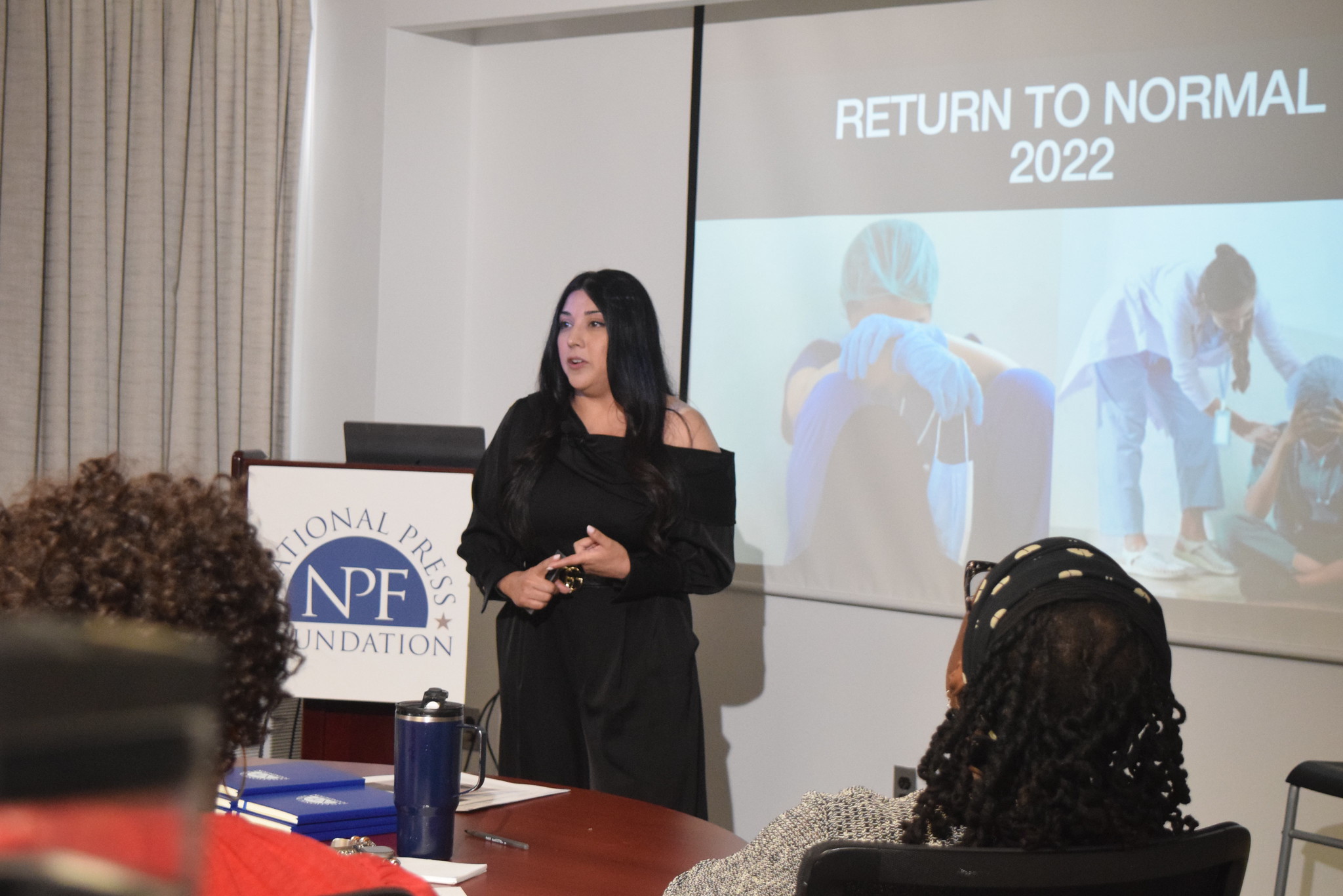
“When we say ‘trust the science,’ we’re talking about trusting this process and that process is iterative. It moves continually closer to the truth. But no one single study is the truth,” which is why you should avoid saying a study “proves” anything, Espensen told NPF Covering Workplace Mental Health journalism fellows.
Instead, Espensen advises using the release of a study as a timely news peg to “go more in depth about the problem or about the larger trend or pattern that you might be seeing” in the research.
Co-panelist Caroline Colvin, a reporter for HR Dive, said “having studies can help bolster anecdotal evidence” in your reporting, as well.
How to know if you should report on a study
As a journalist reads a scientific study, there are questions they should ask themselves as they’re going through the work, Espensen said:
- How many subjects were there? “Bigger is always going to be better,” Espensen said. “But ‘how big is big enough’ is going to vary by field and circumstance and research method. So if it is super tiny, that’s going to be a red flag.”
- How were participants selected? (How can/can’t that be generalized to the overall population? What biases are present?)
- Is the difference statistically significant?
- Is the difference practically significant?
If the reporter decides it’s worth informing the public about, the next step should be to interview an expert outside of the study authors or affiliates.
Questions to ask of an outside expert in the field of science:
- Is the methodology sound?
- Are the conclusions supported by the data? “For example, if it’s an animal study and they’re making claims about what it means in humans, that type of study does not support the conclusions that they’re coming to,” Espensen said.
- What limitations or caveats should I keep in mind?
- What’s next for this research?
- Will this finding stand the test of time?
- How does this fit into the larger body of research?
Espensen also reminded journalists:
DON’T use causal language if it’s not causal – use “associated with” or “correlated with” instead.
DO explain the study’s limitations. These can usually be found in the “Discussion” section.
And, always, the old adage, “there’s no such thing as a stupid question,” applies.
“You really want to make sure that you’re checking your understanding the entire way through that reporting process, so that includes during an interview asking the expert questions like, ‘if I say X, would that be correct?’ Or ‘what I’m hearing is Y, is that right?’ … ‘Can you say that again? What do you mean?’”
Access the full transcript here.
The Covering Workplace Mental Health journalism fellowship was sponsored by the Luv U Project, with associate sponsor the American Psychological Association. NPF is solely responsible for its content.