5 takeaways:
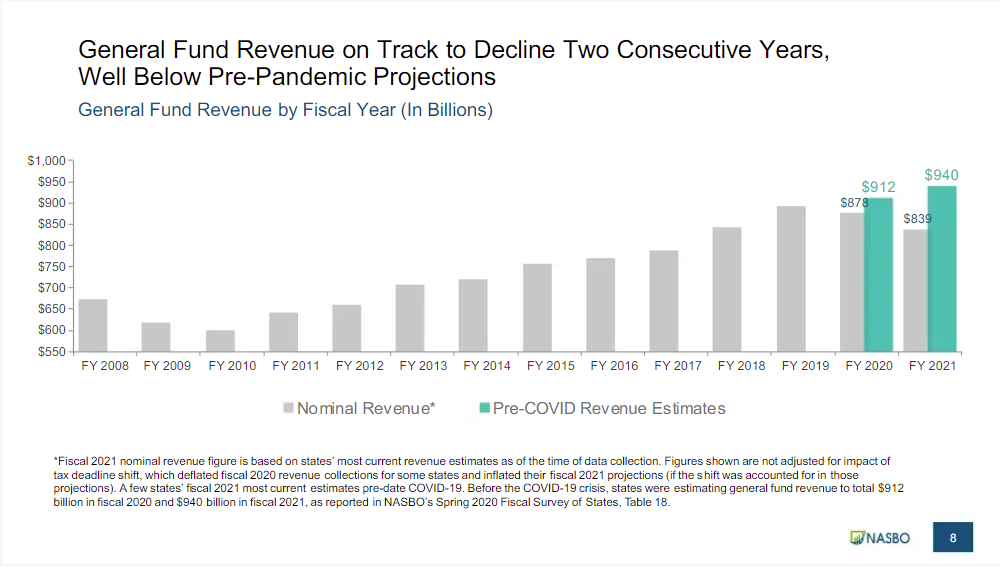
➀ COVID-fueled revenue losses are real – but not as extreme as feared. General fund revenue for states is on track to decline for two consecutive years, as COVID restrictions shut down wide swaths of state economies. The gulf between pre-COVID estimates and current ones is wide: $940 billion then, $839 billion now. However, things are looking better than once feared. “Immediately after coronavirus spread throughout the country, in that spring 2020 period, we saw a number of states sharply reduce their revenue forecasts,” said Brian Sigritz, director of state fiscal studies for the National Association of State Budget Officers. “Some states are anticipating up to 20% revenue declines. And by and large, those level of revenue declines have not occurred.”
➁ Recovery is uneven, often depending on when and how hard a state was hit by COVID. Shelby Kerns, executive director of the National Association of State Budget Officers, said that energy producing states and those dependent on tourism or with higher unemployment rates have been hit the hardest, as well as states with economies that are more reliant on services. “There’s still a lot of uncertainty, and still a lot of unevenness from state to state and from worker to worker, family to family,” she said.
➂ A state’s tax structure will influence when a state experiences COVID pain. States that rely heavily on sales taxes tend to be hurt by an economic slowdown first – as retail and hospitality sales dry up, so do associated sales taxes. “In personal income taxes, you don’t see the impact till later on,” Sigritz said. Data on state tax and other revenue is collected by the National Association of State Budget Officers and available in its Fiscal Survey of States.
➃ States have trimmed their budgets for fiscal 2021. General fund spending for fiscal 2021 will be 5.5% less that governors proposed before COVID appeared. It’s the first time since the Great Recession of 2007-2009 that spending has dropped. The biggest cuts in spending have come out of K-12 education. To address COVID shortfalls, 19 states made mid-year budget reductions in fiscal 2020. They also tapped rainy day funds.
➄ Full recovery can take a long time. The Great Recession of 2007-2009 also decimated state budgets, sending tax revenue down 12.5%. It wasn’t until 2013 that revenue got back to its 2008 level – and for some states, the wait was even longer. Barb Rosewicz, project director for state fiscal health at the Pew Charitable Trusts, said that reporters should explore how states responded to the last fiscal crisis for clues as to what might happen this time. For example, some states built and maintained rainy day funds, while others – New Jersey is a chief example – has little or no rainy-day money heading into COVID and have already spent it.
This program was funded by Arnold Ventures. NPF is solely responsible for the content.