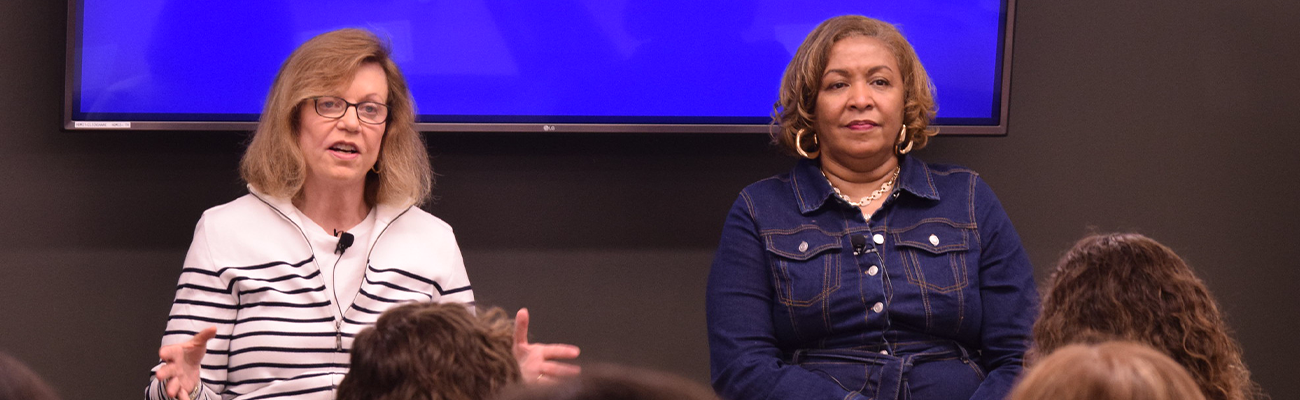
Politics and journalism benefit from the “lived experience” of women, yet true gender equity remains elusive, two trail-blazing women reporters told the 2024 National Press Foundation Women in Politics Journalism Fellowship.
Sonya Ross, editor-in-chief of Black Women Unmuted, and Susan Page, Washington Bureau chief at USA Today, said that while the numbers have improved since both arrived in Washington decades ago, the imbalance remains in both American institutions.
“So, given the day of the week, sometimes I feel like we’ve made this great progress, and sometimes I feel like there are so many obstacles and so much further that we need to go,” Page said.
Citing political gains since 1979, when few women held positions of power in state capitals and Congress, Page said women are bringing more than just numbers to the table.
“It’s more than a numbers game because many women have different priorities and different ways of operating than men do,” Page said. “That’s not true of every woman and every man, but it is true with some broad strokes … to issues like child-care and education and healthcare.”
Continued transformations also are needed in America’s newsrooms.
“Lived experience matters, and sometimes there is resistance to your lived experience in forming your journalism,” Ross said. “Well, having a uterus does not make you biased about politics. If you’re sitting there listening to things that you know impact women in a certain way and you know that because you’re a woman, that can’t possibly be bias. That is informed lived experience governing how you cover something.
“Otherwise, you have this homogenous approach to journalism that forces you to suppress that, when suppression is not always the best thing for that set of facts.”
In both politics and journalism, the journalists said the torrent of abuse leveled at women is posing a challenge.
“The amount of harassment to women politicians and women journalists on social media is quite extraordinary,” Page said, adding that women in both spheres “really have to figure out” strategies for when a response is appropriate or necessary.
Ross said much of the abuse is an attempt to silence the target.
“I’ve been targeted,” Ross said. “But I also am very aware that there is a desire to run you out; that what they want is for you to stop doing what you’re doing, to stop covering what you’re covering, to change your voice and agree with them. And denying them the satisfaction of getting me to do that keeps me going.”
Access the full transcript here.
This program is funded by Pivotal Ventures. NPF is solely responsible for the content.