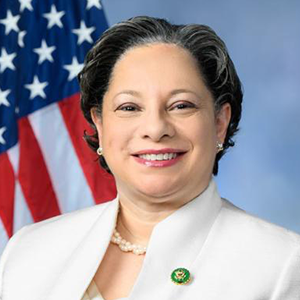
After her historic 2023 election as the first Black woman to represent the state of Virginia in the U.S. Congress, Jennifer McClellan knew she would use her father’s Bible for her swearing in ceremony. She remembers looking through it on Jan. 5, 2021, and finding an envelope containing a receipt from one of his trips to a Virginia polling station.
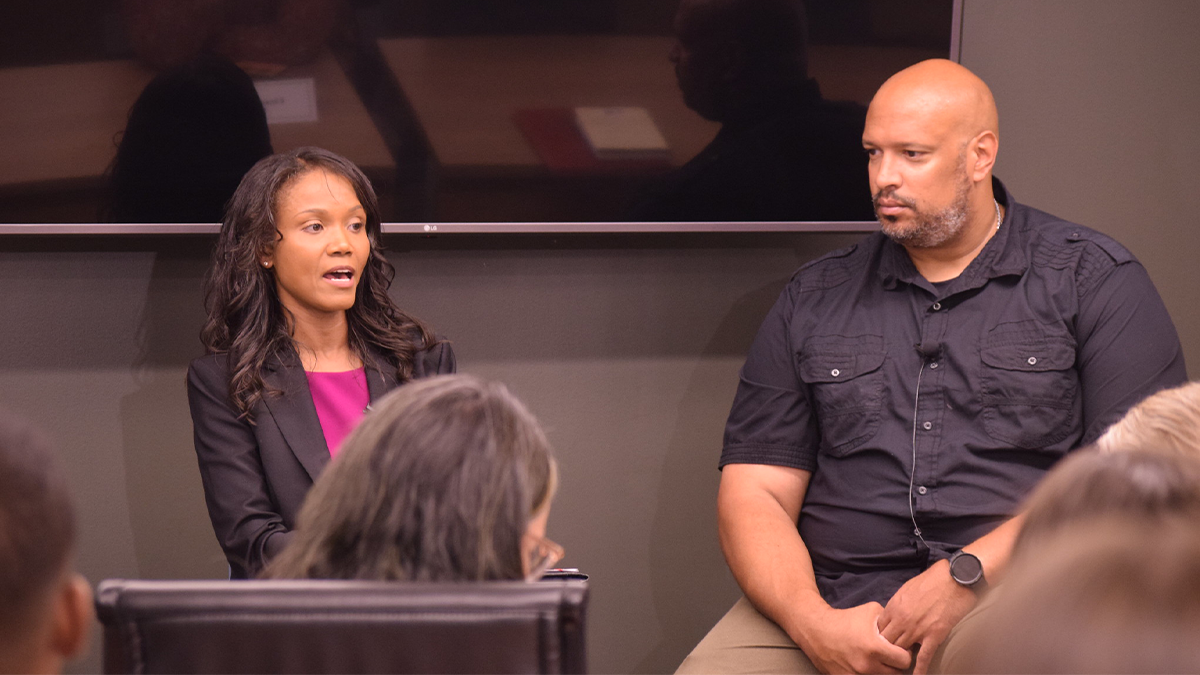
“Does anybody know the significance of Jan. 5, 2021?” McClellan asked the 20 journalists selected for the 2024 National Press Foundation Women in Politics Journalism Fellowship during her keynote session. “The 5th was the night that Georgia elected the first Black man and the first Jewish man to the U.S. Senate. And the next day we were going to see the first Black woman certified as Vice President of the United States.”
McClellan prepared for bed thinking about her own family’s history, and how many Black Americans have succeeded due to their ancestors’ struggles for rights and human dignity. “And then what happened the next day? The next day, for the second time in American history, people tried to take by force what they couldn’t win at the ballot box.”
That anecdote was a powerful scene setter for McClellan’s session, which illuminated her political career and provided powerful context for understanding the challenges women of color face while navigating American politics.
“To me, being the first Black woman embodies that, but being the first Black woman from Virginia, the birthplace of American democracy and the birthplace of American slavery, the home of massive resistance, and the home of the first African-American man elected governor …being the first Black woman is a tremendous honor, but is also a tremendous responsibility.”
McClellan’s parents grew up during the Depression in the Jim Crow South. Her childhood yielded vivid examples of how her ancestors rose above incredible challenges.
“Hearing stories of my great-grandfather having to take a literacy test and find three white men to vouch for him to be able to register to vote in 1901, hearing my mom tell stories of growing up in the Gulf Coast of Mississippi, where she was the third youngest of 14 children and the first one in her family to go beyond the eighth grade. The school in her town that taught Black students was at the Catholic church and only went to eighth grade. So, for all of her sisters, their only option was to become a domestic and all of her brothers, their only option was to either go into the military or become laborers. And so, she had to move to Jackson and live with her sister after working for a year as a domestic just to be able to go to high school.”
Those stories sparked McClellan’s love of history, and the more she read, the more she concluded that government could both help and harm citizens. “So, when I was 11, I decided I wanted to be a part of making government that’s a force for good. Now at 11, I didn’t know what that meant. For me, I knew I was a Democrat and I knew I was that kid who watched the six o’clock news at dinner, I watched presidential debates, I followed what was happening.”
That political inclination deepened by the time McClellan entered the University of Richmond and began volunteering for the Young Democrats of America. She dreamed of being a lawyer in the Senate Judiciary Committee one day, but her first career step was at a law firm dealing with Telecom Act Implementation. When former Delegate Viola Baskerville ran for Lt. Governor in 2005, she called McClellan to ask, “‘Do you think you might ever want to run for office?’ I’m like, ‘Yeah, maybe one day.’ She’s like, “Well, that day might be here.’ It was the most Democratic district in the state, so I knew that whoever won that seat would have it probably for as long as they wanted. And the more I thought about it, the more I realized I want to be the one making the change, not just selecting other people to do it.”
McClellan won that race and entered the Virginia General Assembly as a 32-year-old Black woman from the most Democratic district – in a state legislature that was mostly white Republican men over the age of 50. She eventually became the first member of the House of Delegates to give birth while in office.
“What I very quickly learned was everyone’s political views are shaped by their life experience and what they know, be that what they learned at home, be that what they experience or what they learn at school. And so, I had to – not only with these guys, even if I didn’t agree with them and even if I was uncomfortable, I had to figure out what makes you think what you think? Why do you believe what you believe? Tell me your life experience. What makes you tick? More importantly, I had to be able to share all of that for myself.”
When people ask McClellan what pivoting from a state legislature to U.S. Congress is like, she compares it to graduating from high school and heading off to college.
“And just like in college, you find your circle, you find your sorority, you find your people. I have found a group of, there are about eight of us, who sit together on the floor who have become a little sorority and look out for each other and when we get discouraged or frustrated, we sort of check in on each other. And so, that I think really helps to get through the moments where you say, ‘Why do I keep doing this?’”
The memory of holding her father’s Bible on January 5, 2021—and watching the attack on the United States Capitol the very next day—provides another powerful “why” for McClellan.
“And in that moment, I realized something that hit home to me for the first time during COVID as I was watching the video of George Floyd’s murder. I am fighting the same fights that my parents, my grandparents, and my great-grandparents fought. In that moment, I could have felt overwhelmed and frustrated and disgusted and give up.
“But in that moment, I found the strength to realize, I fight these fights so that my daughter and my son don’t have to. I fight those fights knowing I fight them from a position of more strength than my parents, my grandparents, and my great-grandparents ever could have imagined. And I fight those fights so that if my children have to fight them, they fight them from a position of more strength than I have today.”
Access the full transcript here.
This program is funded by Pivotal Ventures. NPF is solely responsible for the content.