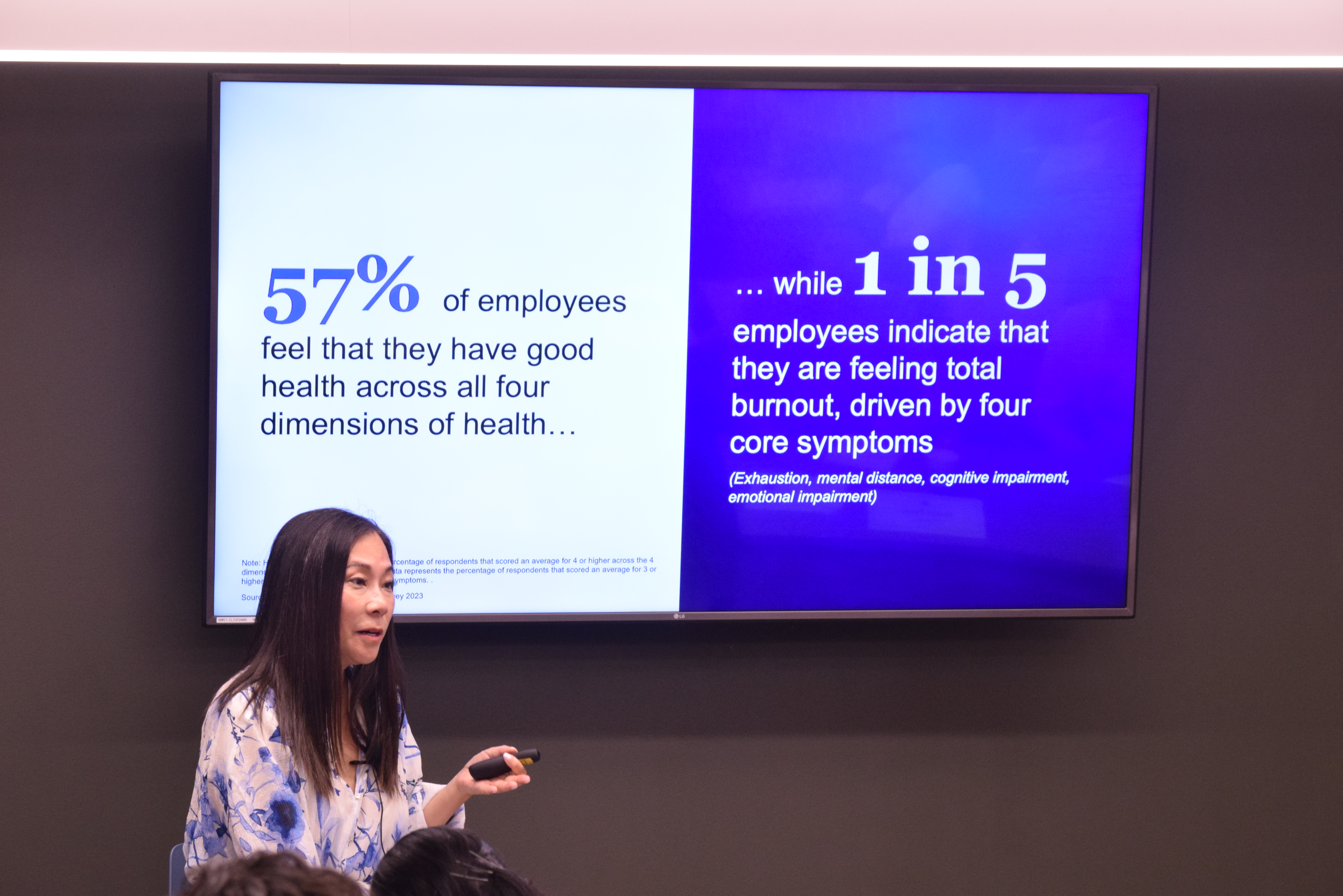
When it comes to workplace mental health and well-being, challenges for early-career workers are often extremely different from those on the other end of the employee journey. Because there are now five generations coexisting in the American workplace, there’s a new and complex dynamic that employers must navigate.
But during the Covering Workplace Mental Health Journalism Fellowship, a central message emerged. Betsy Schwartz, senior director of the American Psychiatric Association Foundation’s Center for Workplace Mental Health, urged fellows to remember an important common theme.
“The future of the American society and culture is driven by attention to mental health, and that all of human potential is only really tapped when we as a society recognize the importance of mental health.”
Journalists must move past the tropes about generational differences to more fully grasp what’s at stake, Schwartz said. She highlighted some key factors to consider:
- Workplace mental health is a critical business issue with significant financial and productivity costs for companies that fail to address it.
- The engagement and retention of younger employees depends heavily on an organization’s ability to connect daily tasks to a meaningful mission and purpose. “Gen Z would take a pay cut if it meant increased meaning and connection to the mission,” Schwartz said. “So if pay is less important than mission, that’s something that employers really need to focus on and play to that reality.”
- Supporting the growing population of employee caregivers through flexibility and comprehensive benefits is not just the right thing to do, but a strategic necessity to retain valuable talent. Schwartz shared her personal experience of caring for her sister who had a massive stroke six months ago, and how she has assumed the main responsibility of caring for her. “I can tell you that my multitasking has gone into really high gear yet and my employer has given me so much flexibility and support that it’s made all the difference in the world.”
Managers are the most critical factor in an employee’s experience, and Schwartz said training them in empathy and mental health awareness is one of the most effective investments a company can make.
“The APA did a survey just last year that showed that when companies invested in training managers in mental health, it had a positive impact on the overall culture. So the training that we offer at the Center for Workplace Mental Health that I mentioned, Notice, Talk, Act at Work, It offers very informative, practical ways of interacting online in a course that can teach someone basic skills. There’s a lot of training programs out there that really help people learn concrete skills.”
Access the full transcript here.
This program is sponsored by the Luv U Project, with associate sponsor the American Psychological Association. The National Press Foundation is solely responsible for its content.