As America continues to absorb the horror of mass shootings, such as the Dec. 16 school shooting in Madison, Wisconsin, journalists must maintain their equilibrium when reporting on tragedies while effectively communicating the impact on communities.
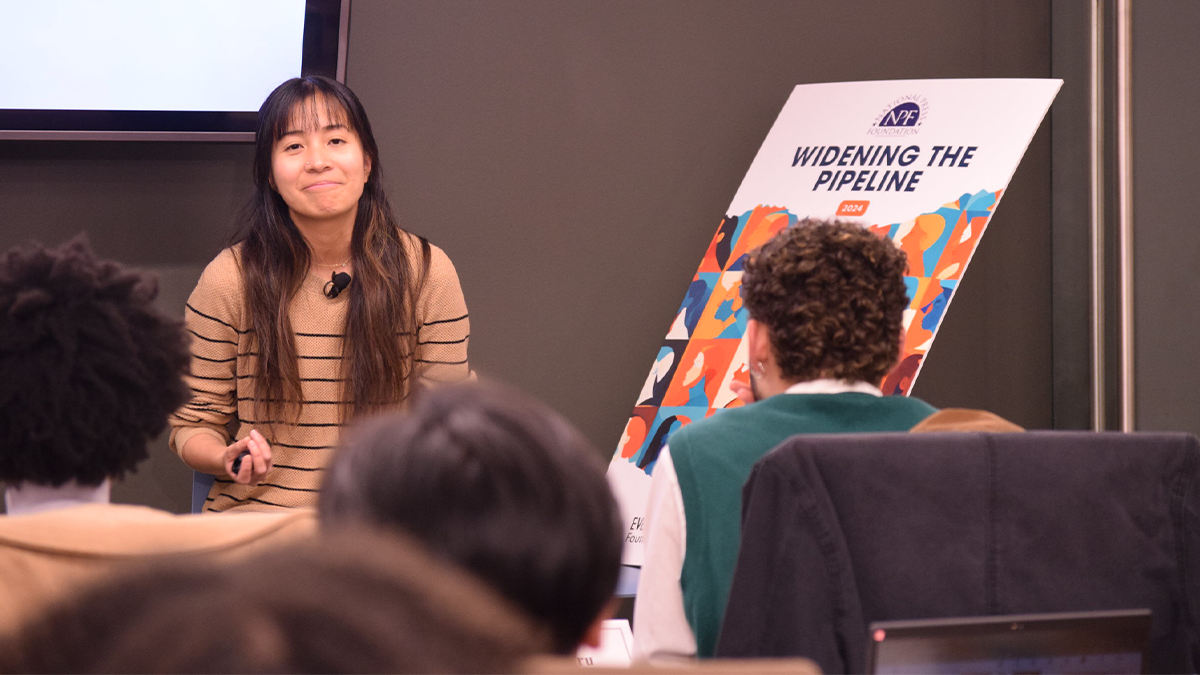
Silvia Foster-Frau, The Washington Post’s Pulitzer Prize-winning national investigative reporter, spoke with Widening the Pipeline fellows on Dec. 9 about her experiences covering incidents like the 2017 mass shooting that killed 26 people and wounded 22 others at a church in Sutherland Springs, Texas.
Foster-Frau had been working on a story about an annual fair when her San Antonio Express News editor called about the shooting. “And I got there and there were ambulances and police cars and people’s bodies being pulled out of this small church in Sutherland Springs. And so this was … the first story I did on that community,”
The tragedy yielded a new focus for Foster-Frau, that of reporting on how a community recovers from a horrific event.
“One man, John Holcomb, lost three children, his pregnant wife, both of his parents, his brother and his niece in the shooting. And the gunman who killed himself after the shooting was the husband of a woman whose family attended the church. So people knew him and he was part of the community.”
She earned a daunting new reputation.
“I became this kind of go-to reporter for covering this story. And as a local reporter, you stay a lot longer usually than national reporters do, right? You stick with it. It’s in your backyard. It’s the people that you write for that are affected by it. And so I stuck with this story and kind of made myself the main person.”
Covering mass shootings was difficult for Foster-Frau, but she found comfort in knowing she was raising awareness about the epidemic.
“Feeling like I’m doing something and not just being helpless to this horrible situation can sometimes really be the thing that helps get you out of it,” Foster-Frau said. “I also have creative outlets that I try to use completely outside of work to just help process.”
Foster-Frau also found comfort in supporting other journalists who covered mass shootings by sending care packages. Social media was another way to reach out.
“I connected with a reporter at the Orlando Sentinel, and we started this Facebook group called Journalists Covering Trauma so that we could all … talk about what it was like,” she said.
Foster-Frau also talked about her move to The Washington Post for a job covering multicultural issues. Her childhood in Galesburg, Illinois, her mother’s Puerto Rican heritage and father’s Iowa roots prepared her for the challenge.
“I definitely felt like our family were kind of outsiders to our community, and it’s actually something that now I’ve come to really value,” she said. “It obviously presents its challenges growing up, especially, but now I see that it offered me this really unique perspective and ability to kind of move between different worlds that I think really has benefited me as a reporter.”
Foster-Frau says being part of the Post’s Pulitzer Prize-winning project about AR-15 weapons was surreal.
“When I found out the news and was absorbing and processing it, I felt so proud of my younger self. Because when I was young and wanting to be a journalist, I didn’t have a lot of examples of that in my bubble of the universe, and it sounded so far away just so unimaginably out of reach. And so to have then gone through the years of life and just doing the day in and out of reporting to have wound up eventually where getting to a point where you realize, oh, I’m at The Washington Post.”
Access the full transcript here.
This fellowship is sponsored by the Evelyn Y. Davis Foundation and Lenovo. NPF is solely responsible for the content.