Veteran sports journalist, author and entrepreneur Jemele Hill remembers a time right after graduating from Michigan State University, when when she was juggling internships and trying to leverage them with an actual job offer. The situation called for some fancy footwork.
“I did go back to them and say, ‘Hey, they offered me more than what you guys offered me.’ So they counter-offered. I was like, all right, I can’t do this too many times. Even though I’m young and brash, I’m also a little self-aware. And I talked to some other people on staff who also started as interns.”
Those conversations resulted in her first full-time job as a sports reporter with the Raleigh News and Observer, and the rest is sports journalism history.
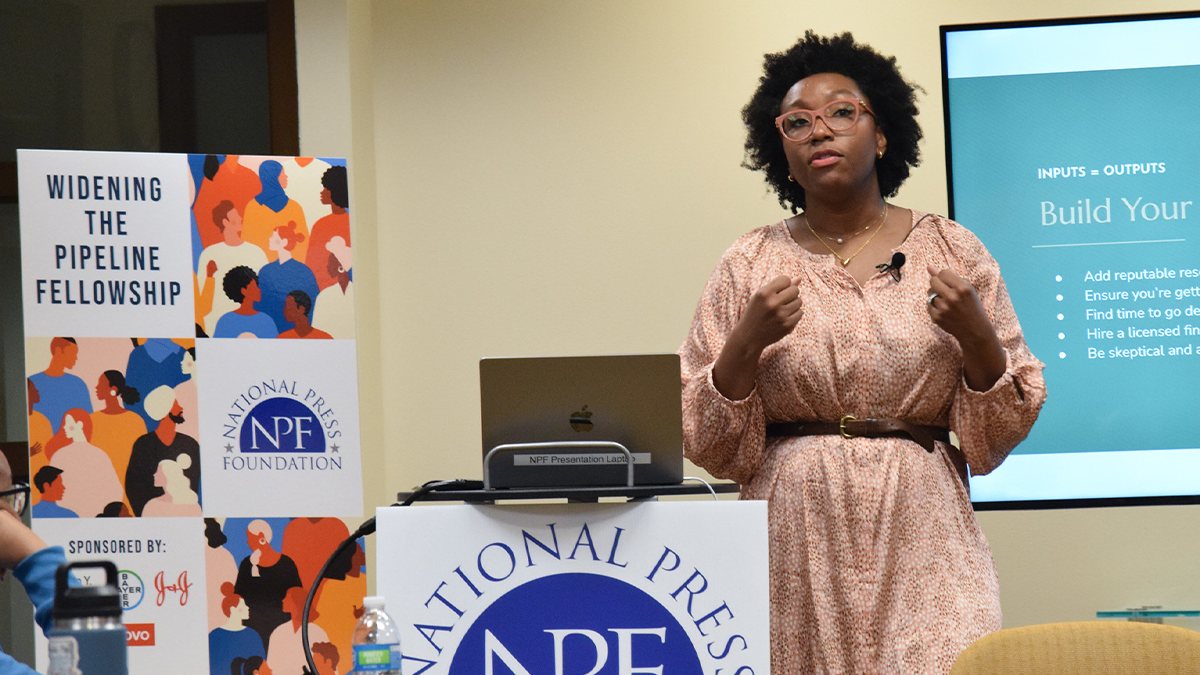
As one of the first Black women sports columnists in America, Hill provided valuable perspective on mapping out a career strategy for NPF Widening the Pipeline fellows. She has traveled from local newsrooms to the heights of national broadcast television, where she co-hosted ESPN’s SportsCenter. After publishing a memoir (Uphill, 2022), producing a documentary about football player and activist Colin Kaepernick, and now hosting the “Spolitics” podcast, Hill has powerful insights about testing your market value as a journalists and doubling down on yourself.
3 Key Takeaways:
1) Women have to speak up more
Hill says she learned a lot from reading former Meta COO Sheryl Sandberg’s book Lean In: Women, Work and the Will to Lead. At one point, Sandberg recounted how whenever there was a new position or a new project, all the men in the room would raise their hands, even if they had no experience.
“The women who were more experienced than them tended to not do that,” Hill said. “(Sandberg) realized that a lot of women have that fear of being exposed, if you will, and so what we will do is if a job has a hundred qualifications, we could meet 90 of those – but we’re focused on the 10 ways we don’t maybe fit the qualifications or maybe the little bit of experience that we don’t have. Meanwhile, a dude will have 10 of those qualifications. They’ll be like, ‘I’m applying anyway.’
“So that’s why I always say to myself, over and over, ‘God, please give me the irrational confidence of a man.’ No offense, men. But I think men are naturally, that kind of confidence is more conditioned and encouraged in them.”
2) Be careful chasing ‘dream jobs’
Just as Hill was getting into the groove of her Raleigh News and Observer job, the opportunity of a lifetime seemed to emerge when Sports Illustrated came calling.
“I dreamed of working at Sports Illustrated because I saw myself very much as a writer. And that’s where the elite sports writers in my mind went to work for.”
The job they offered Hill was that of writer-reporter.
“I asked them, ‘what does that mean exactly?’ And when they gave me the job description, it’s like, you’re kind of a glorified copy editor. I didn’t get in this to do that, right? I wanted to write stories for the magazine and long form stories that really resonated and made a deep impact. That’s what Sports Illustrated was really known for. And as much as that was my dream place, it was not my dream job. And there is a difference.”
Hill warned against sacrificing career development for the sheen of a high-profile company name.
“You can be at a great place that you’ve always dreamed of working, but if you’re not doing the thing you want to do, what’s the point of going there?”
3) Silence is NOT Golden
Those negotiations for her first full-time job taught Hill an important lesson she never forgot: “the value of sharing your salary.”
“I know it’s something that we’re taught not to do or people think it’s impolite or there’s a taboo around it, but these newsrooms and these companies kind of rely on the silence and they use that part of it against you because they think you won’t ask the question.”
Access the full transcript here.
The year-long Widening the Pipeline Fellowship for journalists of color is sponsored by the Evelyn Y. Davis Foundation. The National Press Foundation is responsible for its content.