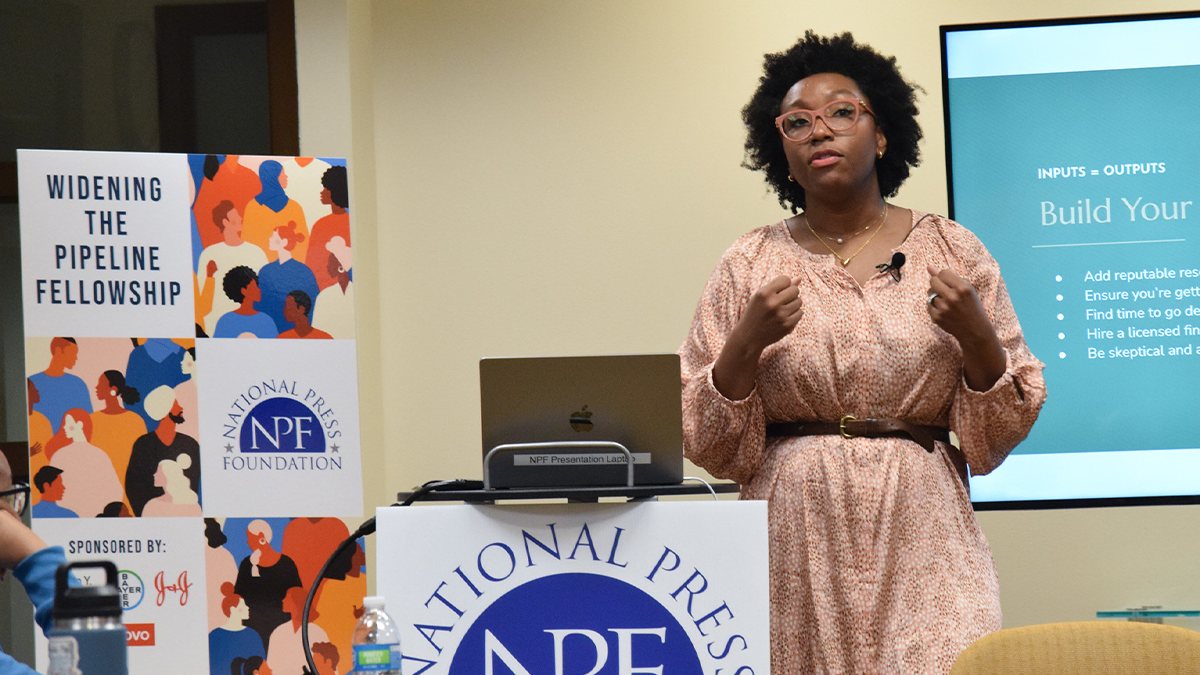
Finding your place and owning your expertise can be a complex journey for journalists of color. And there’s an added conundrum: knowing when to stay and navigate a challenge or when it’s time to leave a toxic workplace. Larry Graham, the founder and executive director of The Diversity Pledge Institute, spoke with NPF’s Widening the Pipeline fellows about how to calibrate career timing.
3 key takeaways:
1. Know when to move on
Knowing when to move on is key to navigating a toxic newsroom because staying in a job that isn’t fueling growth is counterproductive, Graham said.
However, before doing this, try speaking up first.
“You really have just a couple of options: to speak up, speak loudly, do it repeatedly,” Graham said.
If you’re not heard, it’s a “hard pass.”
Graham compares a bad job to a bad meal, like a beet sandwich.
“In these types of situations where we’re feeling marginalized, we’re feeling downgraded, we go for a second bite, a third bite, we’ve eaten half that sandwich.”
Graham’s point: Why put up with something that’s not for you?
2. Research potential employers
Graham said he has left organizations over salary, but that there are also other factors to consider.
“Like anything else, it depends on leadership. What is it? Financial acumen, business acumen, and the quality of the work and the communities they serve.”
Looking at a company’s overall track record and mode of operation will often yield the kind of intel that can guide your career strategy.
With diversity, especially with the DEI backlash, “it is less about what a lot of organizations are saying and more about what their actions indicate who they are,” he said.
Graham has found non-profits to be a good place to learn how to identify what a company truly stands for.
“A lot of times with that … mission, vision, values, you get a good sense of who they are, who they’re providing coverage for [and] why they’re doing it,” he said.
He recommends doing the research to determine whether a non-profit newsroom is financially stable. Also, don’t be quick to dismiss grant-funded jobs, especially if they cover multiple years.
“The grant is specifically for this position. That’s job security in a very shaky job market if you ask me,” Graham said.
3. Prioritize community
Rather than a “what’s in it for me?” focus, Graham encourages building community in his work leading DPI.
“I don’t see how you can truly, truly create community in journalism if it’s always a transactional relationship,” he said. “I stress the importance to everybody that I’m trying to prioritize … community over profit.”
Read the full transcript.
The year-long Widening the Pipeline Fellowship for journalists of color is sponsored by the Evelyn Y. Davis Foundation. The National Press Foundation is responsible for its content.