Community development often comes down to funding. Starting a business or buying a home is something that can be challenging, especially for people who are denied opportunities for loans or live in communities with poor infrastructure and few resources. Angie Main, the executive director for Native American Community Development Corporation (NACDC) Financial Services, works to make this process easier for Indigenous communities as well as those off of reservations in Montana.
NACDC’s projects include a workforce and professional development initiative, and a revolving loan fund of $45 million, one of the largest ever granted to a Native Community Development Financial Institution (CDFI). A CDFI helps support economically disadvantaged communities by offering resources and programs which invest federal dollars alongside private sector capital.
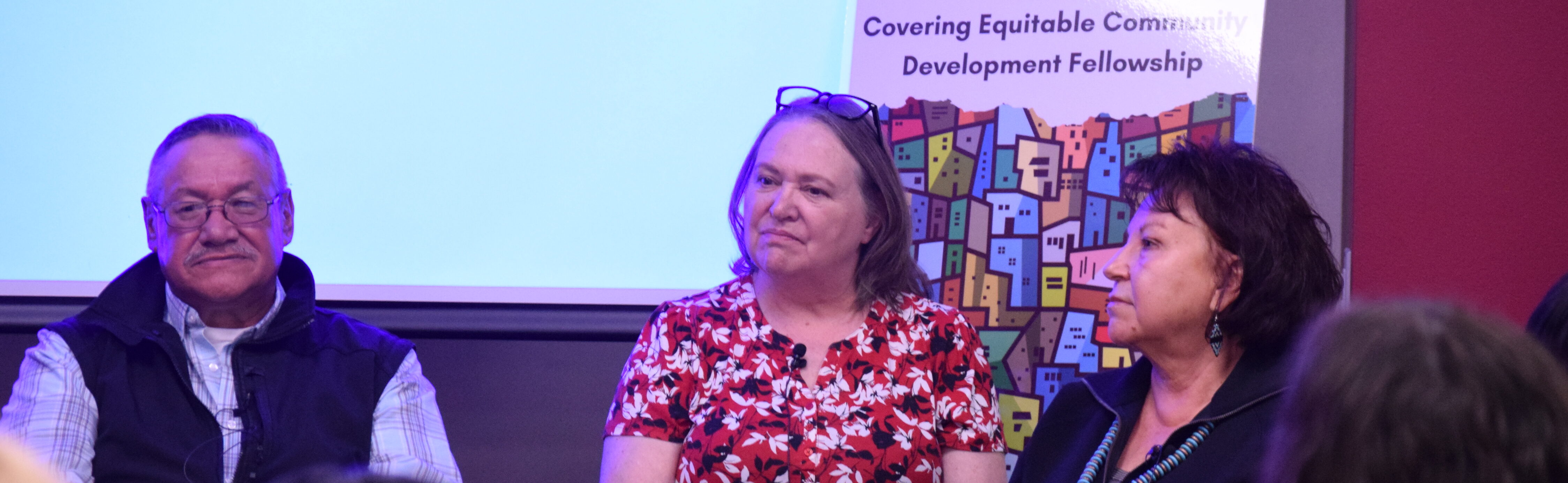
Main, a member of the Gros Ventre tribe, spoke to NPF Covering Equitable Community Development fellows about how they work to “close that racial wealth gap.” The reservation poverty rate for Indian families is 36%, compared to the national family poverty rate of 9%, according to the U.S. Department of Health & Human Services.
“We’re trying to work with mainstream finance industry so that they will invest in us, they can trust us. Actually, trust being the biggest word because right now there’s not a whole lot of trust between Native American communities and mainstream institutions and vice versa,” Main said.
Part of what sets CDFIs apart from traditional banks is the focus on community – and that means being on the ground.
“We are mitigators of risk. … We work in those communities. We know those people. When it comes time to make a payment or whatever, we see them at football games, we see them at basketball games. We can say, ‘Hey, you got a payment coming up.'”
Main was joined by Gary and Susan Racine, a couple who financed two businesses with support from NACDC. When Gary was laid off from his job with the Blackfeet tribe in 2014, he saw a notice about a small fast food business for sale in Cut Bank, Montana, just outside the reservation. But getting funding was a big problem, Gary said.
“I went to different banks off the reservation, different communities. And the loan was for $60,000. And every bank that I went to basically turned me down. They say that it was because that there was not property attached to the business, it was just the business alone because the business was inside of a mall.”
A chance enounter with a NACDC staff member got them started through the process of learning about financing, and then getting approved.
“In the end, it turned out to be a good, little business. It didn’t make a lot of money, but it served the community and it served the people, and people from Browning and all over Indian country,” Gary Racine said.
This is why Main is pushing for more investors, for instance, in Indigenous-developed housing.
“When you make an investment into our organization, you not only invest in an organization, you invest in a community.”
Access the full transcript here.
The Covering Equitable Community Development journalism fellowship was sponsored by the Robert Wood Johnson Foundation. The National Press Foundation is solely responsible for its content.