President Trump has deployed National Guard troops to Los Angeles, Washington, D.C., Memphis and Chicago, attempted to do so in Portland and suggested that San Francisco, Oakland, New York, Baltimore, New Orleans and St. Louis may be next. But it’s the nation’s capital that has seen the most prolonged deployment, ongoing since Aug. 11. Currently, more than 970 D.C. National Guard troops remain deployed and nearly 1,500 out-of-state troops, although lawsuits have been filed to remove both.
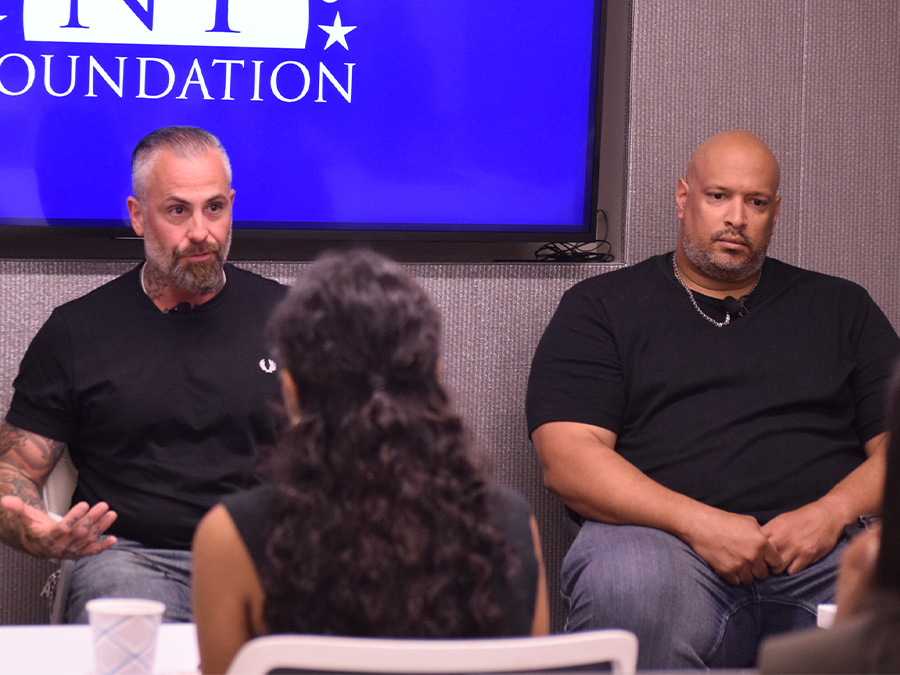
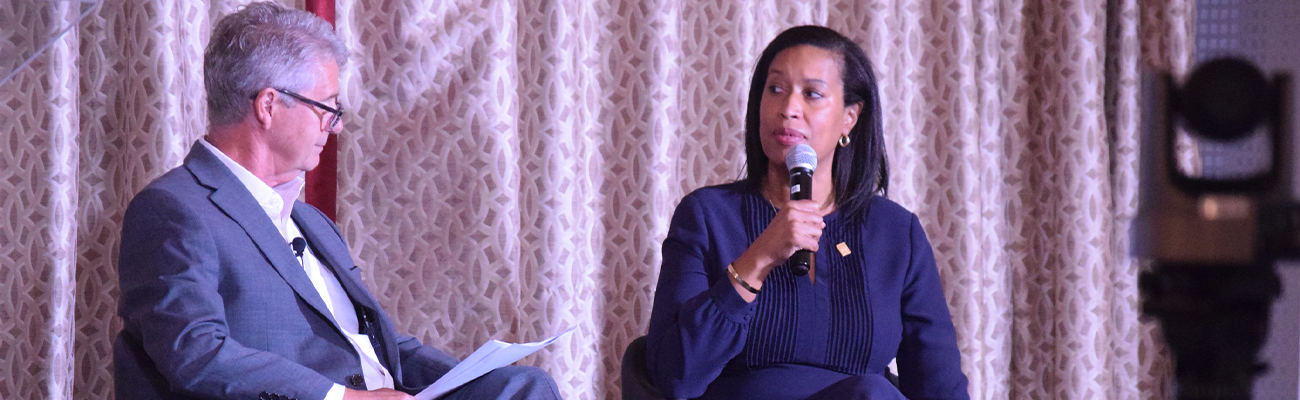
“We don’t want out-state guard here. We don’t want people to be accustomed to long guns or military policing them, so I’m not telling them to ever think that that is normal,” D.C. Mayor Muriel Bowser told National Press Foundation journalism fellows Oct. 8. “But the National Guard captures a lot of attention. It is the immigration enforcement that has been the most destructive here … people are dead concerned about ICE and their tactics.”
Bowser, who has spent 10 years as mayor and another decade in city council and neighborhood commissions, has been on the front lines of the Trump administration’s impact on cities – especially those with Democratic leaders and majorities. “I think one of the big things that other cities can do, especially that haven’t had this incursion yet … is they could look at D.C.”
Bowser said the progress that had been made in growing trust between D.C. residents and the Metropolitan Police Department “has been terribly disrupted by the presidential emergency,” in part because “anybody in a uniform is the same for some people” and they’re not distinguishing between MPD, ICE, DEA, National Guard and others.
“It was purported that ICE would be used to go after criminals, and that’s not what we see happening,” Bowser said. “We see ICE going after any and everybody.”
After the Jan. 6, 2021 insurrection, there was a push for the D.C. National Guard to be moved under the D.C. mayor, but it failed. “That should and must happen,” Bowser said. “The D.C. National Guard is basically misnamed. … It’s the President’s Guard, the president of the United States controls the D.C. National Guard,” Bowser said.
The District of Columbia lacks a voting representative in Congress, despite having a larger population than Vermont and Wyoming.
“The mayor of D.C. is mayor, county executive and governor all at once,” she said. When it comes to the federal government, “I think our relationship, regardless of who’s in power, is defined by proximity and vulnerability.”
That vulnerability has played out not only in terms of law enforcement, but the economy.
“The shift in our economy caused by DOGE, first and foremost, is probably the greatest threat to the city’s economic future,” Bowser said. In a Washington Post poll from May more than 1 in 5 D.C. residents said they were considering moving – that nearly doubled among families who had lost an income due to DOGE cuts.
These events have renewed local advocacy for D.C. Statehood, also known as the #FreeDC movement, but it is unlikely to gain support in the Republican-controlled Congress.
Despite these challenges, Bowser said “the single hardest problem that I have confronted in government” is homelessness.
After the National Guard deployment, the Trump administration said it cleared 50 homeless encampments in the District.
“A lot of the park space in D.C. is federal, not local. And so we have worked with the Park Service on enforcing their no encampments on federal space. And we also are enforcing no encampments throughout the district,” Bowser said, noting that there is housing, but some people “are challenged to make good decisions for themselves, whether it is mental illness or substance misuse.”
Clearing homeless encampments is not new, but D.C. protocol gives residents two weeks’ notice, whereas federal clearing happened with much less warning.
“We’ve had some more success, frankly, with the idea that people don’t want to engage unknown force. They want to work with the outreach workers that they’re used to and accustomed to. And so we are stepping up our process,” Bowser said.
Access the full transcript here.
This program is sponsored by Arnold Ventures. NPF is solely responsible for the content.