Four years ago, Tom Manger was “happily retired” after more than four decades in law enforcement when he was transfixed by the startling images streaming across his home television screen.
“I’m looking and there’s a live shot of the Capitol being attacked,” the longtime police official told the National Press Foundation’s Paul Miller Washington Reporting Fellowship class. “For the next two hours, I just stood there. I was alternately in tears. I was screaming at the top of my lungs. I was angry. And it was the first time in all the time that I’d been retired that I wished I was not retired. I wish I was back. How could this happen?”
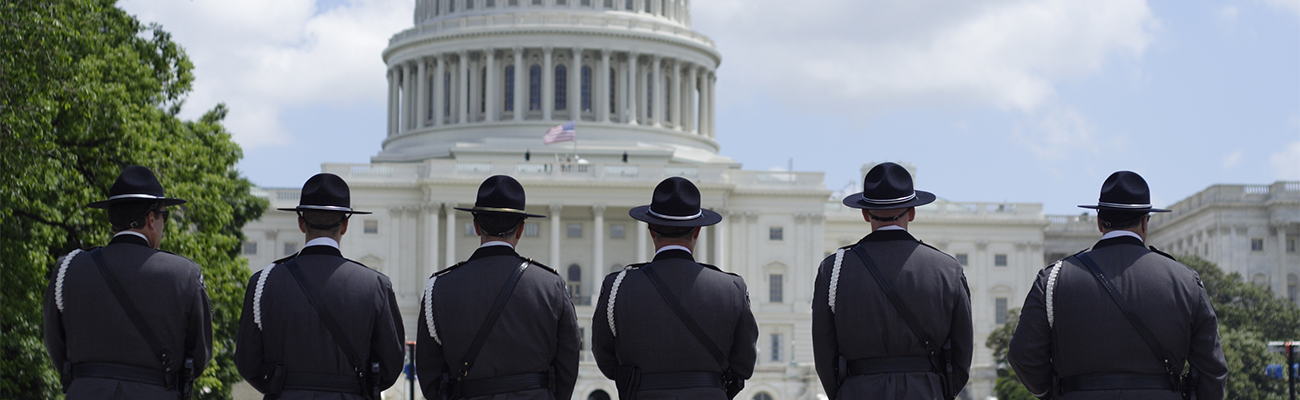
Six months after that stunning assault, Manger was back in the fight, leading the agency most devastated by the failed attempt to overthrow the government – the U.S. Capitol Police Department.
Almost every decision since then in the years-long effort to restore the agency has been informed by those chilling images of a then-unprepared and overwhelmed police force whose officers were abused and beaten while protecting the seat of American democracy.
Threats to Congress Skyrocket
Even as the department has focused on providing badly needed training and bolstering recruitment, Manger said the threat of political violence has only increased since 2021.
Last year, the department recorded 9,000 threats against members of Congress, likely an all-time high, and a world away from the 2,000 in 2016.
“Why is that? I mean, we’ve always had people disagree on things, but today … civility has just sort of gone by the wayside; if you and I disagree on women’s right to choose, well, you’re the enemy,” the chief said.
From Assaulting an Officer to Pardon
Manger also is confronting another possible threat to the department: the prospect of pardons for rioters who stormed the Capitol, assaulting dozens of officers from both the Capitol police force and the D.C. Metropolitan Police Department.
“You cannot politicize this,” Manger said. “It’s not about … the president-elect, it’s not about Jan. 6. It’s about politicizing when a police officer does their job.”
Manger said the video from that violent day speaks for itself.
“I got cops that were just stomped, were beaten with hockey sticks. I mean, it was just brutal. They were brutalized. And so I could name you a bunch of other cases that didn’t happen on Jan. 6 – that if these people were pardoned because of the cause that they were representing, I’d be very unhappy about it,” the chief said.
With the inauguration looming, Manger said security measures have been ramped up to repel any attempt at disruption.
“I’ve spent the last three and a half years trying to get us into a position where something like Jan. 6 would never happen again,” he said.
“It’s going to be hundreds of thousands of people there and not all of ’em are there to celebrate the inauguration,” he said.
Part of the early preparation has included a broad search for officer candidates to bolster lines of defense.
“We do a much better job at selecting the right people, and I think that that’s ultimately going to help and has helped our profession,” he said.
“I’m really trying to restore the cops’ confidence in the department, and I’m trying to restore the sense of safety to the people who work on Capitol Hill. And I’m not saying it’s perfect and that every single person feels great again, but I will tell you that we’ve made huge, huge progress in both of those areas.”
Access the full transcript here.