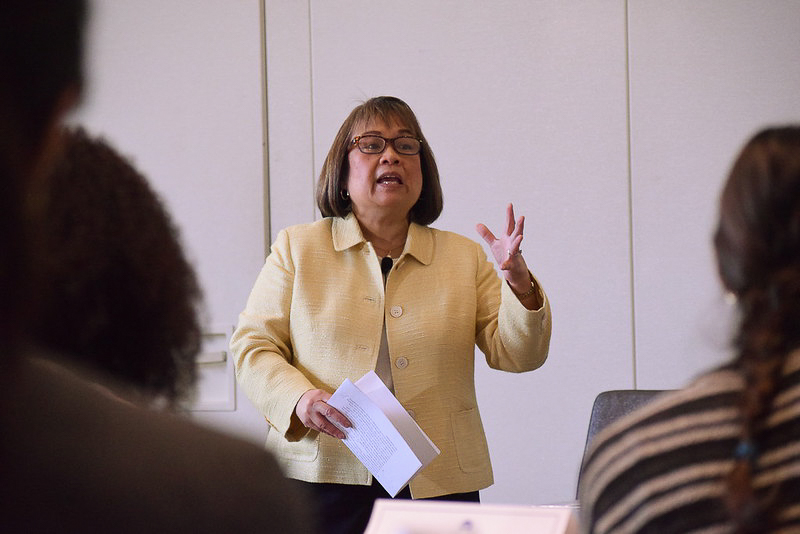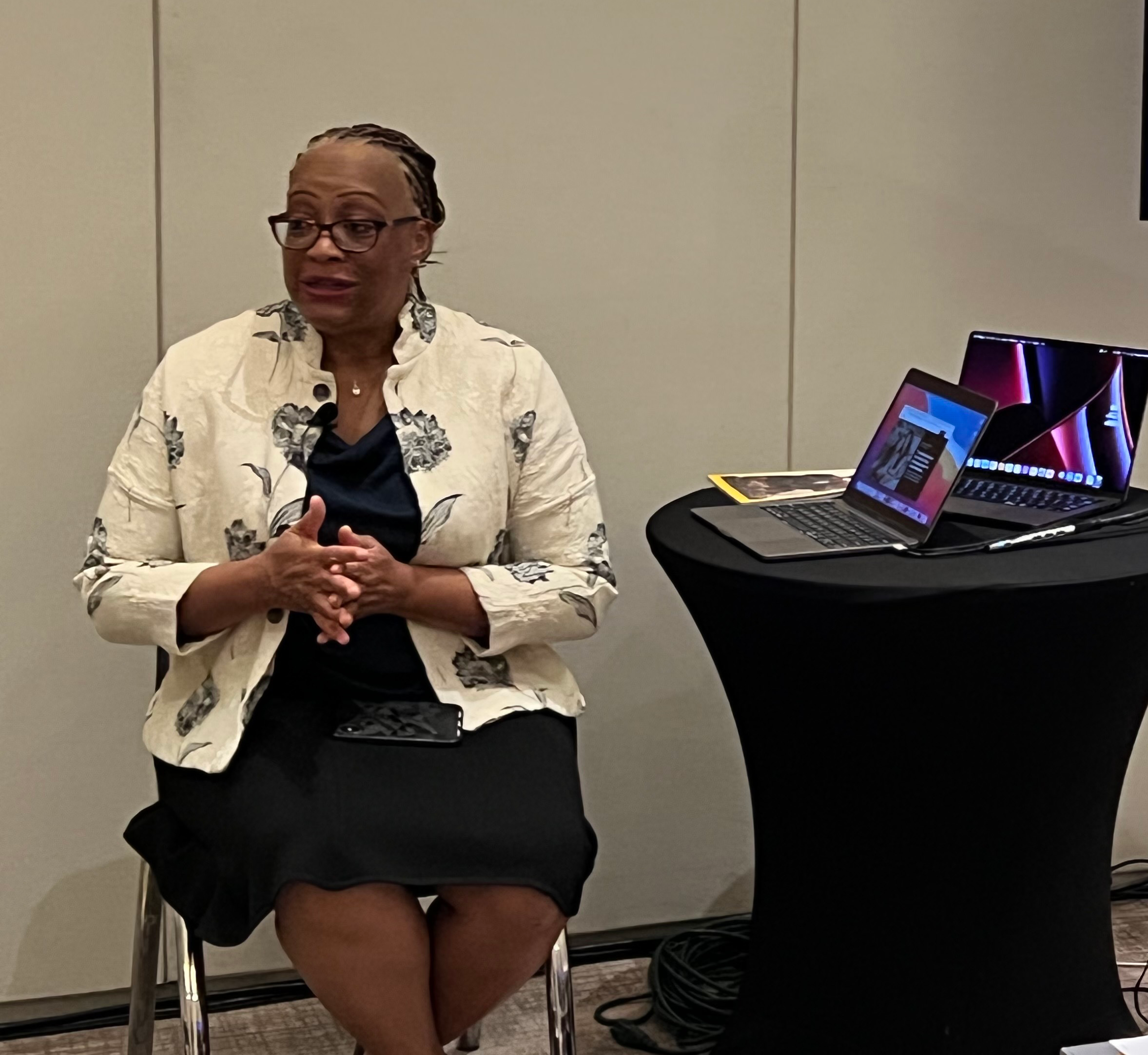
From her days as a 17-year-old page designer at the Detroit Free Press until the present, Philadelphia Inquirer food editor Jamila Robinson has held one unwavering belief: that she belongs in spaces where few journalists of color were present. Her journeys through the realms of culture and entertainment editing, content strategizing and now leading the James Beard Foundation’s diversity efforts prove that Robinson doesn’t need an engraved invitation to the decision-making tables. She shared her recipe for career success with Widening the Pipeline fellows. [Transcript | Video]
5 takeaways:
➀ Find your own tune and play it.
As a high school student learning about journalism, Robinson wanted to be a classical music critic or editor. “Because I really love, love, love, to this day helping other people with their writing and seeing how one word will change the entire movement of the story, trying to get rhythm and context and ideas, and I love that so much.
But as a Free Press journalism apprentice, editors asked her to cover pop music. She eventually became one of the first reporters to review the Motown Philly album by the Philadelphia R&B group Boyz II Men.
That pivot broadened her skill set. “This was at the center of when hip hop was really emerging and I was like, ‘Not my genre.’ And then learning how to adapt and take those skills, everything I know about music, now I can write in this whole other way.”
➁ If you can’t change the people, change the people.
In her work as an academy chair with the World’s 50 Best organizations, Robinson travels the globe working with restaurateurs.
“We are a group of tastemakers who are thinking about what are the trends? What are people cooking? How are ingredients being played? What chefs are important?”
But early on in her tenure, Robinson started noticing something peculiar. “Oh, it’s like everybody’s white, everybody’s a man. Why do these people get to decide?” Also, The World’s 50 Best Restaurants only covered Europe and Asia, and most of the restaurants in the Asian countries were all French and Italian. “Best restaurant in Singapore? French. Best restaurant in Brazil? Italian.”
Robinson couldn’t understand how the restaurants native to the geographic locations on these lists were never reflected. She was told that’s just how people vote. For Robinson, that answer wasn’t good enough.
“The World’s 50 Best has been working in the last few years to change the academy chairs for a much more diverse cohort,” Robinson said. “So there’s the Middle East and North Africa, there’s another Africa contingent,” Robinson said. “We’ve split up South America because Brazil is huge. So now when you look at The World’s 50 Best Restaurants or Asia’s 50 Best, you’re going to see more from Singapore, Taiwan, China.
“We are really changing the conversation about what is a great restaurant, who gets to decide and who are the people who are in the academy?”
➂ Breaking news intersects with food and culture a lot more than you’d think.
Robinson spoke to the Widening fellows just a few days after a chemical spill happened on the Delaware River. “We cover restaurants. Well, how are you going to get espresso if we can’t have water? How are you going to make bagels today if you don’t have water? And food is the thing that impacts everything. It impacts every sector of the economy. It affects every sector of business, so it’s a big news day for us.”
In addition to food and dining, Robinson also oversees the Inquirer’s arts and entertainment coverage. “There may be some shows that are canceled because of the water crisis, so it’s not as urgent, but the restaurant situation, it feels very, very 2020 to us today,” Robinson said. “Because we don’t know what’s going to happen and they say, ‘Well, we’ll know by midnight if the water is completely contaminated,’ and that’s going to have made the week really long.”
➃ Ask questions. Lots of them.
In 2006, when Robinson edited food and dining content for the St. Louis Post Dispatch, the paper was nominated for a James Beard Foundation award, the nation’s highest honor in culinary dining and culture.
Robinson attended the awards ceremony in New York—and noticed how few people of color were in the room. “There’s me, Tony Tipton Martin, who was the first Black food editor at a major publication, and maybe four other Black people. Almost no Asians or Asian Americans. There were no people of Latin descent at all. Almost everybody’s white, almost like 70% men and I was so confused. And what I said, “I don’t understand, how is it I’m one of the only black people here as much as we like to eat? I’m so confused.”
“All of American culture is built on the backs of black people. How are there no black people here?” Robinson said. “I went to everybody who would listen and said, ‘I don’t understand why this room looks like this.’ It was blindingly white and their response to me was, ‘Well, Jamila, since you have so much to say and you have so many questions, maybe you should be a judge.’ “
➄ Center yourself on what really matters.
Robinson isn’t saying that it’s easy to be the one person in the room who challenges the status quo. Even at her top manager career level, there’s still plenty of pushback from people who may resent her presence. But Robinson said there’s a bigger goal in mind.
“I know who I am, so push back, there’s only so far you can push me back because I know who I am,” Robinson said. “I know what I feel good about and I know who I feel comfortable with and I know what I want to see in the world. And those things are beauty, insight, inspiration, joy, and I work toward those things. I want to work for places that allow me to look for joy, beauty, insight, sweetness and light.”
The Widening the Pipeline Fellowship is sponsored by the Evelyn Y. Davis Foundation, Bayer, J&J and Lenovo. NPF is solely responsible for the content.