
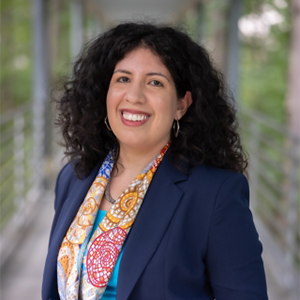
Confronting structural racism in the healthcare system and fostering robust community engagement is essential in navigating equity challenges within clinical trials, said Sandra Yankah, a postdoctoral research associate at Duke University’s Margolis Center for Health Policy.
Yankah and her colleagues Andrea Thoumi, the area lead for community health and equity, and Trevan Locke, the assistant research director, spoke to NPF’s Covering Rare Diseases fellows about what they’re doing to build equity in clinical trials.
The Margolis Center for Health Policy is working to analyze and formulate health policies that can further advance solutions in healthcare transformation, biomedical innovation and education, said Thoumi.
One major focus for researchers is clinical trial representation. They’re closely analyzing how the social determinants of health – such as economic stability, neighborhood and physical environment, education, food and community – result in inequitable trial representation.
“So, if one is an immigrant, for example in the US, your documentation status will have an effect on whether you are able to access various health insurance, whether that is private health insurance or the Medicare or Medicaid health insurance programs….”
There’s also an overrepresentation of historically marginalized people in low-wage jobs. They often have multiple jobs, making it difficult for them to participate in trials for various reasons. They may also have limited Internet access, which reduces access to digital health services. And they may live in neighborhoods with few or no pharmacies—and no public transportation.
Because of these social determinants, community engagement is essential. The goal is to confront systemic barriers and establish collaboration and shared leadership, Thoumi said.
Margolis is exploring how to improve trial representation.
In typical clinical trials, Locke said, there are three major components: preclinical testing, three phases that go through safety, efficacy and randomized studies to evaluate a new therapy, and post-market considerations. Margolis researchers believe a key strategy is the development of point-of-care trials.
“We’re trying to set up these trials ideally integrated where patients receive their normal care, so local doctor’s office, local clinics, leveraging integration with the health records that pretty much everyone is using these days to enroll patients, randomize them, collect the data, and support streamlined approaches for evidence generation,” said Locke.
There are a lot of initiatives, ideas and a strong commitment to enhancing representation, said Yankah. But in her research, she’s noticed a significant absence of coordination and accountability.
“Making clinical research representative isn’t a job for just one group,” she said. “It’s something all stakeholders need to tackle together because of the pivotal role they all play in different parts of the clinical trial enterprise.”
The following groups are stakeholders, according to Yankah:
- “We advocate for the mandatory inclusion of diversity action plans in all submitted trials. Regulators have a unique opportunity to be at the forefront of providing resources to guide the creation of high-quality plans.”
- Industry stakeholders. “Our plea is for support in creating sustainable clinical research ecosystems. By broadening our reach to local and community sites, we can enrich the diversity of participants.”
- NIH and non-industry funders. “We propose a powerful incentive, enforceable enrollment plans. NIH holds the authority to compel sponsors to align their plans with demographics and disease burden. …”
- Policy and research-oriented nonprofits. “These groups have the propensity to stand as beacons of progress, researching to establish best practices for data collection and evaluation. …”
- “We envision a transformative step, a scoring metric that reports how well-published trials meet representation expectations….
- Health systems and providers. “We urge active support for a diverse workforce trained in clinical research principles. …
- Institutional review boards. “We propose that representation expectations and community engagement be an integral part of IRB reviews, supporting a future where community-based reviews drive research, ensuring resources are directed towards areas that matter the most to local and disease communities.”
“Collectively, these actions create a framework that not only demands accountability but propels us towards a future where clinical trials are truly representative,” Yankah said.
Access the full transcript here.
This training was sponsored by Fondation Ipsen. NPF is solely responsible for the content.




 Reload document
 Open in new tab