When Willie Underwood was growing up in Gary, Indiana, he endured a stark lesson in how the path to equity can take unexpected turns. In the early 1970s, after his mother learned that restrictive covenants barring Black families from living near the lake were illegal, she began planning to buy a house in a predominantly white neighborhood. It took about a year, Underwood said, but that decision changed his life—but not all in a good way.
“I went from a private Catholic school that was all-Black that believed in educating me to make me the best person I could be, to a school that was predominantly white, and the teachers had a policy, ‘We’re not educating them,’” Underwood said. “So they took all of us, all the Black males in the school, in that third-grade class where I started, and put us in remedial classes where I’m now in kindergarten. And I was there under the guise that I had a learning disability.”
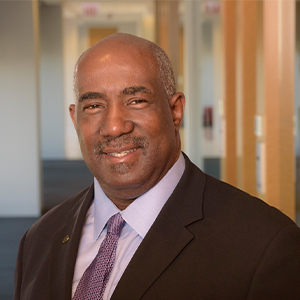
But if the teachers were giving up, Underwood’s family doubled down on their educational goals. Three graduate degrees and a host of professional awards and accomplishments later, Underwood has more than fulfilled the wishes of family elders who wanted him to become a doctor. And as the immediate past chair of the American Medical Association Board of Trustees, Underwood told NPF Covering Equitable Community Development fellows that understanding how inequity is often baked into systems is critically important for journalists covering healthcare.
For example, the goal of the Flexner Report, a 1910 evaluation of medical education in the United States and Canada commissioned by the Carnegie Corporation, was to establish uniform standards for medical education. Notably, none of the report’s investigators were Black or brown, or had experience providing care for communities of color. Prior to its publication, there were seven Black medical schools in the United States. But because of the report’s conclusions and criteria including physician income and medical school revenue, within a decade only two remained: Howard University College of Medicine in Washington, D.C., and Meharry Medical College in Nashville.
“So now you have Black physicians not being produced, and at the same time, white doctors are able to say that they’re inferior, their hospitals are inferior,” Underwood said.
At the American Medical Association, Underwood works with the Center for Health Equity to amplify the impact of racism on health care in communities.
A centerpiece of the AMA’s equity initiatives is West Side United, launched in January 2017 in Chicago. The collaboration of health care and civic institutions share ideas on how to improve health in the city’s predominantly “minority” West Side Community. The project is based on the premise that good health involves more than physical well-being to include employment, education, nutrition and mental health.
“If you get a poor education, you get a poor job,” Underwood said. “You get a poor job, you live in a poor neighborhood. And you live in a poor neighborhood, you die at least 14 years younger than everyone else who gets a good education.”
The West Side United coalition has since raised more than $175 million and created employment for more than 4,500 people, Underwood said. That’s a significant accomplishment for a community struggling to fill gaps caused by historic inequities including racist policies like redlining and lack of investment in health care facilities.
“Health inequities cost this nation depends on anywhere from $350 billion a year in direct healthcare costs, to $450 billion a year when you include loss of productivity,” Underwood said. “It’s going to be a trillion dollars in direct and indirect healthcare costs by 2040. We’re done if that happens. So we need to figure out how we put things together that change that for the betterment of all of us.”
Access the full transcript here.
The Covering Equitable Community Development journalism fellowship was sponsored by the Robert Wood Johnson Foundation. The National Press Foundation is solely responsible for its content.