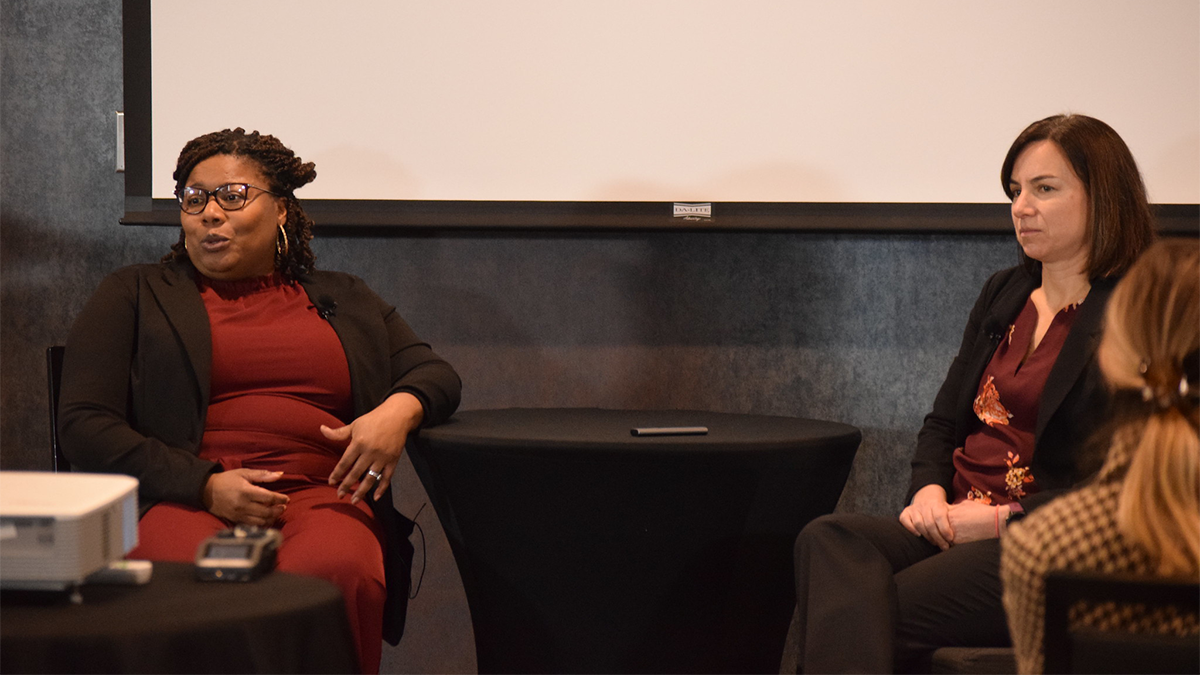
For WFAE Interim Executive Editor Ely Portillo, the biggest problem with reporting on childcare is that it often turns into a story about the “same old.” He and Janet Singerman, President and CEO of Child Care Resources Inc., spoke to NPF’s Future of the American Child Fellows in Charlotte, North Carolina about covering childcare and what still needs to be done.
“Childcare is a story about economic development,” Portillo said.
A 2022 study from the North Carolina Early Childhood Foundation found that about 400,000 working parents across the state of North Carolina are constrained by childcare needs.
“Childcare, I believe, is a story about equity — racial, gender, socioeconomic,” said Portillo. “Any lens that you look through, childcare is a major factor in whether people have access not just to economic betterment, but opportunity for their children.”
Childcare is also a story about the workforce and workers’ rights, he said. “Childcare workers are consistently the lowest, often the very lowest paid among professions that require any sort of qualifications or expertise. The workforce in childcare is largely dominated by women and women of color who are doing some of the most important work and the hardest work but receiving poverty or near poverty wages.”
Child Care Inc. is working to expand access to childcare, Singerman said.
“We work to build the capacity of the childcare workforce by delivering training and technical assistance to support quality instruction and childcare delivery. We help low-income, working families afford the cost of childcare. We administer about $94 million in childcare subsidy funds, which enable low-income families to work and their children to benefit from high-quality early care and education.”
Every day in North Carolina and elsewhere, experienced early educators are leaving for jobs that require less education and less responsibility, she said.
“In an article that appeared just yesterday, it was quoted that Costco is paying $17 an hour. Verizon is paying $20 an hour, and the median childcare worker’s salary in North Carolina is about $21,450 a year in Mecklenburg County.”
The Catch-22 of childcare is that families can’t afford to pay more and teachers can’t afford to earn less, Singerman said.
“There’s a pandemic story to tell,” she said. Childcare in North Carolina never shut down during the pandemic, which Singerman said was good because childcare became recognized as an essential service. The federal government stepped in and provided $24 billion nationally in emergency funding as part of the American Rescue Plan – North Carolina received about $1.76 million.
“Those funds were used really to stabilize the industry. The state provided two different kinds of grants, one to offset fixed operating costs and the other to address compensation. So while we were having a workforce shortage overall and people weren’t coming back to work and wages were rising and childcare wages were flat and we were losing staff, the state created a program to supplement childcare workers’ compensation. That has been very, very successful in stabilizing the industry thus far.”
However, that funding ended in October 2023.
“What’s going to happen now is here’s the $1.3 billion that we had from ARPA monies and COVID and CARES Act monies down to an annual typical federal investment of about $400 million. So that’s the funding cliff. When you talk about the funding cliff all over the country, this is what we’re talking about. How do you go from an under-financed system to begin with to a system that has increased operating costs, increased staffing costs?”
The relationship that Child Care Resources Inc. has with journalists is crucial, Singerman said.
“I look to you because you have the wonderful opportunity to influence, wonderful opportunity to articulate in an unbiased way what the real story is. However, we can help you with that real story, however these relationships can help, I encourage you to craft them in the communities that you serve.”
Access the full transcript here.
This fellowship is funded by the David and Lucile Packard Foundation, the W.K. Kellogg Foundation and the Heising-Simons Foundation. NPF is solely responsible for programming and content.