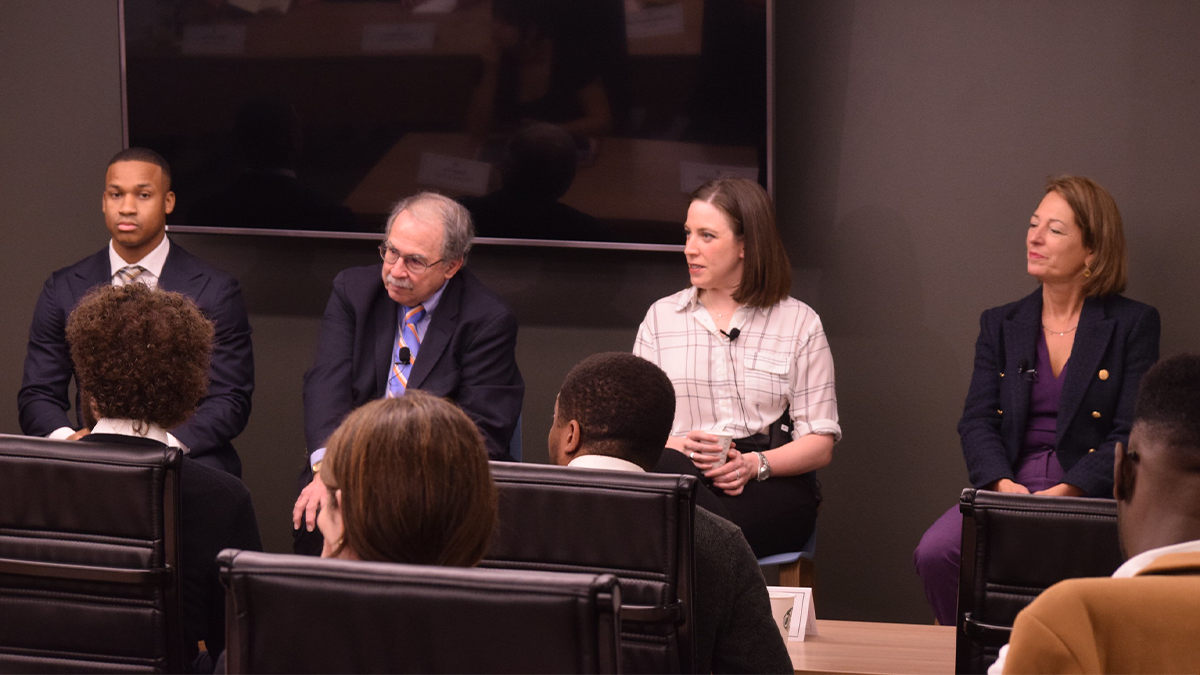
When David Maraniss prepared to launch a book project on Green Bay Packer coach Vince Lombardi, among the first questions he posed had nothing to do with the professional football hall-of-famer.
“I turned to my wife and uttered the immortal, loving words: ‘How would you like to move to Green Bay (Wisconsin) for the winter?’ ”
“Brr,” was the short answer, but ultimately, the move “made all the difference,” Maraniss said.
While the abrupt relocation may have seemed radical, the decision was an inherent part of the author’s long-established process, sharpened by decades of reporting and editing at The Washington Post. Maraniss left the newspaper earlier this year amid a furor directed at leadership under owner Jeff Bezos.
“If you’re writing about a person, you want to understand the forces that shape them,” Maraniss told the National Press Foundation’s Paul Miller Washington Reporting Fellowship class. “And you can only do that by going back to those places. If it’s a social movement again, it’s important to see where its roots were. So going there has always been essential for me.”
Vital on-the-ground reporting, Maraniss said, is part of a four-pronged strategy he has employed for most every long-form project, from books to newspapers.
It requires a full immersion in the physical and cultural context of a story; securing key documents to include public records, personal letters and journals; in-depth interviews with knowledgeable sources; and a commitment to finding the “messy truth” beyond the established narratives.
That pursuit was inspired by a longtime newspaper reporter, Maraniss’ father.
“I didn’t write my first book until I was 43 years old,” Maraniss said, having authored a dozen since. “So, I’ve always believed that you can have early success and that’s great, but it’s important whatever you’re doing to get the foundation first and learn the fundamentals as deeply as you can. And from there you can experiment. That’s true of any art form, whether it’s being a musician, a jazz musician, an artist. You learn the fundamentals first. So that’s what I did.
“I was sort of the dumbest kid in a family of really smart siblings, and they were professors and pianists, and I was the dumb one that followed my father into newspapers. But so I had that in my blood from the start. And I also, from a fairly early age, had a combination of curiosity and a love of storytelling.”
Those skills, Maraniss said, were developed in newspapers, including some early days at the Trenton Times in New Jersey, describing it as a “wonderful laboratory” where on one wild day he filed four front-page stories.
“City Hall burned down; there was a prison riot; the water filtration plant broke, and so there was no water in the whole city – and it was Labor Day or something,” he said. “So, I learned how to do anything, basically, at an early age.”
The most valuable of those lessons – being there – has always paid dividends.
Some vivid examples come from the early reporting on the Lombardi book, “When Pride Still Mattered, The Life of Vince Lombardi.”
Maraniss’ arrival in Green Bay was announced by the local newspaper, which included the author’s personal telephone number in the article – an unexpected invitation for potential sources to reach out. In short order, the author was talking to a cast from Lombardi’s past: a much older newspaper delivery boy who recalled running in fear when the local icon with the famously gruff manner answered the door on bill payment day. There was also the caddy who described some club-throwing and the coach’s habit of deducting $1 from the tip for each lost golf ball.
For a book on Bill Clinton, Maraniss spent considerable time in the president’s home state of Arkansas. Within a day after arriving at the only hotel on the edge of town, the night clerk struck up a conversation with the unfamiliar guest.
“What are you doing here?” Maraniss recalled the woman asking. His response triggered another unexpected connection.
“She said, ‘Oh, Billy Clinton, I’m his great aunt.'”
Access the full transcript here.