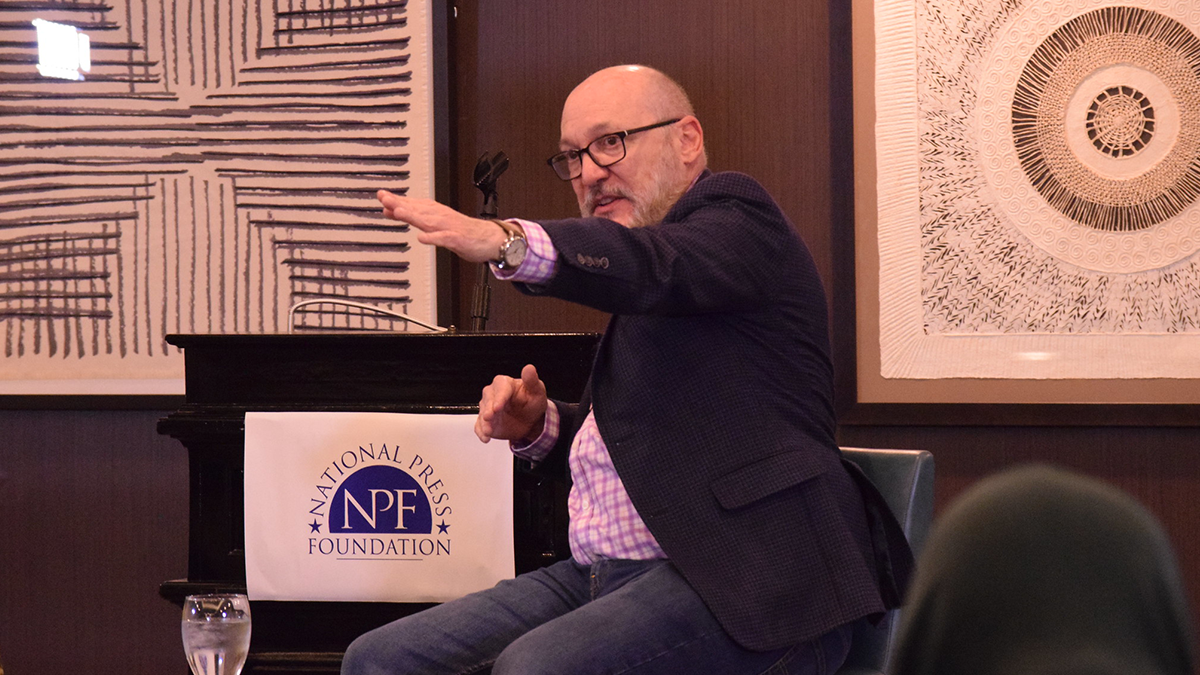
When Edward Barksdale was growing up in Lynchburg, VA, at one point he wanted to be a potter and create beautiful ceramic objects. But the only place offering lessons in town refused to accept Black students. Decades later, when Barksdale earned his credentials as one of only six African American pediatric surgeons in the country, he employed one of the artistic techniques he’d learned from his youth: Kintsugi, the art of using liquid gold to mend broken pieces of pottery.
That imagery ignited Barksdale’s vision of doing more than just repairing the physical wounds of children affected by violence and trauma. In 2019, Barksdale and collaborators developed the University Hospitals’ Antifragility Initiative, which uses a holistic approach to confront the violence many children and their families endure. He told NPF fellows that to properly heal the youngest victims of violence, communities must pour resources like mental health support into the broken places. [Transcript | Video]
5 takeaways:
➀ Strength can come from trauma.
Shortly after Barksdale arrived in Cleveland in 2015, he experienced one of the worst weeks of his entire career. In that time frame, he treated four children under age 10 who had been victims of gun violence–including a five-month-old baby whose tiny heart he’d held cupped in his hands before she eventually died.
By 2019, Barksdale and his collaborators decided to act. “I wanted to take these kids that I was seeing in the emergency room in Cleveland, and with a team of people, put them together with liquid gold.” Borrowing from the person-centered, holistic strategy of the Health Alliance for Violence Intervention, the Antifragility Initiative began offering ongoing support through neighborhood outreach. “Our program is unique because I feel that healthcare occurs in the hospital and health occurs in the community, so we go into the community.”
➁ It’s about community, equity, prevention, opportunity, and care.
Healing in the community requires another tactic, Barksdale said. “We want to reduce revictimization and retaliation. The greatest risk factor for someone shooting someone is being a victim of violence before.” The initiative also confronts toxic stress in communities and takes factors like Adverse Childhood Experiences (ACES) into consideration. “We want to improve social-emotional outcomes, and we want to make our hospital softer so that we’re not retraumatizing them,’ Barksdale said.
➂ Rapid response is critically important.
During a violence-related hospitalization, Barksdale says there’s a “teachable moment” that social workers and mental health counselors can leverage. “(It’s) the time in which the most macho man or woman is seeing a white light or seeing their vulnerability, and they’re open to education. We build a relationship.” Within 48 hours after a patient is discharged, outreach workers are following up with them and their families by phone and through home visits. “We then move to develop an understanding of who they are spiritually. I don’t mean religiously, but what’s their purpose? We help them understand their identity. Are there issues with self-esteem? The most important component of hope, I believe, is a sense of agency. We help to find if they have a sense of agency and how we can restore that.”
➃ Giving people access to urgently needed resources is key.
“We find that one of the biggest drivers, if not the biggest driver of violence for our children is food insecurity,” Barksdale said. “Our children are foraging and that brings them into harm’s way. We get them clothing, we get them housing, and we address their mental health needs by providing trauma-focused cognitive behavioral therapy.
➄ Hope can heal trauma in communities.
Barksdale said he’d been hesitant to talk about hope when he described the Antifragility Initiative until he started reading what U. S. Surgeon General Vivek Murthy has been writing about loneliness and despair. “I recognize that we’re in a difficult place in the country, and so this is our program. To heal, to hope, to be whole in our community.”
Since its launch, the Antifragility Initiative has supported 365 child victims of violence and 182 family members, Barksdale said. Of the injured children, only 10 have been injured again. And he says the mental health outreach has been extremely effective.
This fellowship is funded by the David and Lucile Packard Foundation, the W.K. Kellogg Foundation and the Heising-Simons Foundation. NPF is solely responsible for programming and content.