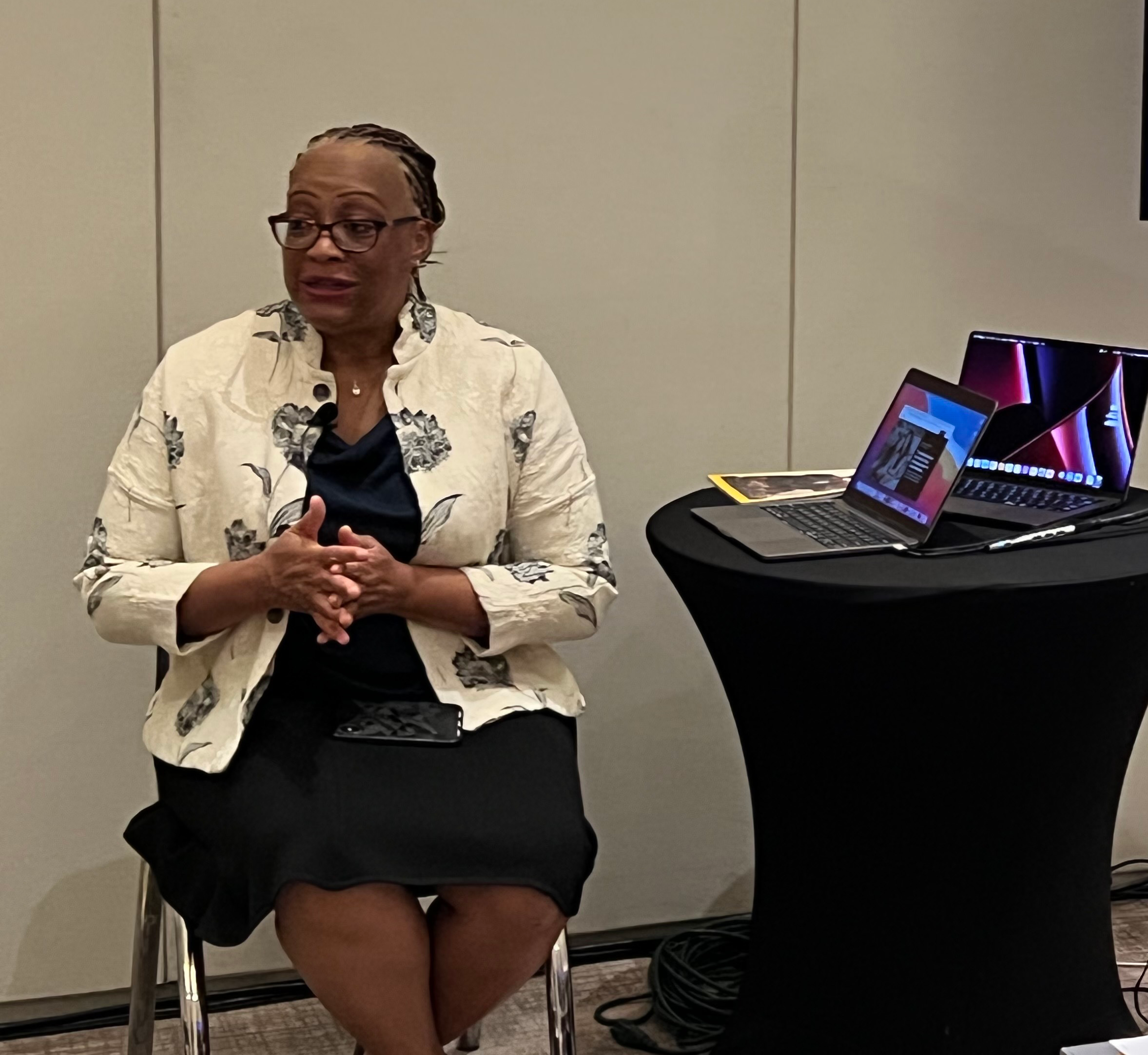
Wesley Lowery was covering Congress at The Washington Post when the protests over the police killing of Michael Brown in Ferguson, Missouri began in August 2014. He asked if they needed a set of extra hands to cover the story, and they asked him to get on a plane. Three months later, he was the last national reporter to leave Ferguson. Then, he was sent to Cleveland after 12-year-old Tamir Rice was killed. Lowery got attacked by the right-wing yet continued traveling to almost every city that had significant major protests or when a police killing made national headlines.
Lowery published “They Can’t Kill Us All: Ferguson, Baltimore, and a New Era in America’s Racial Justice Movement,” won a Pulitzer prize for his work on “Fatal Force” and has continued his impactful reporting on racial justice. His most recent book, “Whitelash: A Changing Nation and the Cost of Progress” will be released in June. Lowery shared his experiences as a journalist of color with the Widening the Pipeline fellows. [Transcript]
4 takeaways:
➀ Understand you’re not alone as a journalist of color. “We’re held to standards that are different than a lot of our colleagues and we get no credit even when we meet those standards and exceed those standards, right?” Lowery said. As a young “journalism nerd,” Lowery thought that if he showed up and followed the rules, people would give him the credit he deserves. “My skin has had to grow significantly more thick in the time since then,” he said. He said to cling to the moments where you’re in spaces with people who are like you, who are co-laborers and who have each other’s backs. “NABJ is my thing. That’s the family reunion.”
➁ Think about the stories you’re uniquely positioned to tell. Lowery shared one of the secrets to his strategy for covering protests. “I understood the way these undercurrents played into every story we were covering,” he said. “You couldn’t cover climate without covering race. You can’t cover justice without covering race. You can’t cover education without covering race.” He realized that if no one else is going to look at it from those angles, he would use it as an opportunity to do reporting that others weren’t doing. “And also, frankly, people might return my call because I look a little different than some of my other colleagues.”
➂ On what street corner would your murder be solved? That’s the question Lowery wanted to figure out after reading author Jill Leovy’s “Ghettoside: A True Story of Murder in America.” “She posits that the most urgent civil rights issue of our time is the police failure to solve the murders of Black men,” he said. He wanted to take what she found in Los Angeles to a national level. He began mapping out homicides, “And sure enough, the places where there were high amounts of homicide and statistically, almost no arrests, were poor, Black neighborhoods,” he said. Lowery wanted to take this truth that Black people knew and blast it out to everyone, paving the way toward a public dialogue.
➃ Write down true things, Lowery said. “If the act of writing down those true things changes the reality, that’s an added plus. But we don’t cover the police killing or the lynching with the belief that by writing this story, it’s never going to happen again.” Being a journalist means accurately recording the objective realities we live in, he said. But being objective doesn’t mean balanced nor neutral. “I am not seeking balance because objective reality is not balanced.”
The Widening the Pipeline Fellowship is sponsored by the Evelyn Y. Davis Foundation, Bayer, J&J and Lenovo. NPF is solely responsible for the content.