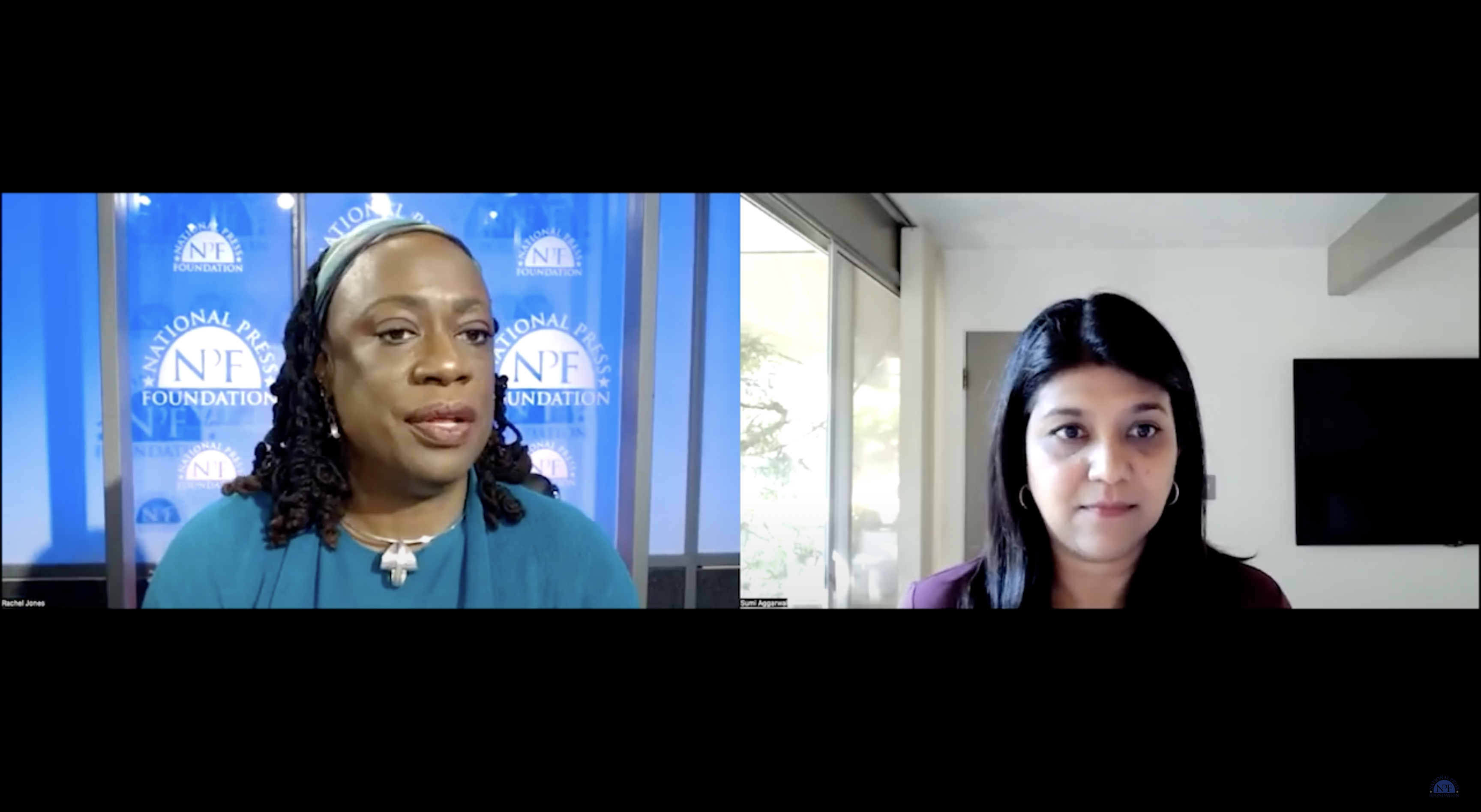
Since broadcast radio began in earnest in the 1920s, stations have pondered which voices would accurately represent their audiences. NPR’s original mission statement aimed to expand the target audience to include people previously excluded from civic discourse. However, in the first few years of its run, the Carnegie Commission identified diversity problems. NPR later established the Department of Specialized Audience, but as journalists of color have left NPR in recent years, some still question whether diverse voices are being heard. [Transcript | Video]
Though the network made history in February of 2023 by offering the very first bilingual broadcast of President Biden’s “State of the Union Address,” University of Oregon professor Christopher Chávez believes there’s still a long way to go. The author of “The Sound of Exclusion: NPR and the Latinx Public” shared findings from his book research for his book with Widening the Pipeline fellows.
5 takeaways:
➀ White voices dominate the telling of diverse stories. Chavez used the example of an NPR story about Latinos reported by correspondent John Burnett and hosted by Steven Inskeep, which included a quote from Attorney General Jeff Sessions. “You don’t hear the voices of the actual people impacted by the policies themselves,” Chávez said. “You don’t hear the voices of advocacy groups or humanitarian groups that are on the field locally.” Broadcasts are always in English, even if the population being reported on speaks another language.
➁ There’s a seemingly immutable barrier to inclusion for Latinos. When considering the potential public radio audience, Chavez said, the issue of language and linguistic proficiency becomes a critical factor. “Many Latinos speak Spanish or are bilingual, so there’s a different kind of linguistic range. And then second, just the constant specter of citizenship. No matter how long our residency may be in the United States, no matter the fact that many parts of the country were owned by Spanish-speaking countries, Latinos are still considered newcomers, perpetual immigrants, not quite American.”
➂ Juggling diversity with what the core audience wants to hear can be tricky. In some ways, Chávez said, it’s a competition between short-term and long-term goals. “Short-term, they don’t want to lose listeners. They don’t want to lose funding,” he said. “They’re an organization and they want to stay viable, and so they want to kind of protect that listener that is more fluent, that is giving money.” But that audience is getting older and older and older—and remains whiter than ever, while the overall listening audience is getting younger and more diverse.
➃ Broadcast voices can be disingenuous to fit a culturally-accepted mold. Chávez said one NPR announcer, Chenjarai Kuminyika, discussed listening to his own voice on the radio. “It becomes unfamiliar to him,” Chávez said. “It’s not the voice that he speaks in his everyday life…He’s modeling it off of current NPR voices.” Style guides, editorial standards and mission statements can all contribute to industry standards for what broadcast voices should sound like. Chávez said as his students enter training programs, they start self-correcting their voices to fit a standard. “I try to tell them to be authentic, but there are risks,” Chávez said. “That’s sort of the professional reality.”
➄ Changing trends in radio have reduced opportunities for diverse voices. In 1971, NPR broadcasted a roughly 30-minute-long segment on the protests surrounding the Vietnam War. The host, Jeff Cayman, interviewed protestors on the street, getting a variety of voices. Now, Chávez said, “the idea of a 30-minute segment on a single piece is unthinkable.” As radio segments have shortened, producers have been hesitant to “disrupt the listening experience,” even by including accented or nonstandard voices. To avoid losing listeners, broadcast stations have talked more with expert and government sources that speak in standard American English. “In this case, it’s that very steady monotone meant to be kind of devoid of any kind of regional accent, any kind of ethnic accent,” Chávez said.
The Widening the Pipeline Fellowship is sponsored by the Evelyn Y. Davis Foundation, Bayer, J&J, Twitter and Lenovo. NPF is solely responsible for the content.



 Reload document
 Open in new tab