For investigative journalist Wesley Lowery, the current atmosphere of existential angst swirling through the media realm seems just like old times—specifically, when he left j-school.
“In that era, that 2010, ’11, ’12, ’13 era, a newspaper was closing every day,” said Lowery, the executive editor of the Investigative Reporting Workshop. “The New York Times was having to take a loan of hundreds of millions of dollars from Carlos Slim in Mexico. And we were literally openly speculating like, ‘Will the New York Times exist? Will every single newspaper close in the next two years?’ was basically the conversation when I was like, ‘I need to get a job in journalism.’ ”
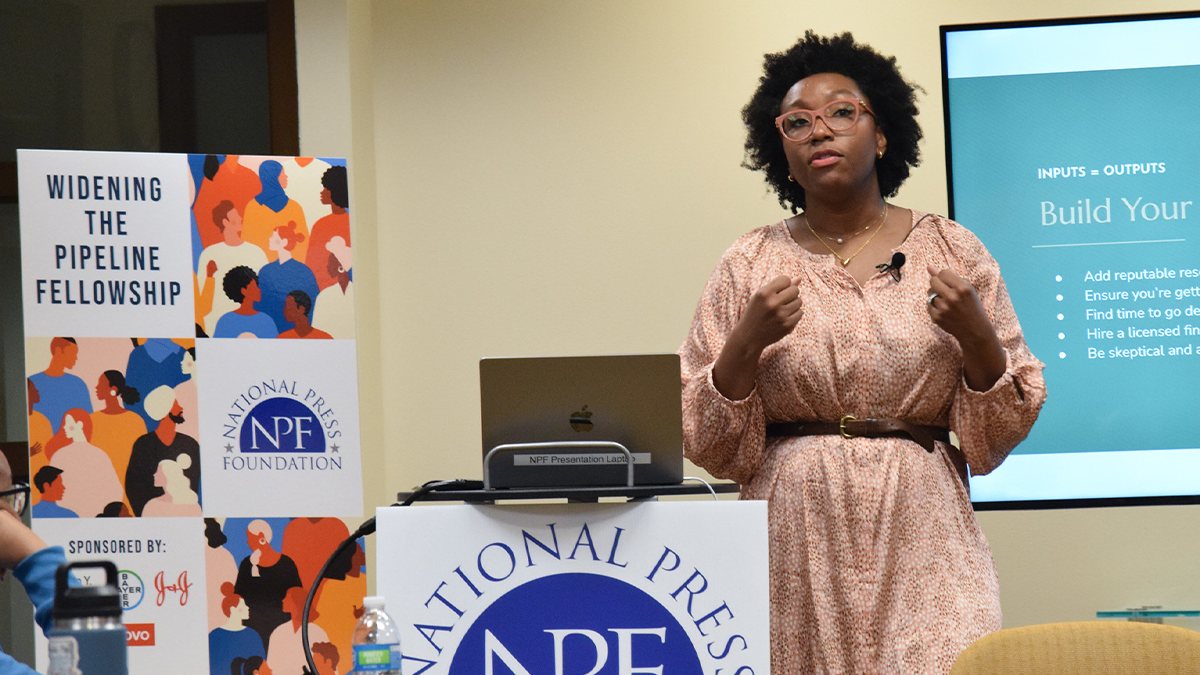
So Lowery didn’t gloss over the anxiety and frustration experienced by many young reporters like those in the Widening the Pipeline fellowship. “I can in a lot of ways relate to the environment in which you all have been thrust into, because I was imagining it that way as well as I entered this space. I think we are in a really difficult moment, a really difficult space because there’s no way to escape the big, deep structural/cultural issues about how we in our society and our democracy, how we pay or do not pay for quality news and information.”
Lowery shared important insights with Widening the Pipeline fellows about how to stay open to changes in journalism and be equipped to respond.
Keep the proper perspective.
Lowery rose to national prominence as a reporter for the Washington Post when he covered the 2014 police shooting of Black teenager Michael Brown in Ferguson, Missouri. The subsequent protests, which led to Lowery being arrested at one point, propelled him to the forefront of conversations about race, police brutality and America’s so-called racial reckoning.
At the Post, he was on the reporting team that won the Pulitzer Prize for National Reporting in 2016 for their “Fatal Force” project. Since leaving the Post, Lowery has worked for CBS “60 Minutes” among other media platforms, and authored two books— “They Can’t Kill Us All: Ferguson, Baltimore and a New Era in America’s Racial Justice Movement” and “American Whitelash: A Changing Nation and the Cost of Progress.”
But the constant drumbeat of change has kept Lowery pragmatic about his career.
“I grew up and my greatest aspiration in life was to be like the Metro Editor of the Cleveland Plain Dealer where I grew up,” Lowery said. “Today that would be a job overseeing two people basically, because this whole structure has changed and shifted. So again, what it forced me to do very early on was to be less romantic about ‘hyper,’ ‘Well, I’m going to be the editor of this thing,’ the status that comes with that, and to make it much more about the work. What do I want to be producing? How do I want to be thinking and how am I open to different ideas?”
But as journalism continues to deconstruct and reform itself, Lowery advised Widening fellows to remember an important bottom line.
“We will always need people who can ask questions. Who can research and report. Who can explain and teach. The core competencies of what we do as journalists will always be necessary….I feel almost fortunate that I came out at a time when so much was breaking about what had happened previously, that it made me, as much as I’m the biggest journalism nerd in the world and wanted to do this forever, it made me a little less nostalgic about specifics.”
Access the full transcript here.
The Widening the Pipeline Fellowship is sponsored by the Evelyn Y. Davis Foundation and Lenovo. NPF is solely responsible for the content.