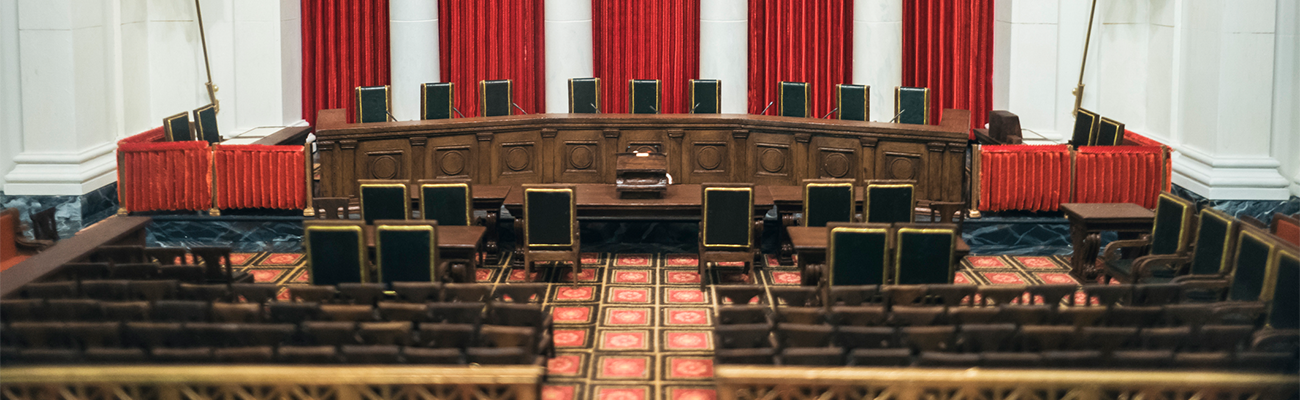
When Politico revealed two years ago that it had obtained a majority draft opinion striking down abortion rights in America, it not only offered a stunning open window into the Supreme Court’s closed deliberations, it also marked a new urgency in the press’ approach to its coverage of an institution long shrouded in secrecy.
ProPublica soon followed with a Pulitzer Prize-winning series of reports describing how politically connected billionaires won access to the court by showering justices with gifts and travel.
What changed?
Reporters directly involved in the groundbreaking work told the National Press Foundation’s Paul Miller Washington Reporting Fellowship class of an increasing perception that raw politics was playing a larger role in the court’s operations.
“I think there’s just a growing sentiment in the public, even before the Dobbs decision, that there’s more politics around courts than there used to be,” said Politico’s Josh Gerstein, co-author of the report on the court’s draft decision. The reporting sparked a firestorm and angry protests that threatened the physical safety of some of the justices.
More controversy followed when the court earlier this year ruled that ex-presidents were immune from prosecution for conduct related to their official acts in office. The ruling landed as then-former President Donald Trump faced multiple criminal prosecutions, including two federal cases involving the alleged illegal retention of government documents and attempts to overturn the 2020 election. Justice Department officials withdrew the two federal cases against Trump after he won the election last month, based on Justice policy that sitting presidents cannot face criminal prosecution.
“I guess the most obvious example of (political influence) is the way we’ve seen Supreme Court nomination fights handled over the last couple decades where it just seems like it just keeps getting turned up more and more and more,” Gerstein said. “And at a certain point there’s a logic that maybe people were not always thinking through that if you are the product of a highly intense partisan political fight as every Supreme Court justice that’s gotten on the court in the last … 25, 30 years has been, they’re not going to leave all that baggage at the schoolhouse door, in this case, the courthouse door, and be somehow a pure divined law decider by the time they arrive there.”
Kirsten Berg, a member of the ProPublica team, said the investigative reporting was indeed a departure from the norm in court coverage.
“It’s a culture that’s been very much reinforced by the judiciary in that they really shroud themselves with secrecy and reverence and try to project themselves as an apolitical or a-partisan body,” Berg said. “It’s also set up by design to be a little more secretive. You don’t have the access like you do to Congress people. You don’t have the expectation of communicating to the press like you might with the executive branch. The judiciary isn’t subject to the Federal Freedom of Information Act.”
The closed culture, Berg said, required her colleagues to think “creatively” about how to learn more about the justices, especially their outside associations and private travel.
“We sort of thought about creatively trying to get at what people would know about these types of trips,” Berg said. “We didn’t think we’d get to it through the justices, who are quite closed. We didn’t think we’d get to it through friends. One of our big veins of information was through service workers. Thinking about the people who worked at these lodges, the people who worked on the private jets, the people who were the fishing guides …
“There’s an extremely active aviation tracking community that tracks private jets everywhere. And we got kind of digging through those communities, got some hints about the whereabouts of, for example, Harlan Crow’s jets and found some undisclosed trips from Thomas, from those sources,” Berg said, referring to Justice Clarence Thomas’ travel financed by the billionaire GOP donor.
Gerstein said penetrating the wall of secrecy requires a commitment to building trust with a variety of potential sources.
“I think different people approach this in sort of different ways,” Gerstein said. “I know other reporters that I really admire that may have through force of personality, be able to just sit down with somebody at lunch and get them to spill all the beans about things. That’s never been me … What has worked for me, to the extent anything has worked, is more being a dedicated reporter who’s intent on getting things right and covering things in detail, listening when people have objections or nuances that they think were not revealed in stories.”
In some important respects, Gerstein said Washington is not unlike any other place where journalists are digging for the truth.
“If you establish a reputation for covering things, not sensationally but accurately … being invested in getting the details right, people will emerge from the woodwork to talk to you about things,” he said.
Even very closed groups can be penetrated.
“Washington D.C., in a sense, is a small town; and so there aren’t that many things that go on here for a long time that … are sort of outside the realm,” Gerstein said. “What happens in Vegas doesn’t always stay in Vegas.”
Access the full transcript here.