5 takeaways:
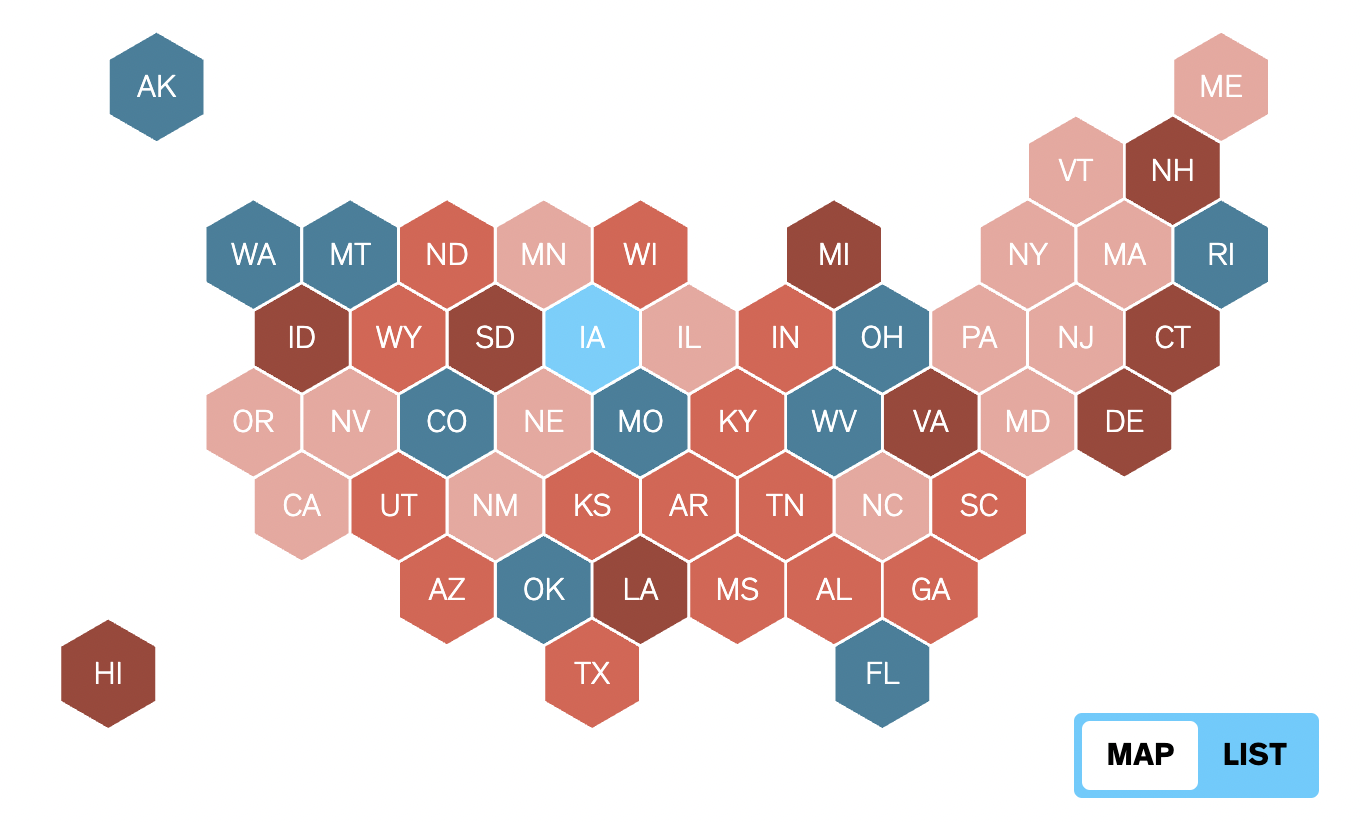
➀ One-party control of redistricting is a recipe for abuse and discrimination. Redistricting takes place every decade when state and local governments redraw voting districts after the Census to account for population changes. “Gerrymandering” is the practice of drawing electoral districts to give one political party an unfair advantage, and it is unconstitutional. Whether a redistricting plan constitutes gerrymandering is for the courts to decide. “In redistricting, the biggest signal that there likely will be abuses is when one party controls the process … that’s a recipe for abuse, both political discrimination, discrimination against racial and ethnic minorities,” Michael Li, senior counsel at the Brennan Center for Justice, told NPF’s Statehouse Reporting Fellows. “After the controversial 2020 Census and GOP wins in many states, Republicans drew or will draw 189 congressional districts, while Democrats will draw 75, Li said. (Transcript | Video )
➁ Gerrymandering strategies take many forms. Sometimes the goal is to maximize the number of seats that the party can win, sometimes it’s to protect the seats they already hold, and sometimes, it’s to protect particular incumbents, Li said. “The essence of a really aggressive seat-maximizing gerrymander is that you don’t draw districts that your party wins by 80%, right? Because if you draw districts that your party wins by 80%, you’re using your voters really inefficiently. Instead, what you want to do is spread your voters out among as many districts as possible to win a bunch of districts by say 53% or 52%. And that way, you have the most seats possible. But that means that districts sometimes could be vulnerable, right? If you’re worried about demographic change, if you’re worried about political change, maybe you don’t want to maximize seats.” For example, in Texas, Republicans had the advantage and didn’t choose to grab more seats, instead, they created a “vote sink” in Austin.
“They tried to stick every Democrat that you could find in the district and that had the effect of shoring up and making the Republican districts that surround it a lot safer,” Li said. “The map was redrawn to make Republican seats much more Republican. Now, Democrats could win 58% of the vote, but still have only 37% of the seats, which is to say that Texas could become a deeply blue state and still Republicans would have almost a two-to-one advantage in the congressional delegation,” he said.
By contrast, in New York, “Democrats were playing a seat-maximizing game, in part because they were more confident about the electorate, but in part, because they only control the drawing of 75 seats. So, some lessons: There will be many fewer competitive seats, particularly in Republican states and that is because Republicans this cycle valued safety over having more seats.” In states where an independent commission draws the maps, there hasn’t been much change in competition, Li said.
➂ Communities of color are often most affected. The rise in political polarization, the history of segregated housing and other factors have combined so that voters of color are most affected by this political manipulation. “Because of residential segregation, it is much easier to pack together or break apart communities of color to achieve a political effect,” Li said. However, those drawing the maps argue that this is not racial discrimination, which would be illegal, but rather an attempt to balance the power of the other party, which is legal. “In Texas, people said that they were drawing maps on a race-blind basis and that they were just targeting Democrats, which is a little bit disingenuous because people know perfectly well where … the Asian population has grown, where the Latino population has grown,” Li said. “The reality is in places like Nashville, places like Dallas, places like Houston, there are a lot more pathways for communities of color to succeed politically, and you’re seeing those dismantled.” Li used Houston as an example. “Parts of the minority communities get pulled into districts in Houston. They backfill them with white voters from rural areas. That’s an attack on minority political power … and that’s an important story to be told, even if there is no legal remedy.”
➃ Supreme Court decision on Alabama redistricting will be one to watch. The Supreme Court will hear Alabama’s redistricting case this fall in a test of how far the court will go to prevent racial sorting in voting districts. Li thinks Voting Rights Act suits will become harder to win in the future.
“The Supreme Court is asking, ‘OK, there’s discrimination, but why is the answer to discrimination to sort voters into districts by race …We don’t do that for schools,’” Li said. “The court doesn’t care about things like proportionality … [or] numerosity. … The idea like, ‘oh, well, the Black population has grown … there should be more districts.’ This court will say … ‘we don’t sanction drawing of districts by race,’” Li said. “I think this is a court that thinks we’re in a more post-racial world than many people would think.” Li predicts that whether the Voting Rights Act protects coalition districts will be a major legal issue this decade.
“In most circuit courts of appeal that have decided the issue, the answer is yes, they are protected if the communities are politically cohesive. You can’t just lump non-white voters together … but there are many places in the country [where] Black and Latino and Asian voters work together and have worked together for a long time to elect candidates. … The Supreme Court will have a chance to weigh in on that.” State courts will also play a bigger role this decade, Li said, not only in drawing the maps when the process deadlocks, but also in legal challenges to maps in state court. “North Carolina, Ohio, Maryland maps have been struck down by state courts and ordered to be redrawn. There’s pending litigation in Kansas and New York that could result in maps there being struck down by state courts, but this is in part because federal courts are no longer perceived by litigants as being as hospitable.”
➄ Cover the 2022 elections by comparing the before and after maps. Reporters must cover changes to congressional districts and who’s pushing for what. After the elections, they will need to compare how parties perform in 2022 and 2024 to their performance under the previous map. “You’ve got to tell that story over the course of a decade,” Li said.
The Statehouse Reporting Fellowship is sponsored by Arnold Ventures. NPF is solely responsible for the content.