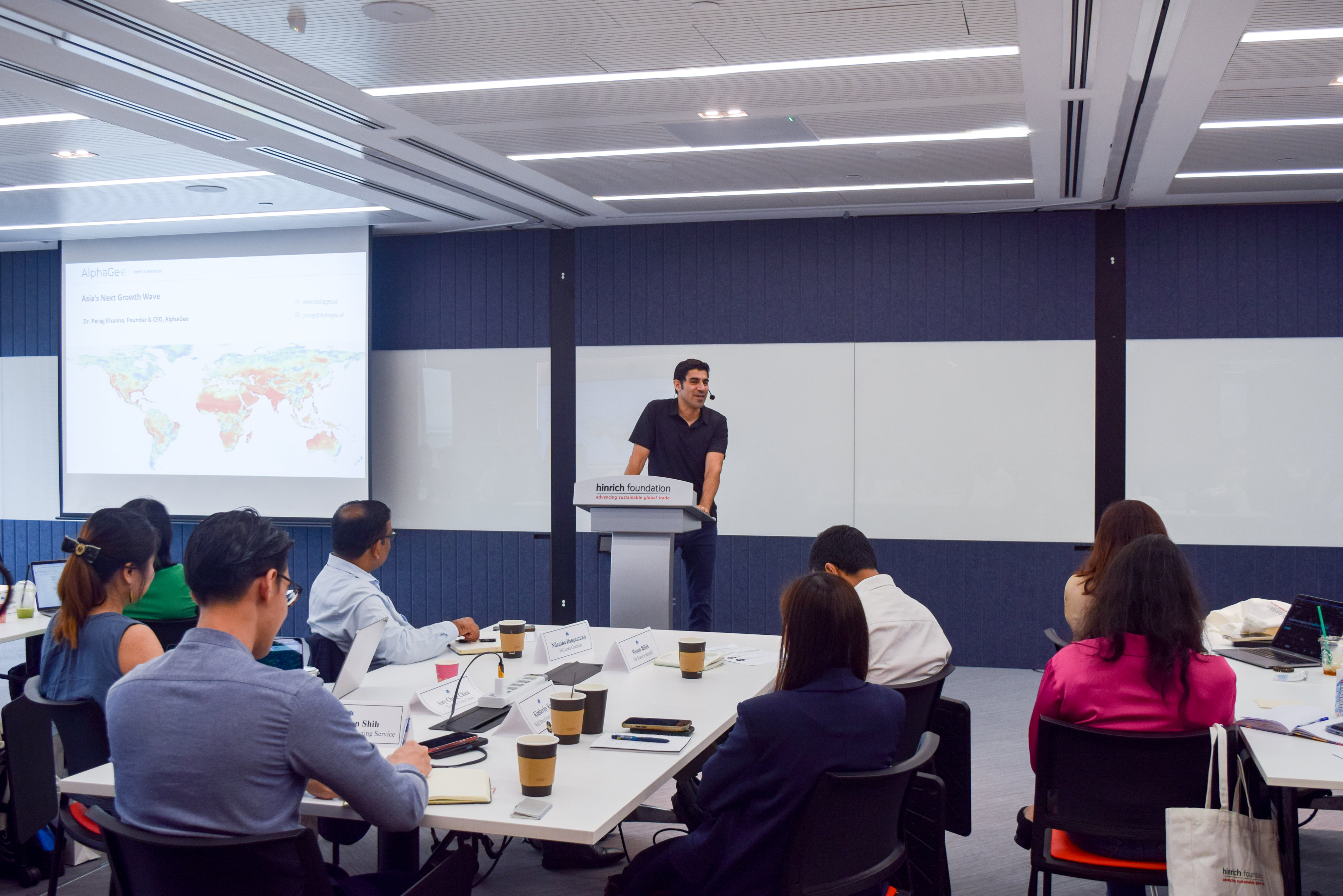
“Never bet against globalization,” says Parag Khanna, author and founder and CEO of AI analytics firm AlphaGeo. He sees Asia as the epicenter of globalization, where economies, cultures and populations are intertwined and interdependent.
Yet Khanna points to several times in the past quarter century, technically a time of global peace in the post-Cold War era, that experts have declared the end of globalization: the 9/11 attacks, 2008 global financial crisis, 2016 with both Brexit and Trump’s first election, COVID in 2020, and today’s trade wars or “new Cold War.”
“Each time the analysts, the commentators, the scholars, the experts were unreflective about the fact that just a couple of years earlier they had said the same thing about a different set of circumstances and been completely wrong,” Khanna told NPF International Trade journalism fellows. “We never stop proclaiming the end of globalization.”
Yet trade and capital flows rebound, and global movements of people continue. It is a mistake to discount “the bottom-up reality of network building, whether it is trade, finance, capital flows, ideas, technology and so forth which is globalization.”
Asia, Not Washington, Driving Globalization
Countries want to move up the value chain and modernize – that is especially evident in Asia. Khanna says the geographical locus that drives globalization trends isn’t Washington or London – it is in Asia.
Government policy in many countries is structured to bring in investment and increase value and exports. Khanna cites the Harvard Atlas of Economic Complexity as a research tool that helps assess market share, value-add in global supply chains and networks. Beyond looking at the rankings of the countries, the atlas can illuminate in what sectors an economy is strong or how trade relationships might help countries displace those countries ranked slightly ahead.
Asia has been moving up the value chain rapidly, displacing incumbents in many areas and triggering competition. Incumbents, whether the European Union, Japan or the United States, are feeling the pressure as Asian countries advance, and it plays out in global industrial policies from U.S. bailouts of the auto industry to European subsidies and industrial supports.
“The biggest story of the 21st century to me is not the rise of China, it’s the Asianization of Asia,” Khanna said, borrowing a term coined by Japanese scholar Yoichi Funabashi in Foreign Affairs magazine to describe Asia’s rise as a whole. “The rise of China is part of that story … it’s one driver of the Asianization of Asia.” Khanna sees mutually reinforcing waves of Asia’s rise, a sequential story of “Asia’s modern miracle” with Japan at midcentury; next the tiger economies of Singapore, South Korea, Taiwan, Hong Kong; China as the third wave of growth; and the current wave of south and southeast Asia, especially Pakistan and India.
Demographics in Asia’s Favor; Climate Less So
Viewing economics as the optimization of land, labor and capital, Khanna identifies many Asian assets, chief among them five and a half billion people.
“You’ve got labor, you’ve got land, you’ve got capital, you have natural resources, you have industrial capacity, you have technology, you have ideas, innovation and know-how – all of those factors are present and are being constantly optimized by way of these cross-border investment and trade flows.”
Demographics are a significant influence. Most human beings today are Asians in Asia, and every day the world becomes more demographically Asian due to aging populations passing away elsewhere in the world and more children being born in Asia.
“The Asian demographic advantage is incomparably larger than any other part of the planet, and the gap continues to grow. So, where Asians are will more or less shape a huge part of the demographic future of humanity … unless you think robots will do everything and you can tax the robots.”
Yet Asia is disproportionately exposed to the perils of climate risk: flood, storm, heat, fire, drought, sea level rise. That will have an impact on economic performance and on migration.
Asians now do more cross-border commerce with other Asians than they do with the rest of the world.
“It only took 35 years, which is spectacular given the cultural diversity,” says Khanna. “What other region of the world is as heterogeneous? Yet despite the internal obstacles, barriers, suspicions, lack of mutual cultural knowledge, different regulations, a lot has been overcome in a very short period of time. I think the Asianization of Asia is a great story that continues to unfold.”
Although Asia has significant income disparity, particularly when compared with the U.S. or Europe, there have not been protests akin to Occupy Wall Street.
“People appreciate where they’ve come from,” said Khanna. “They know what their baseline has been, how poor they have been. They see the overall momentum and progress. They see that reducing poverty by way of creating opportunity, investing, infrastructure, education, healthcare and raising the floor is more important than lowering the ceiling.”
Much of the investment in Asian infrastructure is cooperative and cross-border among Asian countries such as the shared energy grid, railways and other transportation supported by governments, investors or China’s Belt and Road Initiative.
“They’re reinforcing each other. Asians are each other’s largest trade partners and investors. So it’s not even despite geopolitical rivalries. I think of Asia as a sponge more than a set of rival blocs.”
Khanna sees Asia in the “sweet spot” in the world economy: young demographics, low wages, a partner in trade agreements, a magnet for foreign investment, reform-oriented governments, high infrastructure investment, shrewd industrial policy, political stability.
“At any given time in history, there is a part of the world that is having its moment, where these things are happening. And right now, it is Asia.”
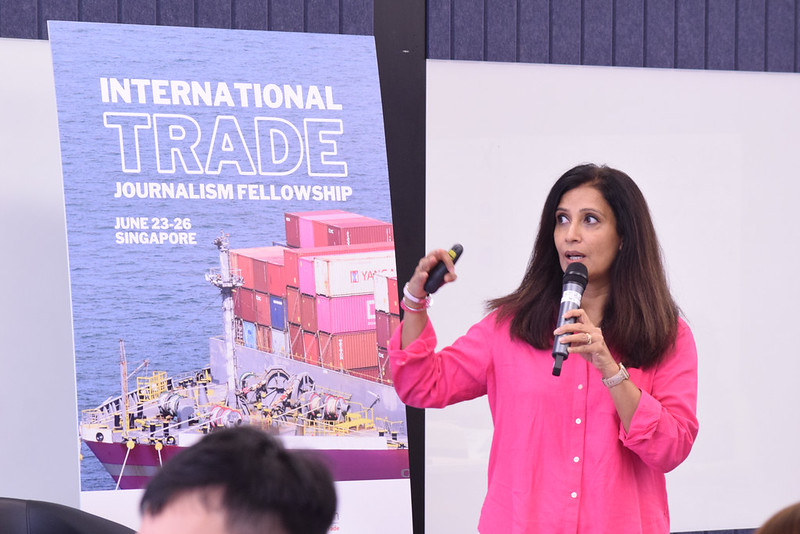
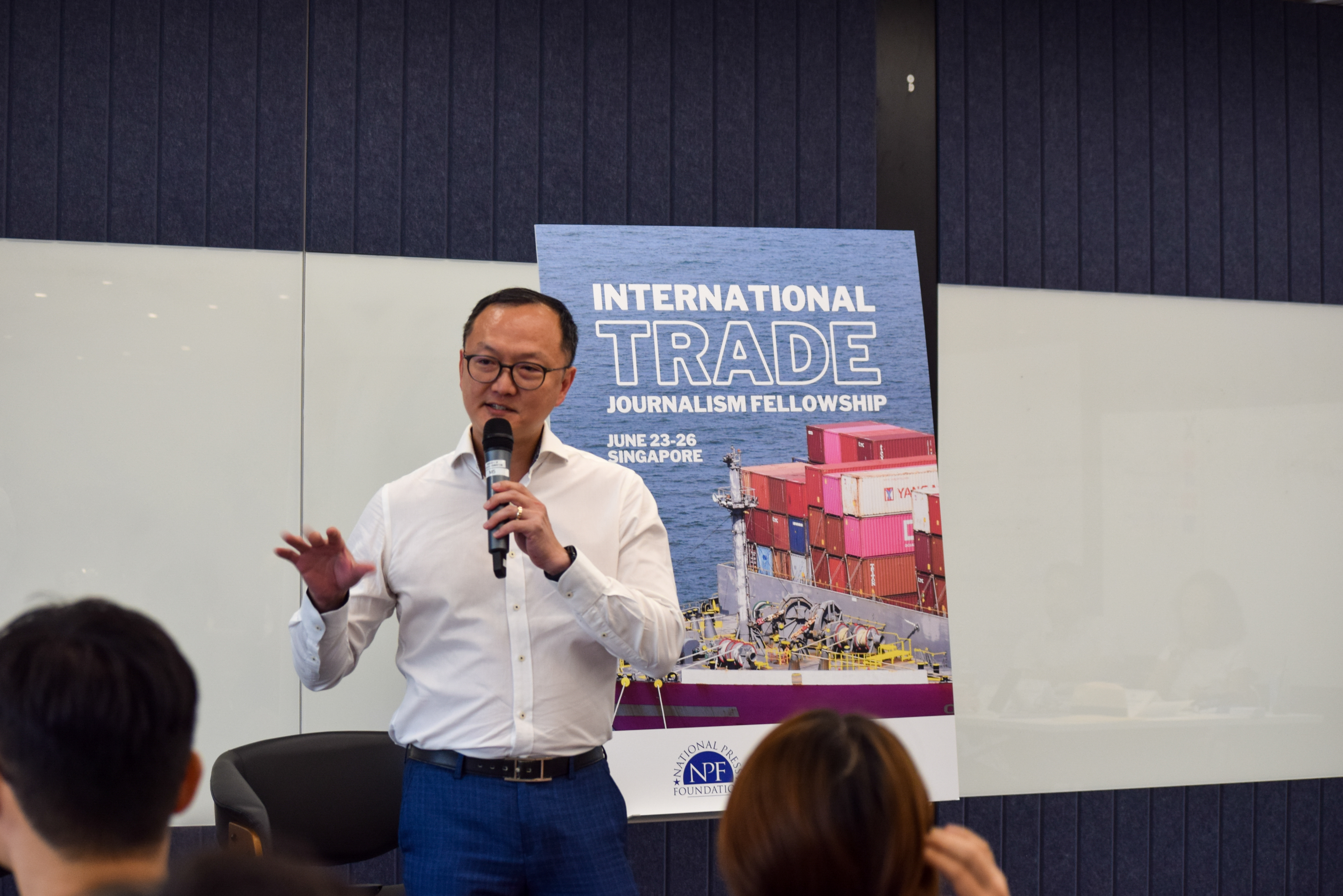
This fellowship is part of an ongoing program of journalism training and awards for trade coverage sponsored by the Hinrich Foundation. The National Press Foundation is solely responsible for the content. All programs are on the record. Resources and transcripts are available to journalists worldwide.



 Reload document
 Open in new tab