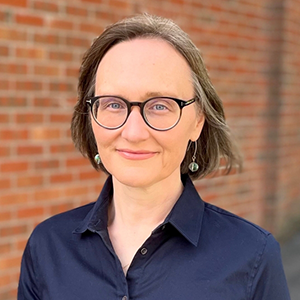
Increasingly, research confirms that the challenges facing older workers are ignored by companies and policymakers. Truesdale co-edited a new book that illustrates how the employment and retirement security needs of older Americans are not being met. [Transcript | Video]
5 takeaways:
➀ Living longer requires more income. Truesdale told the NPF Living Longer fellows that society hasn’t quite figured out how to meet the economic needs for the majority of older Americans. Employer pensions and private savings simply aren’t available to most workers. And, of course, Social Security is strained by the growing older demographic. Truesdale says, “The idea of just ‘keep working, delay retirement’ has become really a standard policy response to population aging, not only in the US, but throughout many wealthy nations. In the US, of course, the Social Security full retirement age is rising from 65 to 67. And there are many people who argue that it should be older still.”
➁ The term “on average” is a non-starter for older workers. There’s no arguing that, on average, Americans are living longer, they’re healthier, and more educated than they were, say, 50 years ago. So, you’d think that delaying retirement would be the perfect solution…but it’s not. “Averages are meaningful, but they’re not the whole story,” Truesdale said. “What we realized is that we really need to be looking at American inequalities as well as averages if you want to understand work and retirement in the US. So, the driving question in a sense is, ‘Okay, who’s left behind?’”
➂ The conversation about when to retire needs to start earlier. Truesdale quoted research that finds only about half of older US adults were steadily employed all the way through their 50s. “About 80% of people who were steadily employed all the way through their 50s are still working at some point between 62 and 66,” she said. “For people whose employment was intermittent during their 50s, the figure falls to around 35%.” In other words, Truesdale said, “We need to be thinking about policies that are addressing workers a decade or more, before traditional retirement ages, in their 40s and 50s, so that they’re in a better position to work longer when they get through their 50s and into their 60s.”
➃ The 50+ worker demographic can be surprisingly elusive. Truesdale calls it “the disappearing workforce.” That’s because workers leaving the labor force don’t really show up in statistics that researchers use. So, when the headlines project a 3 or 4 percent unemployment rate for people in their late 50’s that sounds really good—except that 30 percent of people in that age range are out of the labor force and aren’t looking for jobs, because of poor health, or caregiving responsibilities—or retirement. “These are not people who have retired to go and spend more quality time with their yachts, by and large,” Truesdale said. “These are people for whom leaving work in their 50s means having less to live on as they age.”
➄ Good jobs improve longer-term working chances. Truesdale wants to see policies that stabilize employment for people over the long term. It’s the only way to start consistently promoting working longer and delaying retirement, she said. “If you have a stable, healthy, well-paid job in middle age, or beyond, you will have higher Social Security benefits, possibly higher retirement savings by the time you get to be a little bit older, and you’ll have a better chance of working longer.”
This program is sponsored by AARP. NPF is solely responsible for the content.