During a reporting trip to Wisconsin shortly before state Supreme Court candidate Susan Crawford won a decisive victory over an opponent backed by Elon Musk earlier this month, David Weigel was struck by what he wasn’t hearing on the campaign trail.
At Republican-sponsored rallies, few were celebrating the mass firings of government workers and the potential implications for local communities beyond Washington, D.C., even as Musk, the billionaire Trump adviser and architect of those cuts, was dumping millions of dollars into the race.
Weigel, a longtime political reporter and founding staffer at Semafor, said news accounts featuring real-life consequences of the government’s actions appeared to be breaking through just before the election delivered a stinging verdict in the first political stress test for the new Trump administration.
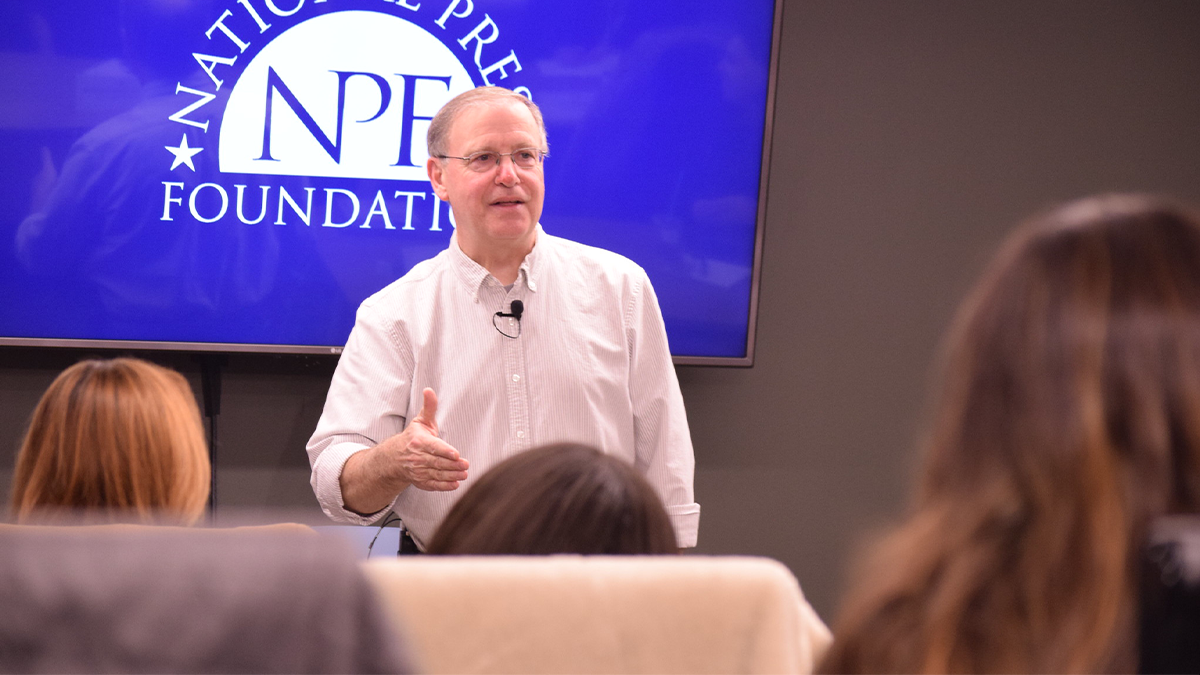
“Always pay attention to what people are not saying,” Weigel told the National Press Foundation’s Paul Miller Washington Reporting Fellowship class. “And I was not hearing specifics at Republican events about the great DOGE (Musk-led Department of Government Efficiency) things that had happened, that were amazing that we all love.”
Weigel said elections provide useful signals about how “uncomfortable” people are with current policies, often highlighted by a candidate’s desire to change the subject.
“Again, that’s usually the clue. Do candidates not want to bring this up? Do they say it’s a distraction? Do they want to move on? Sometimes they say it’s a distraction because people don’t care, but they’re always saying it because they want to pivot to one of the issues they polled is much better for them,” he said.
With the nation now beginning to feel the pain of Trump’s global tariff war and a stock market in free-fall, Weigel urged reporters to move beyond Washington to understand the long-term economic and political fallout.
The early-returns are coming in “a climate where we see that there are a lot of people who took a chance on Trump that are not terribly happy right now with how he’s acting.”
“They (voters)… thought it would be a turn of the dial back to policies that made things cheaper in 2019, and they’re not getting that and as long as they’re not getting that, a lot of the people are not bought in for, let’s say, a two or three-year transition” for manufacturing and other industry to return to America. “They were waiting for prices to get lower quickly.”
When identifying potential places to tell the story, Weigel urged reporters to do their homework before seeking editors’ approval.
“I do pitch it; I don’t just say, ‘Let me go take a wild swing at this place where I might have a story,'” he said. “Knowing people… in these states that I can check in with is very helpful,” Weigel said, adding that some of the best contacts are “not necessarily political actors, who do not care which party wins, but are making long-term investments or advising people on what to invest in based on what they think the economy is going to look like.”
Access the full transcript here.