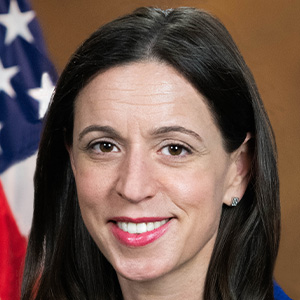
A mass exodus of career Justice Department attorneys has hollowed out key divisions within the sprawling agency, raising troubling questions about the department’s capacity to thwart national security threats while meeting its basic law enforcement obligations, former senior official Liz Oyer said.
Oyer, who was dismissed as Justice’s pardon attorney for refusing to recommend a restoration of gun rights for actor Mel Gibson, told the National Press Foundation’s Paul Miller Washington Reporting Fellowship that the department’s political leadership has exercised “outsized influence in reshaping the place.”
“One of the ways they’ve done that is by forcing out – either firing or forcing resignations – of career officials who are standing in the way of achieving the political objectives of this administration,” Oyer said.
The former Justice official was terminated in March, hours after refusing to endorse the clemency action for Gibson, a Trump supporter, whose gun rights had been rescinded after a prior domestic violence conviction. More recently, Justice officials have targeted President Donald Trump’s political foes for prosecution, bringing criminal charges against former FBI Director James Comey for allegedly lying to Congress and New York Attorney General Letitia James for alleged mortgage fraud. Both have pleaded not guilty, asserting that the prosecutions are politically motivated.
Civil Rights Division ‘decimated’
Oyer said the Justice Department’s actions have “created ethical dilemmas for a lot of the career workforce… and a lot of those people have left as a result.”
The Justice Connection, an advocacy group of Justice alumni, estimates that 5,500 people have left the department since the start of Trump’s second term, The Washington Post reported Nov. 10.
“Many have just walked away from their jobs, haven’t actually been fired, but have found it untenable to remain there,” she said, adding that the Civil Rights Division, long regarded as the heart of the agency, has been “decimated.”
Oyer said the division, which enforces the nation’s civil rights laws, has lost an estimated 70% of its attorney workforce.
National security capacity questioned
Equally troubling, she said, have been losses at the agency’s National Security Division, which handles investigations and prosecutions involving the most serious security threats to the country.
“If we were to have a terrorist attack, for example, or something awful like 9/11, it’s not clear that we have the personnel that we need to be able to respond to something like that in an appropriate way,” Oyer said. “It’s also not clear that the department is continuing to do the type of proactive investigation and enforcement that is necessary to prevent something like that from happening.
“Unfortunately, it may take a real national crisis for people to understand the magnitude of the impact that these departures from the Justice Department have really had, and for us to really fully understand how dangerous it is, what’s happening inside DOJ right now.”
State and local partnerships strained
A realignment of department priorities, including a new focus on immigration enforcement, also has strained key partnerships with state and local authorities that have relied on federal grant money and other federal resources to assist in local investigations.
“DOJ plays a huge role in complicated cases involving large amounts of electronic evidence and data. One area, for example, is child exploitation, sex trafficking, child pornography, dark web type of investigations, things that require sophisticated technological resources to do investigation,” Oyer said.
“State and local law enforcement typically relies on the Justice Department to support them, provide resources and expertise for that type of investigation. And those resources are shrinking and some of those resources are being reallocated toward other priorities like immigration enforcement right now … and those changes are being felt in communities around the country and I think will continue to be felt on an even bigger scale as this goes forward.”
Access the full transcript here.