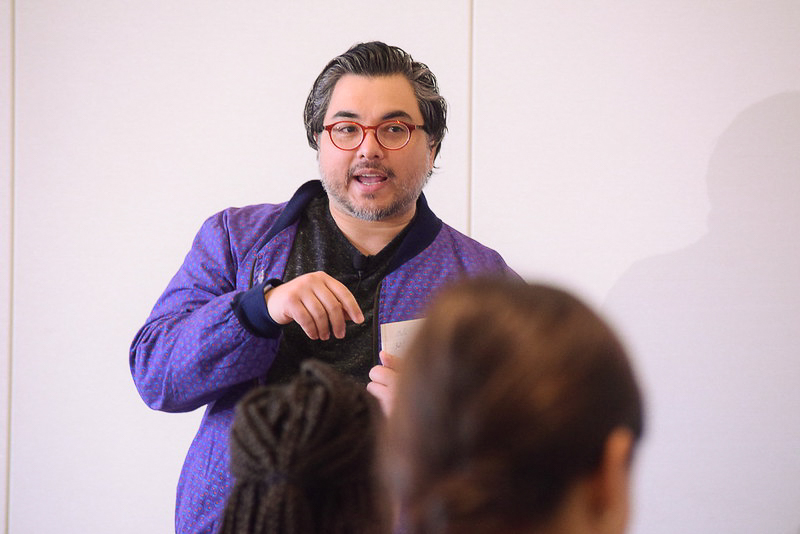
Luciana Lopez’s career has crossed continents and journalism styles, from biomedical writing to covering pop music, from breaking news at Reuters to producing for “All In with Chris Hayes” on MSNBC to editing for USA Today. For journalists looking to leapfrog from medium to medium, she has some advice:
5 takeaways:
➀ Know your audience. Who’s the audience for a wire service? Not only the public or, in the case of Reuters and Bloomberg a lot of people on Wall Street, but other news outlets. You send an alert immediately – a headline. You follow up within five minutes with two paragraphs. “You’re going for speed,” Lopez said. “Then you keep updating. You do those rolling updates really fast because people are looking to you to build their knowledge of something. You are not necessarily writing the end all be all magnum opus story.” Wires live on pre-writes and urgency, so if you don’t have that, wires may not be right for you. “That fast, pinpoint accuracy, that’s what you’re going for.” [Transcript]
For TV, “everything you write, you should be reading aloud,” Lopez said. “You have to think about voice in a very specific way … how is Rachel Maddow’s voice different from Chris Hayes? … How is this going to sound coming out of that host’s mouth? What are some of the expressions they use?”
For print and digital, Lopez said there’s more room to experiment with content and form.
➁ Write in your own words. “Write like a human being,” said Lopez. “If you can’t explain something back to people in your own language, if you have to adopt the jargon of the sources you’re talking to, you don’t understand something,” Lopez said, and it’s a sign to do more reporting.
➂ Do scary things. Lopez advised Paul Miller fellows to handle changes to their jobs the way they do stories. “It’s scary. But we learn for a living. That’s what we do. If you can learn how to do stories, you could learn how to do other platforms,” she said. “Approach your careers the same way you approach your beat. Who, at a company, is a good source for me to make? Who should I be taking out to coffee? Who knows all the office gossip and can keep me in the loop so I know what’s going on?”
When you start at a new publication, “look at what’s been done,” Lopez said. “And then someday you go, ‘I can do that different.’ And you learn how to break the rules. But you got to learn the foundation first.”
➃ Fake it ‘til you make it. When asked how she handled transitions, Lopez answered with a simple “fake it ‘til you make it.” argument. Prior to becoming an editor, she doubted herself, thinking “Am I going to give people horrible advice?” or even “Am I going to miss getting to be the one to talk to sources?” But now, she loves it. Pushing yourself is part of being a journalist. “We love learning new stuff,” said Lopez. “If we wanted easy lives, we would not do this job.”
➄ Do what’s right for you. While Lopez has had a wide range of jobs and experiences, she also has great admiration for reporters who develop deep expertise, like Edna Buchanan, who “knew the cops in her town like nobody’s business.” Every journalist needs to find the right balance for them. “If you want to stay at one place for your entire career and you’re happy, that’s awesome. Do it. But if you’re not happy, leave. … If you need someone’s permission, you have my permission. But don’t do that to yourself. Life’s too short. Don’t be miserable in a job. A job is what you do. It’s not what you are. Just remember that.”
Help support the Paul Miller Fellowship by visiting nationalpress.org/donate. NPF is solely responsible for this content.