By the time she was eight years old, Maryland Delegate Joseline Peña-Melnyk had already developed a sense of the injustices in the world. She noticed how the Latina women like her mother, an immigrant from the Dominican Republic, were treated at the welfare office, and she knew it wasn’t right. Her mother took to calling her la abogadita, meaning “little lawyer.”
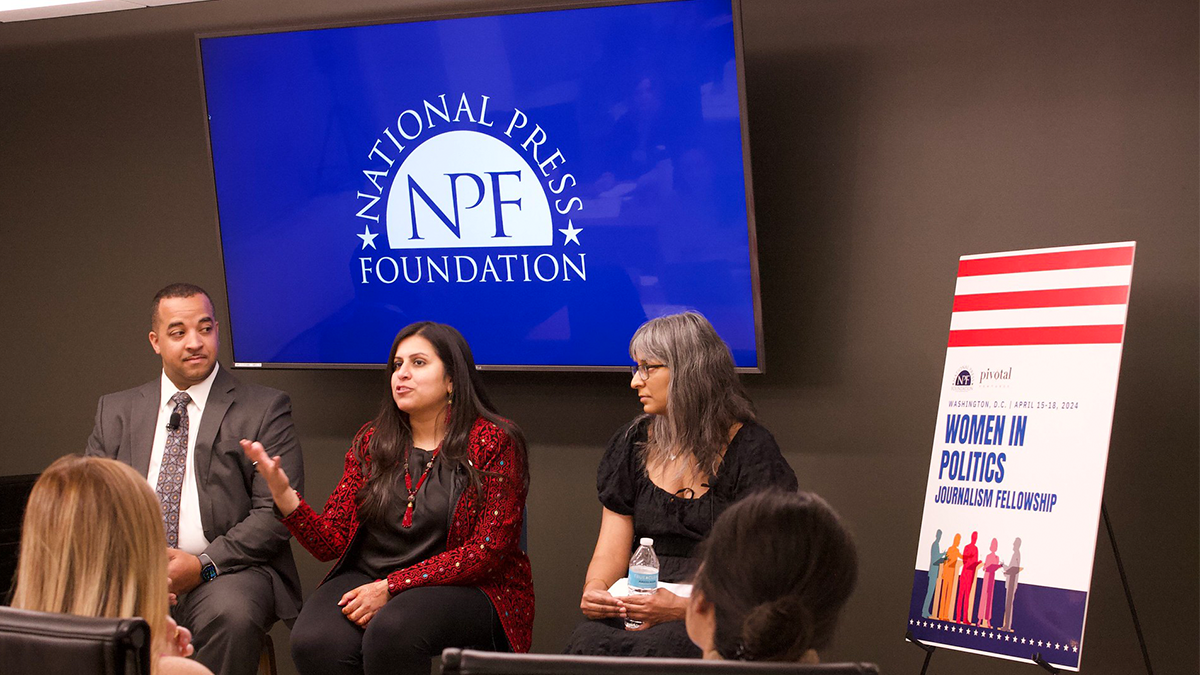
“And I knew there and then that I wanted to be a lawyer—don’t ask me why—and that I wanted to be the voice for my community,” she told journalists during the April 2024 Women in Politics fellowship.
Peña-Melnyk knew she had to graduate college to accomplish this goal, and she would become the first in her family to do so.
“I graduated from a four-year school in less than three years, I was possessed,” she said. “I would tell my younger self, slow down.”
Peña-Melnyk got her first job at a public defender’s office in Philadelphia, but she was eventually let go after she failed the bar exam twice in a row. Because English was her second language, she sometimes struggled with reading comprehension, especially in a timed setting.
“The last time I took [the bar], I failed by one point, one point. And you have to ask yourself, why? Well, there’s no answer. It’s just how life works out. Do you want it? You push yourself. So I took it again and I passed.”
After establishing a solid legal career as both a public defender and a prosecutor, Peña-Melnyk’s approach to politics was equally pragmatic. “I ran for office because I wanted to be a voice in the community because I didn’t see people that look like me. And I have three kids and I always say, you can’t be what you can’t see. It’s important because if we’re not at the table, women are not at the table. If we don’t have diversity, black and brown people at the table, Asian, Native American, white women, you name it, just like your hand, your five fingers are all different. But you need them for your hand to work. It is important to have diversity for the policies to be balanced and for the policies to make sense and for the policies to be fair.
In her policy work, Peña-Melnyk, prioritizes the social determinants of health—access to education, transportation, money, a healthy environment—and why those things dictate how people live. She has also made diversity and equality training in health services a central focus. She pointed out the disparities suffered by people of color during COVID and the high maternal mortality rates for Black women.
“So I put in a bill that during that session that requires implicit bias training for all healthcare providers in the state of Maryland,” Peña-Melnyk said. “And do you think that was an easy bill to put in? No. Because the doctors didn’t want to take another class. The nurses didn’t want to take another class. But I know it’s important.”
Peña-Melnyk also pushed for a bill that would use a federal waiver to expand Medicaid for all. “The Biden administration has allowed a waiver, a 1332 waiver, which is basically permission from the federal government for the states to be innovative and be creative to allow undocumented individuals to purchase health insurance on the federal exchange to Washington state and Oregon,” she said. “So I thought, heck, why not?”
The bill initially died due to pushback from people who assumed their tax dollars were being used to fund subsidies. “If someone had taken the time to read the bill—that is probably not even five pages—you would’ve seen that it says there, you would’ve noticed, no subsidies,” she said.
Peña-Melnyk cautioned fellows about carelessly using words like “undocumented” or “illegals” when reporting on immigration issues.
“In this country, when you hear undocumented, illegals—I dislike that term. It is the way it’s put out there. So we must report responsibly,” she said.
Despite the setback, Peña-Melnyk used the bill’s failure as a learning opportunity. She learned to communicate key information about her legislative proposal to the press to ensure that people know the facts. When she introduced the bill again, it passed. The process was a painful one for Peña-Melnyk, however. Someone called her office to threaten her, and she had to be escorted home by a state trooper.
“It was the first time in 18 years that I was actually afraid, and I’m a tough cookie,” she said.
Fostering collaboration with all of her colleagues helped Pena Melnyk get through that stressful period. “My colleagues were very supportive, both Democrats and Republicans. On my committee, I have with myself, 23 members and we have Republicans and Democrats and they were all very concerned and they were very supportive. I try to be on my committee, an inclusive leader. I know that the Republicans do not represent my values, but I know they have a constituency and they have to go home and I allow them to be able to speak to their constituents and that is important. And they are because we have such a great relationship, they were very supportive and very concerned about my well-being as well.”
Despite challenges, Peña-Melnyk said she keeps at it because she wants to encourage more women of color to advocate for themselves and their communities.
“I think that once a week I talk myself off the ledge about stopping, okay. So now my mission is to mentor others, to mentor a lot of young people like yourselves to be able to run for office,” Peña-Melnyk said. “And when I meet women, I tell them, consider it. It is worth it.”
Access the full transcript here.
This program is funded by Pivotal Ventures. NPF is solely responsible for the content.