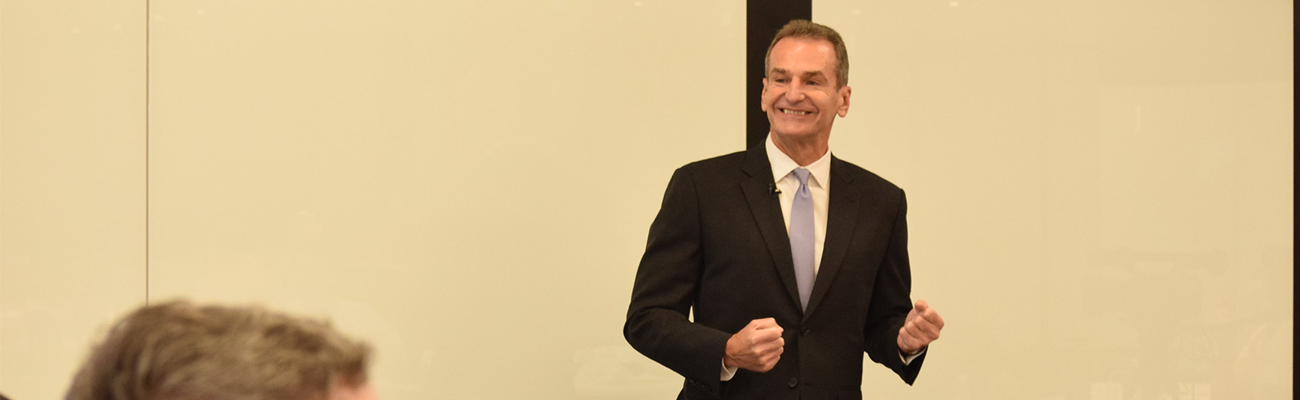
In a conversation with NPF’s international trade fellows in Singapore, former U.S. trade negotiator and Hinrich Foundation scholar Stephen Olson challenged journalists to take a broader historical view of the history of globalization. Understanding the assumptions that drove Bretton Woods and the hyper-globalization that followed will elevate your coverage of the global crackup, Olson said. [Transcript | Video]
5 takeaways:
➀ The old world order is vanishing before our eyes – but journalists need to know how we got here. The assumption that globalization was inevitable and unstoppable may now seem cringe-worthy, but journalists should note the change in world leaders’ rhetoric, Olson said. For example:
“Globalization is not something we can hold off or turn off. It is the economic equivalent of a force of nature, like wind or water. We can harness wind to fill a sail. We can use water to generate energy. We can work hard to protect people and property from storms and floods. But there is no point in denying the existence of wind or water, or trying to make them go away. The same is true for globalization. We can work to maximize its benefits and minimize its risks, but we cannot ignore it, and it is not going away.”
— Bill Clinton, Hanoi, 2000
“I hear people say we have to stop and debate globalisation. You might as well debate whether autumn should follow summer. They’re not debating it in China and India. They are seizing its possibilities, in a way that will transform their lives and ours.”
— Tony Blair, 2005
➁ The unraveling of the consensus behind globalization is hard to date, but “China shock” became a significant force during President Barack Obama’s second term. Olson described the growing skepticism on Main Street that globalization and the rising of Chinese manufacturing were benefitting multinational corporations, Wall Street, and large financial institutions while hollowing out U.S. manufacturing and not boosting the average worker. Moreover, the realization of the weakness of the system of global trade governance – the World Trade Organization – also played a role. Despite calls for action against predatory Chinese trade practices, “There’s an increased recognition that the WTO isn’t going to ride in on a white horse here and save the day,” Olson said. (Donald Trump called the Trans-Pacific Partnership among 12 nations “a rape of our country” and withdrew the U.S. on the third day of his presidency.) The pandemic and the Ukraine war were the final systemic shocks, while the view that global trade is a tool in the struggle between authoritarianism and democracy has also played a role, Olson said.
➂ The end of the notion that global interdependence is a driver of peace is a huge historical shift. The people who built the institutions of the post-World War II era were white men in their 50s whose lives had been defined by catastrophes – World War I, the Great Depression, World War II and the fear of nuclear war, Olson said. It was understood that the Smoot Hawley tariffs were a major contributor to the Great Depression and the war. “And so the pillars of this new system would be global cooperation, try to get global rules in place and establish multilateral organizations that were going to help keep us in line and help facilitate the ability of countries to work out their problems without dropping nuclear bombs on each other’s heads. So these were the Bretton Woods…. the United Nations, World Bank, the IMF… And free trade was an absolute centerpiece of this new world order that you were trying to construct in the aftermath of the Second World War.”
➃ The world trading system is fragmenting into new blocs of trusted trade partners – “friend-shoring.” We are inevitably heading towards a more fragmented system” of “self-selected trade blocs” built on different principles than in the past, Olson said. “It’s not about economic efficiencies. Now it’s much more about building your trade relationships with countries that share a common set of values, a common set of philosophies, a common geopolitical outlook. In short, friend-shoring. You want to build your trading relationships with friends because you’ve got a heightened understanding that your trade relationships can be weaponized against you.”
➄ The U.S. envisions trade “frameworks” – trade ecosystems instead of free trade agreements — that do not include tariff reductions or better market access for partners. This is the premise of the Biden administration’s new Asian trade initiative, the Indo-Pacific Economic Framework. “What this kind of new approach to trade agreement’s about, I would suggest, is about constructing ecosystems,” Olson said. That means “Well, ‘let’s get together with our friends and let’s work out common technical standards.’ [See the Wall Street Journal’s award-winning coverage of the technical standards issue.] ‘Let’s get together with our friends and make a bunch of joint investments in different cutting-edge areas. Let’s work on supply chain resiliency.’ Supply chain resiliency oftentimes, of course, becomes code for ‘let’s get the heck out of China,’” Olson said. “It’s not about reducing trade barriers. It’s ‘let’s make an ecosystem where it’s much more conducive for all of us to do business together.'”
National Press Foundation’s International Trade Fellowship in Singapore is sponsored by the Hinrich Foundation. NPF is solely responsible for the content.