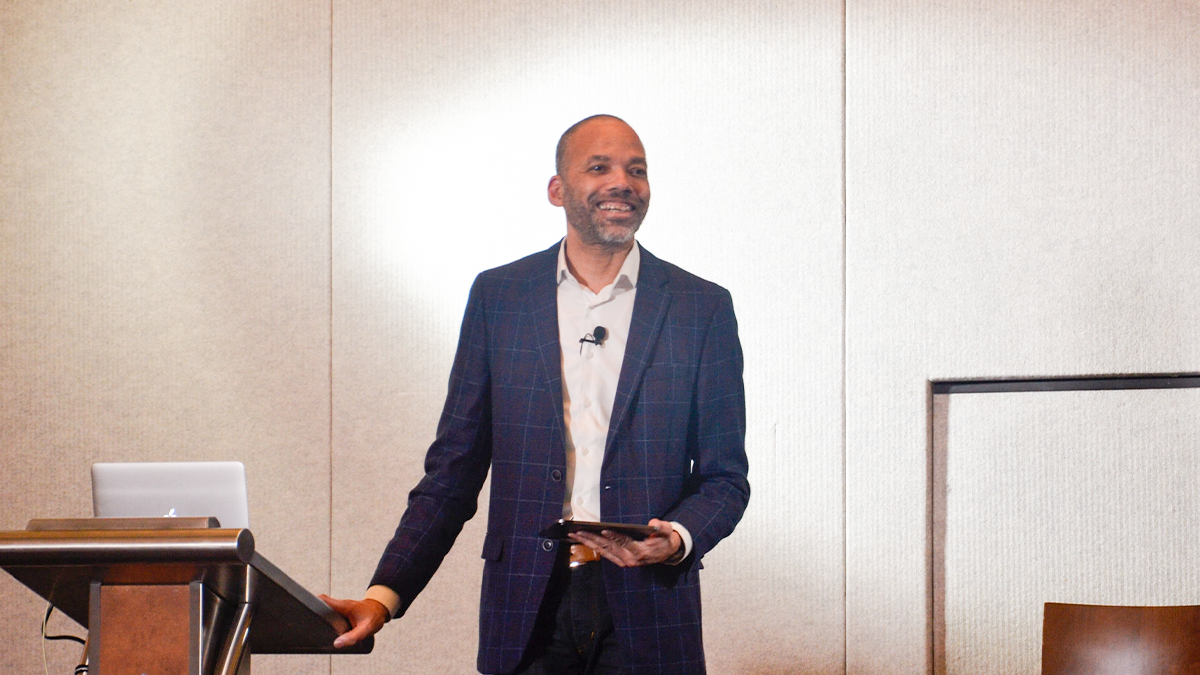
Mickey Osterreicher has been a photojournalist for 50 years, with first-hand experience at crime scenes, natural disasters and protests. As the general counsel to the National Press Photographers Association and member of the Media Law Resource Center, he trains journalists and police on the First Amendment and journalists’ rights. Here’s what you should know. [Transcript | Video]
The First Amendment protects the freedom of religion, speech, the press and protest. “But the First Amendment isn’t absolute, it’s what’s known as being subject to reasonable time, place and manner restrictions,” Osterreicher said.
Time, place and manner restrictions must be content-neutral; narrowly tailored; serve a significant governmental interest; leave reasonable alternatives and avenues of communication.
But you can film the police. “Although the Supreme Court has never ruled whether the right to record police officers performing their official duties in a public place is clearly established,” he said, there have been rulings in the district court of appeals.
“Here in this country, anybody with a camera that’s recording them is seen as suspect. And then again, I could stand here and show you all of the headlines of settlements that cost taxpayers hundreds of thousands of dollars to settle cases that should have never happened in the first place,” Osterreicher said.
Just a sample of those referenced:
- ACLU gets $825K payments over journalists’ treatment in Minnesota
- County to pay $280K to journalists tear-gassed in Ferguson
- Photographer Wins $345K Settlement Over Unlawful Arrest
The case Irizarry v. Yehia (pdf) ruled that the First Amendment protects the right to film the police performing their duties in public.
“In New York, there is a Right to Monitor Act, and it’s been put into in the New York Civil Rights Law, which gives a cause of action if people and journalists are interfered with by police for recording them,” he said.
In California, CA Penal Code 409.7 also protects journalists’ rights to work in police scenes.
“When all this rain was happening out here, mudslides, earthquakes, forest fires, and they would close off the area and they would normally say, journalists can’t go in,” he said, but Penal Code 409.7 says that a journalist may enter.
The Fourth Amendment protects against unreasonable search and seizure.
There are two 4th Amendment Supreme Court Cases surrounding the use of force that Osterreicher alerted journalists to:
- Graham v. Connor (1989). The Supreme Court determined that an objective reasonableness standard should apply to a civilian’s claim that law enforcement officials used excessive force while making an arrest, investigatory stop, or other “seizure” of the person.
- Tennessee v. Garner (1985). The Supreme Court of the United States held that, under the Fourth Amendment, when a law enforcement officer is pursuing a fleeing suspect, the officer may not use deadly force to prevent escape unless “the officer has probable cause to believe that the suspect poses a significant threat of death or serious physical injury to the officer or others.
The 14th Amendment ensures due process and protects individuals from arbitrary state laws or actions that interfere with fundamental liberties. The equal protection clause limits the ability of states to discriminate against people based on their race, gender, national origin or other status.
The Privacy Protection Act of 1980 “protects work product of journalists from being seized, and we’ve seen that used to protect journalists time and time again,” Osterreicher said. A subpoena must be ordered by the court to gain access to the information.
“When you’re out in public is that there’s no reasonable expectation of privacy, and it’s why police can use their dash cams, their body cams, why their surveillance cameras are up and why we’re photographed and recorded scores of times a day,” he said. “It’s not only the police … it’s now protestors that are out there telling journalists, you can’t take my picture” in public places.
Mickey Osterreicher spoke on behalf of the MLRC Institute under a grant from the Knight Foundation.
Crime Coverage Summit 2023: Beyond ‘If It Bleeds, It Leads’ was sponsored by Arnold Ventures and hosted by NPF and RTDNA. NPF is solely responsible for this content.


 Reload document
 Open in new tab