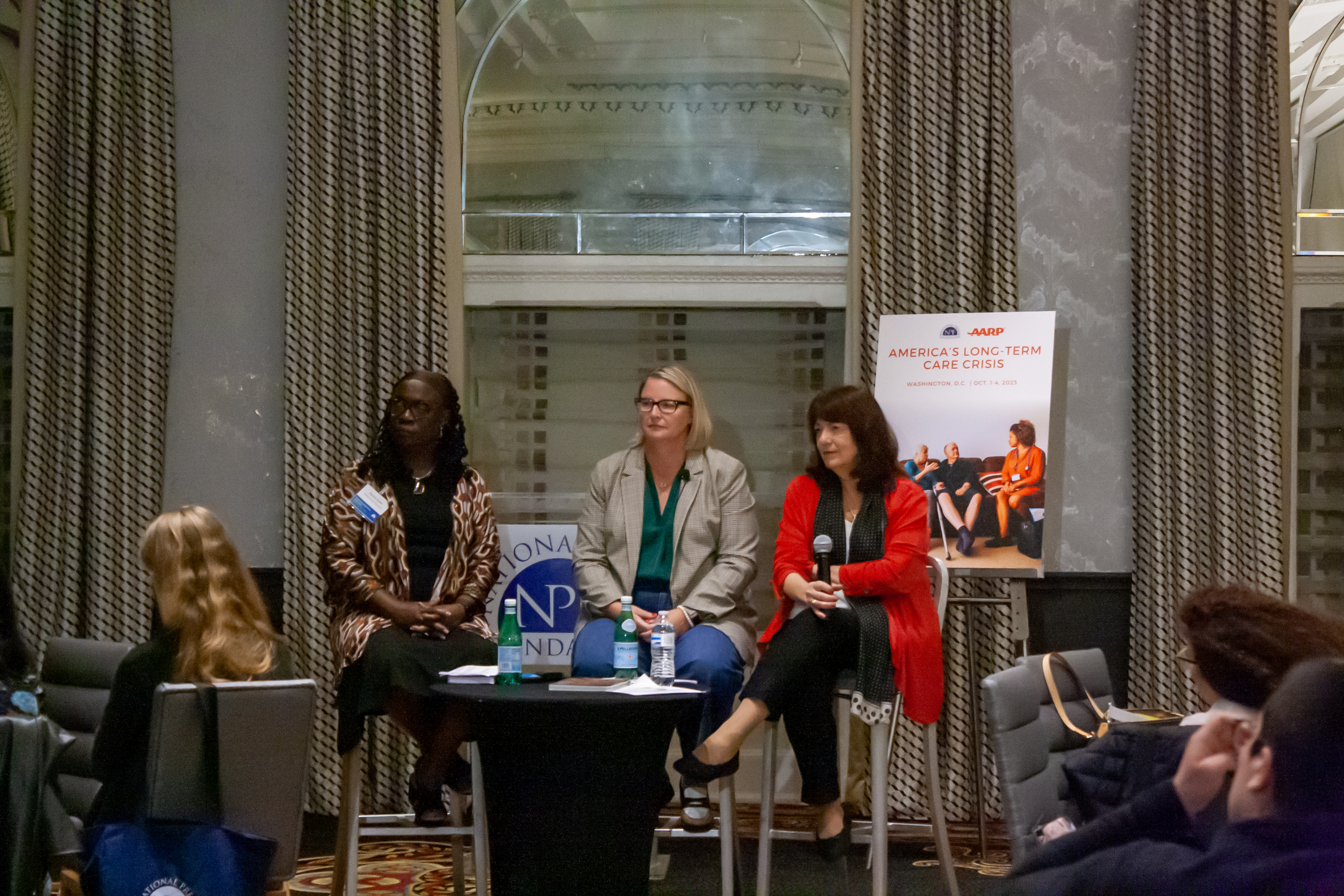
With a government shutdown only narrowly averted, Debra Whitman and Susan Reinhard of AARP helped launch the National Press Foundation’s “America’s Long-Term Care Crisis” fellowship program with some sobering contextual insights about the fate of long-term care supports for American families.
“Members of Congress who are fiscally conservative are not excited about adding entitlements that are expensive,” said Whitman, an economist who is AARP’s Executive Vice President and Chief Public Policy Officer. “The government isn’t taking it on so families are bearing that burden.”
And that burden is massive. There are an estimated 48 million Americans caring for someone over the age of 18. And according to AARP’s 2020 Caregiving in the U.S. report:
- Nearly one in five (19%) are providing unpaid care to an adult with health or functional needs.
- More Americans (24%) are caring for more than one person up from 18% in 2015.
- More family caregivers (26%) have difficulty coordinating care up from 19% in 2015.
- More Americans (26%) are caring for someone with Alzheimer’s disease or dementia up from 22% in 2015.
- More Americans (23%) say caregiving has made their own health worse up from 17% in 2015.
- Family caregiving spans across all generations, including Boomers, Gen-X, Gen-Z, Millennials, and Silent.
- 61% of family caregivers are also working.
Last month, AARP released its 5th Long-Term Care Services and Supports Scorecard, which is a compilation of state data and analysis from a wide range of sources to describe how state systems are performing.
Susan Reinhard, Senior Vice President of AARP’s Public Policy Institute, said the results point to some fairly obvious conclusions. “We need to do family caregiver tax credits, we need to do paid family leave, we need to do sick leave, we need to do flexible sick leave. Very few states have done that.”
But, Reinhard said, “This is doable. When we see some states do it, why can’t the other states do it? The whole goal of the scorecard is to do that, to set that up, to show progress and where you might look for promising practices and states that have done good things and where you can do to make that happen in your state.”
Journalists need to understand the breadth of the caregiving crisis to communicate it properly.
“Understand that we are having a change in our society like we’ve never seen before, where we have more older people than we have children,” Whitman said.
“The average Social Security check is $20,000 a year … not net of my Medicare, which is taken out … half is eaten up by Medicare costs … when we’re talking about these issues they’re all related for individuals” financial health, mental health, physical health, etc.
Access the full transcript here.
The America’s Long-Term Care Crisis Fellowship is sponsored by AARP, which also sponsors the AARP Award for Excellence in Journalism on Aging. NPF is solely responsible for the content.