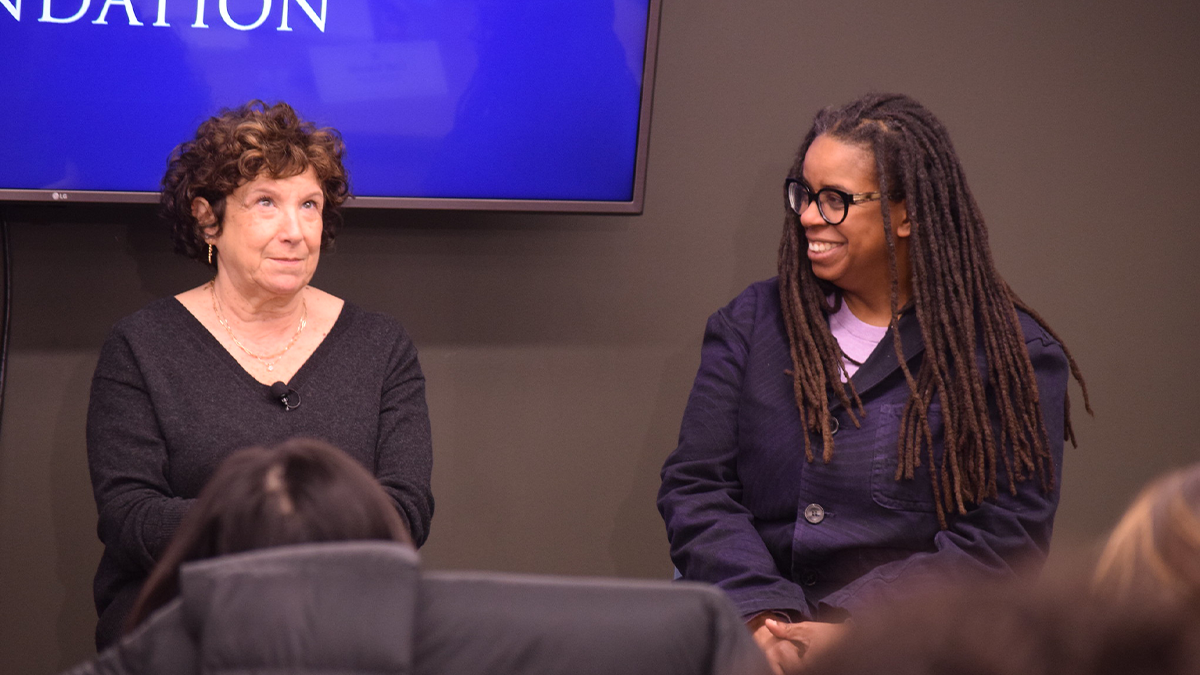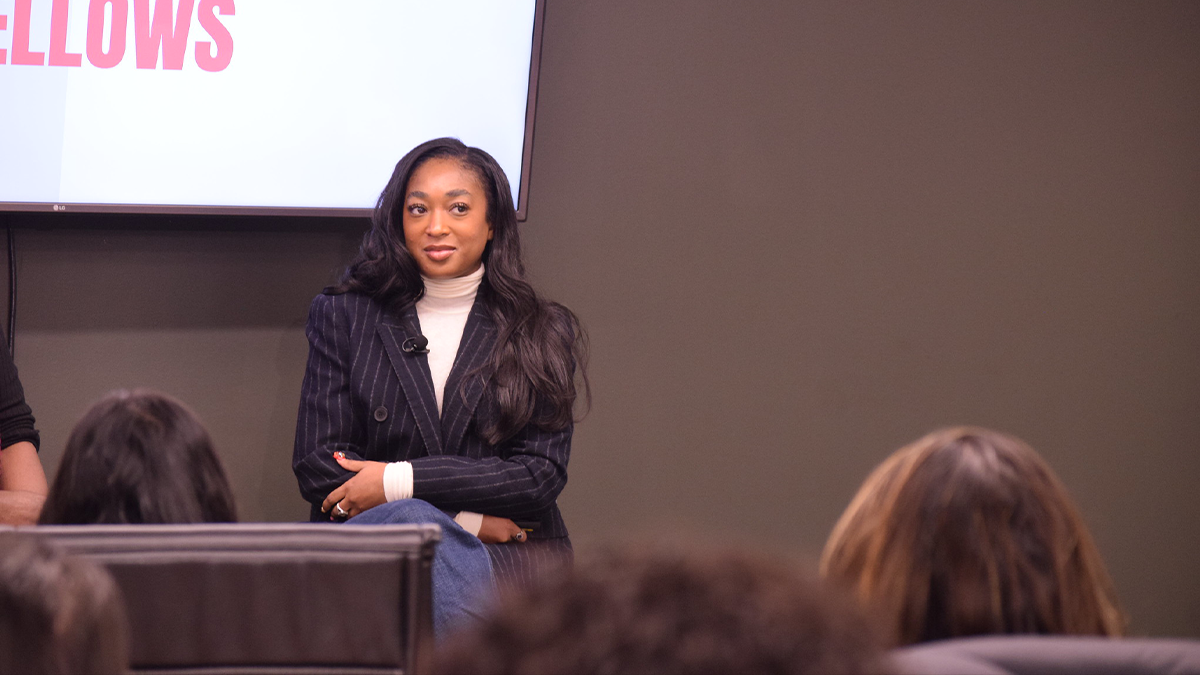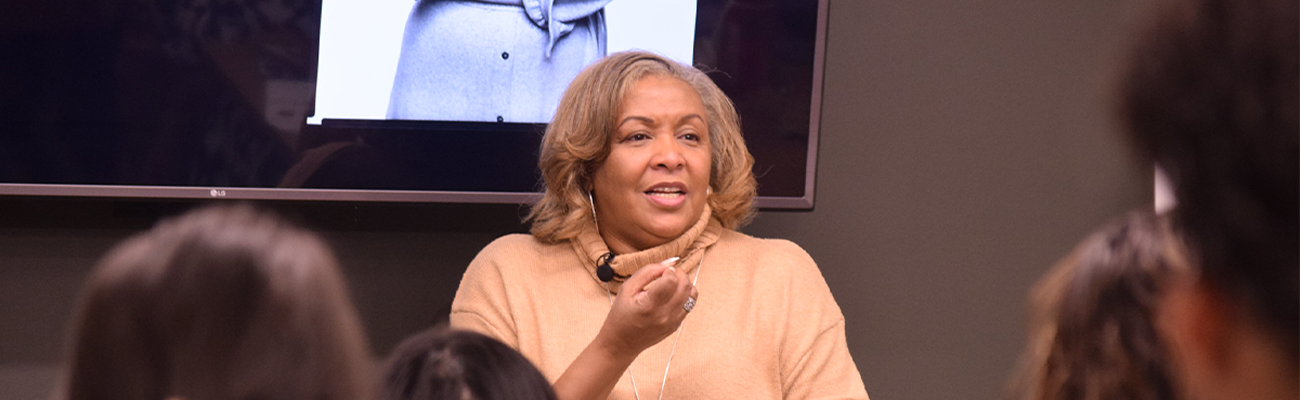
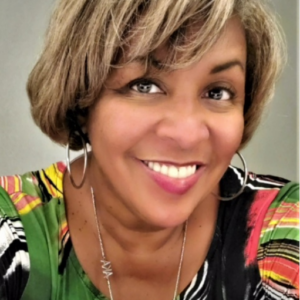
Sonya Ross has spent a lifetime monitoring the pillars of democracy. As the first Black woman to cover the White House for the AP, she’s witnessed political upheaval and turmoil in real time. Even after a 33-year stint there ended, Ross is still “ten toes down” leading her own media platform, Black Women Unmuted.
When Ross spoke with 2025 Widening the Pipeline fellows in February, she posed some tough questions.
“Do we still have Fourth Estate responsibility in this country? An obligation to perform our constitutionally protected duty to inform the governed masses on the activities of the governed? Are we still doing that or what?”
Ross urged the fellows to look to their journalism heroes, people like Ida B. Wells Barnett, Nellie Bly, Bob Woodward and Carl Bernstein—all journalists who faced seemingly insurmountable odds to produce journalism that spoke truth to power.
The following are key takeaways from her session:
History has its eyes on journalists
During this turbulent era for American Democracy, Ross believes the question of what is news becomes even more relevant. She noted the immense challenges of covering the Watergate scandal back in the early 1970s, and quoted legendary Washington Post reporter Carl Bernstein to make her point:
‘Richard Nixon tried to make the conduct of the press the issue in Watergate instead of the conduct of the president and his men.’ Almost inevitably, unreasonable government secrecy is the enemy, and usually the giveaway (to what) the real story might be. And when lying is combined with secrecy, there is usually a pretty good road map in front of us.”
Journalists must always follow the money, but they also need to follow the lies, Ross cautioned.
“The people with the information we want should not be pigeonholed or prejudged by their ideology or their politics. Almost all of our sources in Watergate were people who had at one time or another been committed to Richard Nixon and his presidency. Incremental reporting is essential. Our job is to put the best attainable version of the truth out there, period, especially now.”
View your efforts through your hero’s lens
The history of American journalism offers many lessons that can help journalists today stay focused and motivated, Ross said.
“While you’re reporting on the news, take a moment and say, ‘If my hero ‘X’ were here to talk to me about this right now, how would I explain myself in terms of what I’m doing? And my hero says, ‘OK, so what are you doing about this story?’ How do I explain myself? What would they say about the job I’m doing?”
“To help you make the right decisions about your role and why you’re here doesn’t mean you have to go out there and be the activist and fight, fight, fight. But you do have to say there’s a correct course to follow and would I be impressive to the people who inspire me if I take, if I approach this course this way or that way?”
‘Own the narrative’
Ross invoked the efforts of Samuel Cornish and John Russwurm, two free Black men who in 1827 founded Freedom’s Journal, the first Black publication in America.
“Slavery was still in effect. Black people in this country had no rights. The people who were chattel had no rights. And there was actually immigration in this country then from Africa. Some of them were free. Obviously the other Africans were enslaved and doing labor. But above all of that there was curiosity about what’s going on in Africa and what’s going on over there in the United States that people in Africa need to know.
“So they said, ‘let’s jump in the game and do this ourselves because for too long others have spoken for us. We wish to plead our own cause, which was their motivation. That’s what got them into the game. That’s why they wanted to do this. ‘Own the narrative’ is what I call it today.”
Access the full transcript here.
This fellowship is funded by the Evelyn Y. Davis Foundation and the John C. and Ethel C. Eklund Scholarship Fund. The National Press Foundation is solely responsible for its content.


 Reload document
 Open in new tab