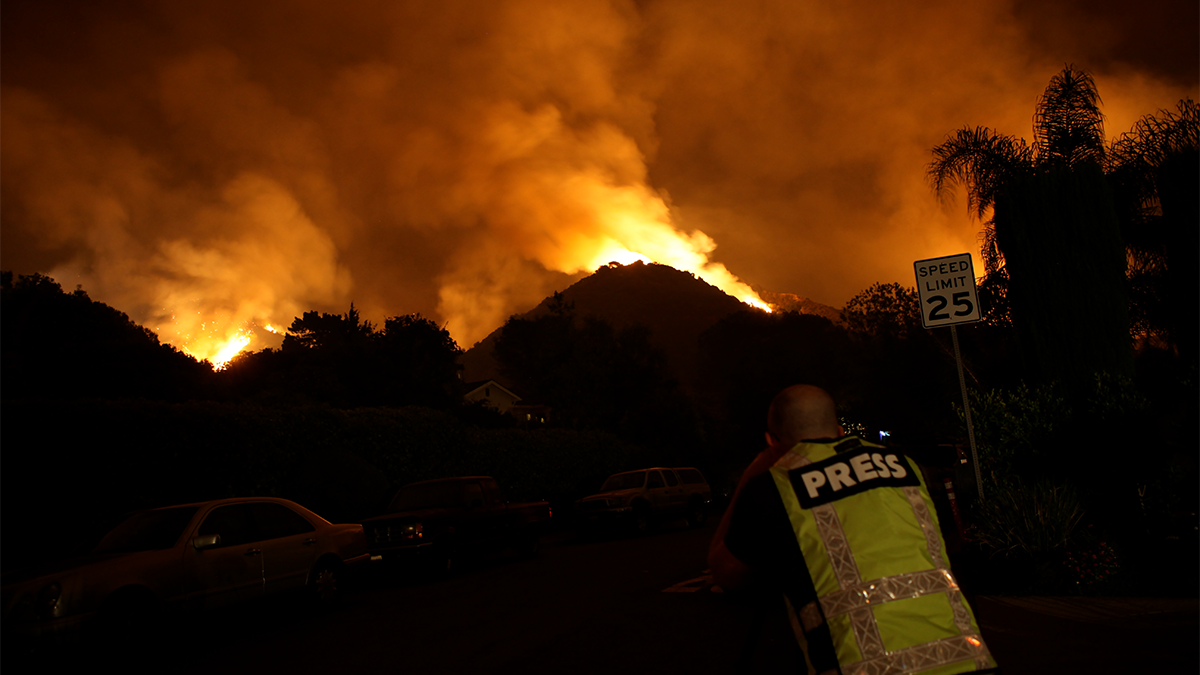
With the physical aftermath of the Los Angeles wildfires, comes the psychological trauma for local communities and journalists.
Reporting on traumatic events is often unavoidable as a journalist, so knowing how to cope with these stories is crucial.
Gretchen Schmelzer, a licensed psychologist, trauma survivor and author of Journey Through Trauma, shared with reporters how they can prepare themselves for covering natural and man-made disasters.
A too-often overlooked remedy for many of the worst and most lasting psychological effects: community.
“Your field of journalism needs to create spaces amongst you where you can share with each other,” Schmelzer said.
3 Key Takeaways:
1. Understand the different forms of trauma
Trauma looks different for everyone, and Schmelzer referenced a few main types of trauma so journalists can approach the right method of healing depending on their experience.
- Acute trauma – when a single incident occurs, and the event overwhelms your capacity to defend or protect yourself. This can be a car accident, for example.
- Repeated trauma – can be a repeated event, like abuse, or can be a continuous event like the wildfires.
“When trauma gets repeated, our body doesn’t gear up, our system doesn’t gear up because we are too smart. Our bodies and brains are too smart to waste that kind of energy. So what happens is that we begin to create protections and defenses,” Schmelzer said.
- Vicarious trauma – is something that isn’t happening directly to you, rather you witnessing it in other people’s lives.
“It’s a change of the inner experience of you as a result of witnessing somebody else’s trauma,” Schmelzer said.
However, even with this kind of trauma, the signs and symptoms are the same signs and symptoms that you get if you experience trauma directly to yourself, according to Schmelzer.
- Grief – acute sorrow or deep sadness caused by loss, misfortune or disaster.
Grief is interesting psychologically because it often links to past losses a person has experienced, according to Schmelzer. It also does not necessarily have to relate to losing a person. It can mean grieving over the loss of a place or a community, too.
“The grief that is happening right now in California is bigger than just the people or even bigger than just homes. It’s a loss of what once was, that isn’t going to be the same and may not be the same for a long time,” she said.
- Moral injury – is when there is a hit to your identity and when you may not be able to act in a way that aligns with your values or who you feel like you are, according to Schmelzer.
“If you are interviewing somebody who’s now homeless and you’re getting the story, but you can’t help them in a way that you wish you could help them, that can be a hit,” she said.
2. Take time to prepare
Journalists have reported four times the rate of anxiety and depression as other fields and 80-100% of journalists have reported exposure to trauma, according to Schmelzer.
“You can’t have … average preparation for a very difficult job. It would be like saying, ‘I only have to walk 30 minutes a day to climb Everest.’ You have to take care of yourself,” Schmelzer said.
Taking steps to prepare and knowing how to heal properly is key. Schmelzer recommends starting with understanding what your resources are.
“You need to understand what trauma is, you need to build good relationships in your life. And then as you feel prepared and safe, you’ll begin to let the trauma story out and be able to start,” she said.
Once this happens, it’s important to recognize what didn’t happen when you were enduring the trauma.
Schmelzer referenced the pandemic, for example.
“If we look at COVID, which was a repeated trauma that went on for a long time, what didn’t happen where a lot of social skills, right? … And now colleges and even graduate schools and medical schools are having to rethink their curriculums to put that in place,” she said.
It’s also important to create a “buffer,” according to Schmelzer.
“If you create a buffer between your childhood trauma and where you are now, you actually have lower levels of vicarious trauma than other people because you have lived experience,” she said.
This buffer includes wellness, repair, supervision and support.
“You have to think about the maintenance and repair of yourself given the work that you do. The supervision or support inside the organization needs to be solid,” Schmelzer said.
3. Bring yourself back to a middle ground
Something that people may experience is the “rollar coaster of extreme stress.” This is true for jobs like journalism, where trauma is routine and there’s lots of adrenaline involved.
In order to get to center, Schmelzer suggests doing something after work that soothes you.
“That’s really different for everybody … that might be listening to music, it might be talking to a friend, it might be watering your plants when you get home, it might be talking to your kids, it might be baking,” she said.
She advises writing down three things that will help you.
“You have to own this roller coaster in order to get to center, which is where your body repairs,” she said.
Access the full transcript here.
This webinar was presented in partnership with NPF and RTDNA. NPF is solely responsible for the content.