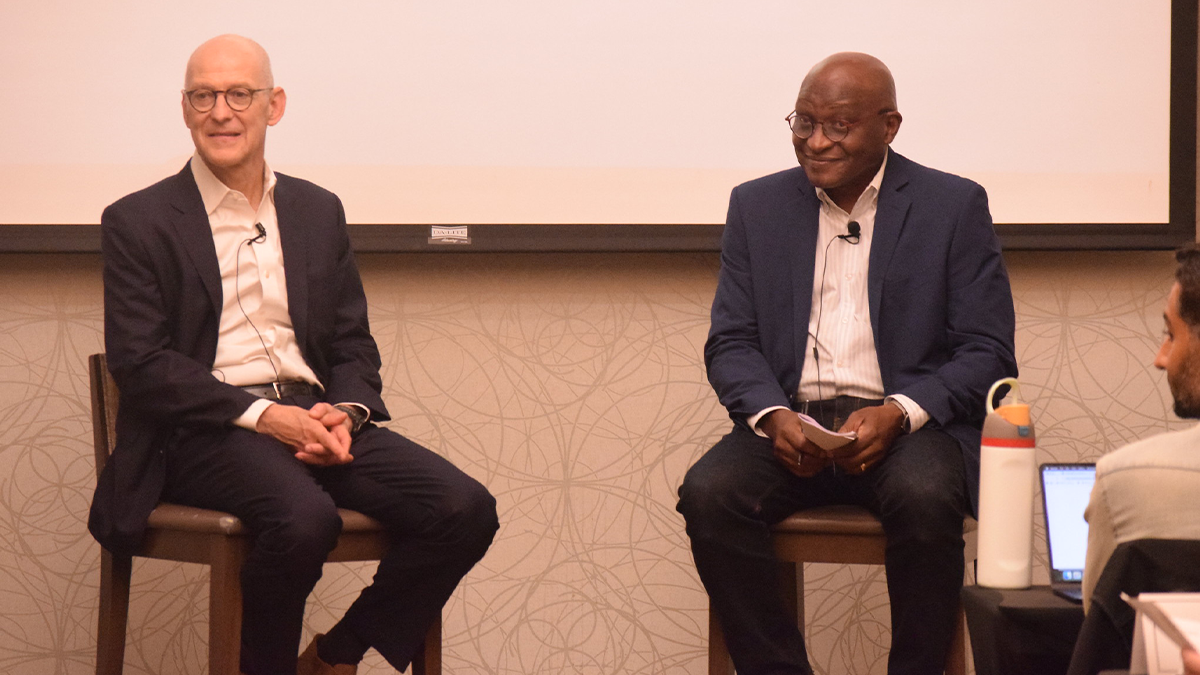
The day after 750,000 people lost insurance coverage under the Affordable Care Act, two policy experts helped NPF Diagnosing the U.S. Healthcare System fellows analyze what’s at stake for millions of Americans.
“One of the reasons they cited for taking away some of that coverage was saying that some of those individuals actually had income that was too low, was below 138% of federal poverty,” said Katherine Hempstead, senior policy adviser with the Robert Wood Johnson Foundation. “So they actually were not eligible for the ACA marketplace.”
Also, many of these people lived in states that hadn’t opted into the federal Medicaid Expansion Program, launched in 2010 under the ACA. It was designed to address gaps that left applicants like poor adults without children ineligible for coverage. Ten states have not adopted the ACA Medicaid expansion program, which makes the uninsured poor in those states especially vulnerable to policy shifts.
While the Trump administration invoked claims of widespread abuse and fraud in the program, another expert said there’s no clear proof.
“I have a lot of questions about the grounds based on which those decisions are made,” said Michael Karpman, principal research associate in the Health, Income, and Benefits Policy Division at The Urban Institute. “I think a lot of this news moves so quickly and it’s important to understand what’s the evidence behind the notion that these were all fraudulent or improper enrollments. While it may be the case that some of these individuals being targeted by Centers for Medicare and Medicaid Services truly are not eligible for the ACA marketplace because their income is too low, the truth is they have no affordable source of coverage.”
Karpman and Hempstead shared data and insights from their research during a contextual conversation about health insurance access for Americans. “Many people with Medicaid are working, but they’re not always consistently working 80 hours per month like the law requires because they have unstable jobs and limited control over their work schedules, which employers can set without worker input and often with little advance notice,” said Karpman.
Those stories and voices must be amplified, he stressed.
“I think it’s the human story that really can shed light on what’s happening, connecting with people who are going through the process, potentially losing coverage or not applying for coverage because they were denied due to the work requirement, or in many cases because they didn’t think they’d meet it.”
America must find a better solution for the healthcare dilemma, Hempstead stressed.
“We spend more, don’t cover everybody and have less to show for it in every way, both in terms of people’s access to care and also how healthy we are as a population.”
Access the full transcript here.
This fellowship is sponsored by UnitedHealth Group. The National Press Foundation is solely responsible for the content.